"Socialism? But look at Russia..."
The collapse of the Stalinist regimes of Eastern Europe was hailed by critics both left and right as "the end of socialism." State Department hack Francis Fukyama declared it "the end of history" - no longer would there be the threat of nuclear holocaust and the rising tide of capitalism would soon raise all boats. Yet in Eastern Europe, life expectancy is 10-15 years shorter than it was under the "socialist" regimes, which is amazing considering how repressive those regimes were. The free-market has shown itself to be even more brutal and impoverishing than the false socialism it replaced.
 Many followers of Stalinism saw their dreams evaporate into thin air: Nina Temple, the General Secretary of the British Communist party announced "... it was not socialism in Eastern Europe. And I think I should've said so long ago." Imagine the Pope saying "God does not exist, and we should've said so long ago". Many former Stalinists have concluded that the market is only the viable option, and that the only way to improve humanity's lot is through tinkering with the market.
Yet both former Stalinists and right wing free-market fanatics share the same flawed assumption: that the Stalinist states were socialist. Marx and Engels wrote that "the emancipation of the working class must be the act of the workers themselves"; under Stalinism, the working class had absolutely no rights and was just as exploited as the working class of the West. The "socialist" regimes of Poland, Hungary and Czechoslovakia (among others) were installed by force with Russian tanks, not by their respective working classes. Marx and Engels argued for a "dictatorship of the proletariat", not a dictatorship over the proletariat.
Yet in order to understand the political and ideological collapse of Stalinism, an understanding of the Russian revolution is indispensible.
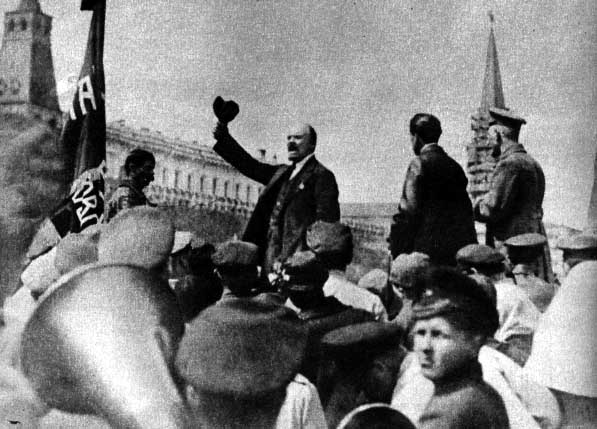
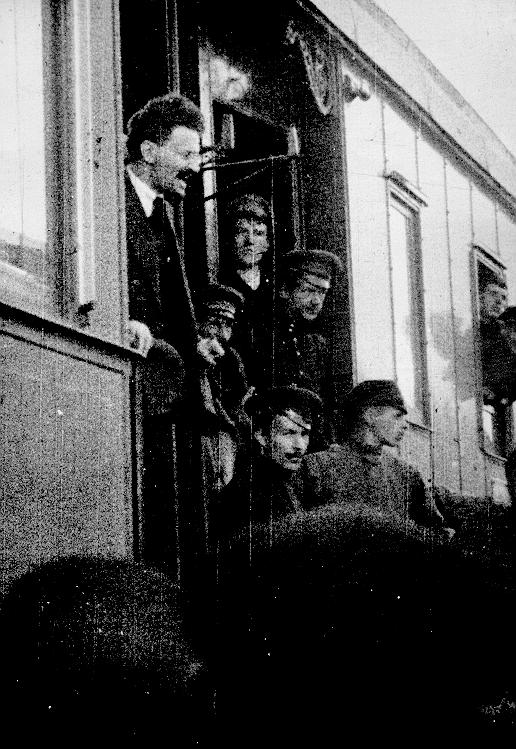 In 1917, the working class, lead by the Bolshevik party, overthrew the Provisional Government and established the world's first workers' state. The power of this state lay in the workers themselves and the organs of workers' democracy, the soviets. But the Bolsheviks knew that because Russia was so economically backward, it could not survive on its own; it would need the help of more advanced countries if socialism and the working class were to attain a final, permanent victory. Lenin repeated this theme in many of his speeches, declaring "Without revolution in Germany, we are finished." Leon Trotsky, the organizer of the insurrection and later the Red Army also made this point; "If the peoples of Europe do not arise and crush imperialism, we shall be crushed - that is beyond a doubt. Either the Russian revolution will raise the whirlwind of struggle in the West, or the capitalists of all countries will stifle our struggle." The revolution in Russia was not an end in and of itself, but rather a means to an end. The workers' victory in Russia would detonate revolutionary struggle abroad; its own success was tied to the success of this international struggle.
The hope for international struggle was not merely the idle wish of Lenin or Trotsky, it was a fact. In 1916, there had been a rising in Ireland (the Easter Rising) against British rule. Following WWI, there were revolts all over the world against imperialism. In Hungary, a revolutionary government came to power under the leadership of Bela Kun. Workers and peasants in Italy rose up and established workers' and peasants' councils, similar to those established in Russia when the Tsar was overthrown after 400 years of undisputed rule. In Germany, the workers and soldiers of Western Europe's most advanced nation overthrew the Kaiser, raising the spectre of revolution throughout Europe and all over the world.
But the revolutions abroad were defeated. In Germany, the Social Democratic Party, along with industrialists, generals and monarchists organized a counter-revolutionary army (the Freikorps) which crushed the workers' movement and killed two of the best German revolutionaries, Karl Liebknecht and Rosa Luxemburg. The Soviet government in Hungary was overthrown by White armies with massive foreign aid. Mussolini's fascists defeated the Italian workers' movement. The isolation of the revolution became even worse when 14 imperialist armies invaded Russia, trying to overthrow the Soviet government and smash the first workers' state. A total blockade on Russia, combined with the invasion, coupled with famine and a massive fall in industrial production decimated Russia and led to the deaths of millions. By 1920, production had falled to 18 percent of its 1913 figure. The revolution's leading class, the proletariat, which was a minority to begin with, saw its numbers cut in half! The Bolsheviks "paid for victory with the destruction of the proletariat that had made the revolution," observed Tony Cliff. Without the working class and without production, workers' control over production became impossible. The Bolshevik party and the workers' state were crippled with the destruction of the working class like an animal whose backbone has been ripped out, leaving only the soft flesh. The isolation of the revolution meant its defeat.
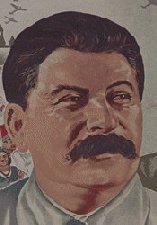
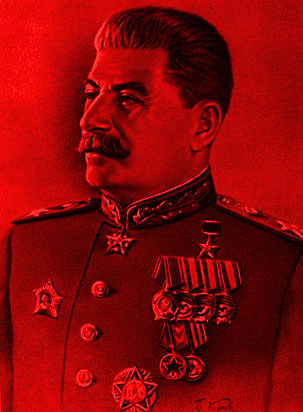 This state of affairs form the background of Stalin's rise to power, beginning in 1924. From the outset, he made his intentions clear, to build "socialism in one country." But the entire idea of socialism is based on the worldwide overthrow of capitalism, which would be necessary in order to put the entire world's resources at the disposal of the workers of the world! Stalin's negation of one of the basics of socialism was not an anamoly, it was just part of his total negation of socialism. With Stalin at its head, a new ruling class rose to power in Russia, the Communist Party bureaucracy. This new class felt itself threatened by Western military power, and so it undertook a series of five year plans to massively industrialize the country. It sought to achieve in 5 or 10 years what the West had done in 100; it sought to create a modern industrial economy out of a country beset by backwardness. In order to begin this process, it expropriated the peasantry and forced them into gulags - much as the Enclosure Acts expropriated the peasantry, leading to the creation of the English working class. Millions starved to death in Stalin's Russia; 10 million were thrown into the gulags. Marx showed in Capital that the beginning of capitalism was not a happy and blissful affair; rather it was brutal and disgusting. He called the initial accumulation of wealth that allowed capitalism to move forward "primitive accumulation". When he wrote about it, he was writing about Britain's expropriation of the peasantry, the slave trade in the U.S. colonies that propped up the early factory system in England and the invasion and plunder of India. But the term, "primitive accumulation" also applies to Stalin's infamous 5 year plans.
The Party bureaucracy now controlled, directed and supervised every aspect of life. Planning to meet human need was not the order of the day; industrialization for the sake of arms production was. Every gain of the October revolution, from the de-criminalization of homosexuality to the right to an abortion, from the unions to the soviets themselves, were wiped out, negated and destroyed.
But did Lenin lead to Stalin? Did the workers' revolution lead directly to its antithesis? Of course not. If Lenin led to Stalin, if Leninism led to Stalinism, why did Stalin have to kill all the Leninists? By 1939, of the 21 members of the Central Committee in 1917, only 1 remained in the party leadership - Stalin! 7 were shot, 3 "disappeared", 3 were politically (and perhaps physically) liquidated and a total of 13 turned out to be "enemies of the people." Trotsky himself was an illustration of this. He organized the insurrection which had put the soviets in power; he organized the Red Army that saved Russia from being overpowered by the White armies; yet he was exiled and later assassinated in 1940 by a Stalinist agent.
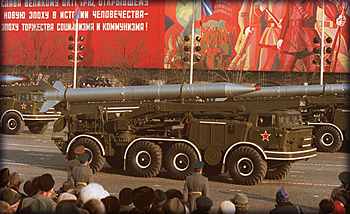
The monster known as the Union of Soviet Socialist Republics, or USSR, had absolutely nothing to do with genuine socialism. It was not a union, it was an empire; there were no soviets; it was not socialist; and it was a dictatorship not a republic. The regime in Russia was not socialist, but bureaucratic state capitalist; the party bureaucracy, through its control of the state, owned the means of production, accumulated for accumulation's sake, exploited the working class, and competed with the imperialist governments of the West. Stalinism competed with the Western superpowers on their terms, using their means. Most of all, Stalinism was the gravedigger of the revolution, not its heir.
Back
Next