Anarchism
Before I say a single word about anarchism, I have to say that this article by no means encompasses every single anarchist sect, tendency, or school. This article is an article about anarchism (and its flaws) in general. As Engels noted about anarchists: "[they are] so unique that no two of them can agree with each other." And speaking from personal experience, I have never met two anarchists who have the same ideas.
Anarchism seems like the most radical way to reject the oppression and exploitation, which is why it appeals to many who are radicalizing. But as this article will show, the most verbal radicalism and a real answer to to today's problems are far from being the same thing.
the Theory
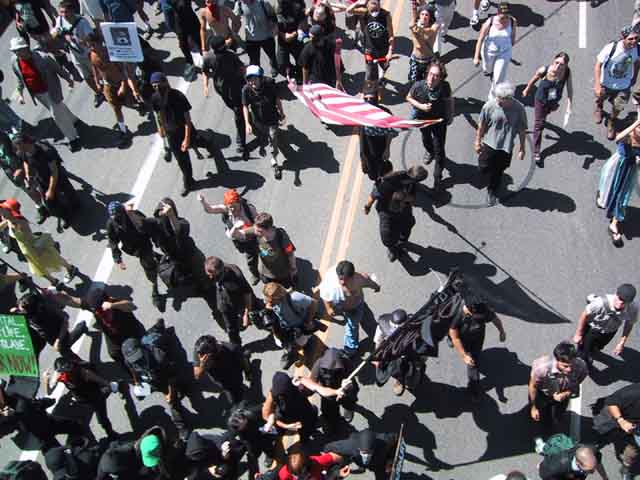 So what is anarchism? According to the Anarchist FAQ, "anarchism is primarily a movement against hierarchy." What is hierarchy? "[H]ierarchy is the organisational structure that embodies authority."{1} And what is authority? The FAQ doesn't say; but most anarchists will tell you that it is the idea or the principal of authority that is "the problem". The anarchist explanation of "the problem" explains nothing; it's like saying that it's the idea of carpet bombing people that is "the problem" with war, not the actual carpet bombing.
"The problems" of today's society - poverty in a world of plenty, jails instead of schools, bombs instead of hospitals - stem not from the ideas in people's heads, but from material reality, from the fact that capitalism is organized around making profits for a tiny minority. If the ideas in people's heads were the root of the problem, then all that would be necessary was for everyone to change their minds, to renounce the idea or principle of authority. Unfortunately, things are not so simple.
Diagnosing the problems as being "the idea of authority" opens the question - where exactly did this idea come from, and why have millions of people throughout the ages believed in this ideas, especially if it led to their own oppression? Who wants to be a slave or a peasant? Why would they believe in the
"the principle of hierarchy" if it meant their enslavement?
Revolutionary socialists, on the other hand, understand that class divisons arose because society could produce enough of a surplus, or extra beyond people's immediate needs, to free a small minority of society from working. This became the first ruling class; they were put in charge of the grain house or whatever repository of wealth; as that wealth accumulated, so did their power. Eventually they became utterly disconnected from the actual process of growing and distributing the food. Freed from lives of back-breaking toil, they were free to develop art, religion, science, math, and so on. The important thing to understand is that class divisions, and the oppression that accompanied them, arose because of changes in the material world, not because of the "idea" of "authority" caught hold.
Socialism is rooted in the development of the material world; it holds that capitalism has developed technology to the point where it can free everyone and provide for everyone, and that the working class has the social power and the interest in overthrowing the capitalism. Without the development that capitalism provided, there could be no socialism, there could be no communism. Anarchism is not rooted in the material world; it sees the idea of authority as being the problem. Anarchism is supra-historical, or outside the stream of historical development. Why did this idea take hold? Why do people still believe it? Where did this idea come from, and why is it still with us today? Why didn't people simply reject this idea 100, 200, or 5,000 years ago and establish a classless society then? To these questions, anarchism has no answer.
Anarchists reject all authority. But as Engels argued:
	Have these gentlemen ever seen a revolution? A revolution is certainly the most
	authoritarian thing there is; it is the act whereby one part of the population
	imposes its will on the other part by means of rifles, bayonets and cannon -
	authoritarian means, if such there be at all; and if the victorious party does
	not want to have fought in vain, it must maintain this rule by means of the
	terror which its arms inspire in the reactionaries.
Anarchists reject the state - all states. This sounds good on paper, when we're talking about the capitalist state. But what about a workers' state?
Because anarchism categorically rejects all states, all authority, all leadership, it has consistently compromised with the status quo, misled revolutions and struggles, and promoted elitism.
the Practice
The shortcomings of anarchism are exposed by its practice.
Let's back track a bit and deal with the charges one by one:
ELITISM: By denouncing leadership as bad, and announcing that "we have no leaders", they have not abolished leadership. Leaders will always exist because different people have different capacities, talents, ideas, and abilities. The human race is not a homogenous mass that eats, thinks, experiences, and reasons the same; if it were, then it would be as homogenous as peanut butter (and be a lot less tasty). The anarchists attack leadership because they see today's leaders, Colin Powell, George Bush, Jr., John Ashcroft, as bad. That they are. But leadership in and of itself is not necessarily bad; it depends on whose leadership, and more importantly, what they are leading. By proclaiming "we have no leaders", they haven't abolished leadership. Rather, they've hidden it. Instead of leaders being democratically accountable for their actions to the majority, the leaders will be the ones with the biggest mouths, the most bossy personalities, or enough time on their hands to out-wait other people at meetings. Either leadership is formal, democratic, and accountable; or leadership is informal, and therefore undemocratic and unaccountable. Or, worse yet, nothing gets done at all because everyone is "doing their own thing" since there is no "hierarchy" - or the discipline to carry out the things agreed to by the group.
This elitism shows in the anarchist practice. For example, Bakunin and his followers joined the First International and formed a secret alliance within it. Instead of open and democratic procedures in the International, Bakunin argued that the "spontaneous" revolutionary action of the masses should be supplemented by the direction of invisible, self-selected revolutionaries, like "invisible pilots in the thick of the popular tempest". He wrote to his supporters, "we must steer it [the revolution] not by any open power but by the collective dictatorship of all the allies - a dictatorship without insignia, titles, or official rights, and all the stronger for having none of the paraphernalia of power."{2} For "the.... triumph of revolution over reaction, the unity of revolutionary thought and action must find an agent in the thick of popular anarchy.... That agent must be the secret universal association of international brothers."{3}
Today's anarchists, the Black Bloc for example, are elitist in the extreme. At protests, they engage in "direct action" - blocking traffic, throwing bricks through Starbucks windows - as a matter of principle. While revolutionary socialists are not opposed to any of those things in principle, the anarchists believe these tactics are applicable to any and all protests. Instead of trying to focus on getting more people (especially working people) to these protests, they instead engage in radical (and rather pointless) "direct actions" which do little to draw more people into the movement. Tactics become a substitute for politics. Most of these anarchists don't understand (or they don't care) that working class people can't afford to be arrested because one of them has the urge to do something "radical". And when others in the movement argue against their "tactics-as-principles" methods, they hide behind the rhetoric of "diversity of tactics". In other words, anyone can do whatever they want at a protest! No one is accountable to the movement, no one is to be held responsible for their actions.
The elitism of today's anarchists is also apparent in their fetishization of consensus. Consensus is a decion-making process in which everyone must come to an agreement to get something done. There was a rather large core of anarchists who attended the Boston Campus Anti-War conference at the end of October, 2002, who insisted on having consensus - even though there were about 200 people in the room! Consensus is an elitist and fundamentally undemocratic decision making process. First of all, it automatically excludes anyone who doesn't have the time for 6 hour meetings (if not longer), i.e. working class people. And majority can be held hostage by an intransigent minority.
But for Emma Goldman, who is hailed by many anarchists and non-anarchists alike for her being a "libertarian," the minority holding the majority hostage is a virture, not a vice:
	The multitude, the mass spirit, dominates everywhere, destroying quality....
	The worker who once took pride in the thoroughness and quality of his work, has
	been replaced by brainless, incompetent automatons....

	...the majority cannot reason; it has no judgment. Lacking utterly in
	originality and moral courage, the majority has always placed its destiny in
	the hands of others....

	I therefore believe with Emerson that "the masses are crude, lame, pernicious in
	their demands and influence, and need not to be flattered, but to be schooled. I
	 wish not to concede anything to them, but to drill, divide, and break them up,
	and draw individuals out of them. Masses! The calamity are the masses. I do not
	wish any mass at all, but honest men only, lovely, sweet, accomplished women only."

	In other words, the living, vital truth of social and economic well-being will
	become a reality only through the zeal, courage, the non-compromising determination
	of intelligent minorities, and not through the mass.{4}
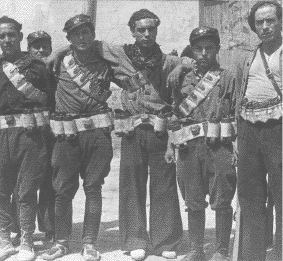 MISLED REVOLUTIONS: In 1873, a revolt gave Bakunin and his anarchist followers a chance to put anarchism into practice. The revolt swept through the major cities of Spain; armed insurgents, many of them workers, took over cities and established local "communes".
The Bakuninists, instead of abolishing the state, established tiny local statelets. They ensured that all the cities and the revolutionary forces were decentralized and had local autonomy; the problem was that because of this, the Spanish army marched unhindered from town to town, smashing each revolt locally, and separately from the others.
In the Spanish Revolution of 1936 (see my article on this), the National Confederation of Workers (CNT) misled the workers' movement. The CNT embraced a huge section of the Spanish working class, and believed in militant direct action and derided "politics," which they equated with parliamentarism, compromises, and sell-out politicians. They preached abstention from voting, which allowed the right to win an election victory in 1934; reacting to the right's victory, the CNT swung behind the election of a Popular Front government in 1936. The right responded; General Franco led a military revolt against the popularly elected government.
Workers all over Spain rose up in self-defense, arming themselves, taking over factories; the peasants seized the landlords' land. This stifled Franco's revolt - temporarily. In many areas, the CNT or local anarchists were in control. But the Spanish anarchists rejected taking power. The anarchist leader Santillan explained the CNT's reasoning:
	We could have remained alone....declared the Generalidad null and void, and imposed
	the true power of the people in its place, but we did not believe in dictatorship
	when it was being exercised against us, and we did not want it when we could exercise
	it ourselves only at the expense of others.{5}
Because they did not have an alternative to the capitalist state (they rejected all states, including a workers' state, as a matter of principle), the CNT actually took posts within the government, within the capitalist state! This government began to disarm the workers and peasants in the name of "unity in the face of the fascist enemy." Trotsky explained the unresolvable contradiction facing the anarchists:
	To renounced the conquest of power is voluntarily to leave the power to those who
	wield it, the exploiters. The essence of every revolution consisted and consists of
	putting a new class in power, thus enabling it to realize its own program in life. It is
	impossible to wage war and reject victory. It is impossible to lead the masses towards
	insurrection without preparing for the conquest of power.{6}
COMPROMISING WITH THE STATUS QUO: Because of anarchists reject "the idea of a state" and "leadership", many reject politics altogether and focus on living an "anarchist" life-style. According to them, in order to have a classless, stateless, hierarchy-less society tomorrow, we have to live our lives that way today. Not only is this super-individualistic, it also means that one rejects organizing agains the status quo. They confuse the ends with the means, and argue that the means must pre-figure the end.
Instead of trying to organize the working class to collectively seize power from the capitalists (as Marxists do), many try to buy food that is not from corporations, practice veganism, and so on. Others focus on establishing "affinty groups". Either way, they are compromising with the status quo; the ruling class is not trembing because people are eating their all-natural veggies. If we want a society free from hunger and oppression, we have to take the society we do have as our starting point. We can't just "skip" over reality as it stands today and pretend that by eating a vegan diet will some how overthrow the capitalist class and win workers' power.
Anarchism: Then and Now
Anarchism arose and gained influence among small-shopkeepers and de-classed elements were crushed under the wheels of the rising power of the capitalist class in the mid 19th century. But later on it gained a substantial audience among worker-militant in the early 20th century, from the CNT in Spain to the anarchist-influenced Industrial Workers of the World in America. Today, anarchism appeals mostly to students, ex-students, and rebellious youth, but not to workers seeking to develop an alternative to capitalism. Why is this?
Anarchism gained influence in the working class as working class revolutionaries became disgusted with parliamentary reformists and sell-out politicians; instead of "politics", they argued that mass working class direct action, general strikes, etc were the key to changing society. Anarchism at this time was a healthy development. With the victory of the Russian working class and the founding of the Communist International, many of the best anarchists were drawn into and became leaders in various Communist Parties in the world. The defeat of the Spanish Revolution - the result of the inbuilt contradictions of anarchism - more or less finished anarchism as a serious force within the working class.
Today's anarchists have little in common with the worker-militants of Spain - who believed that mass, collective action of the working class was the key to its own liberation - despite what they themselves may say or think. Today's anarchism leads to dead ends of elitism, lifestyle politics, abstention from struggle, and a retreat from changing the world, despite its radical rhetoric. Today's anarchists must go beyond the simplistic "authority=bad, state=bad" formulas and instead understand that the emancipation of the working class must be the act of the working class itself, and that the minority who understand this have to be in an organization dedicated to fighting for that - a revolutionary party.
- Anarchist FAQ, "What is anarchism?", http://www.geocities.com/CapitolHill/1931/secA1.html
- Michael Bakunin, Selected Writings, Arthur Lehning, Ed. (New York: Grove Press, 1973), p. 180.
- Ibid, p. 172.
- Emma Goldman, "Minorities Versus Majorities," http://dwardmac.pitzer.edu/anarchist_archives/goldman/aando/minoritiesandmajorities.html
- Pierre Broue and Emile Temime, the Revolution & Civil War in Spain (London: Faber, 1972), p. 327.
- Leon Trotsky, the Spanish Revolution, 1931-1939
Back
Next