 The
Star
The
Star
The
Star
The Official Newspaper of the American University in Kyrgyzstan
Special Urgent Issue, October 3rd 2001
CEP Lecturers, Leaving or Staying (Anya & Tanya)
Academic Senate Elections Take Place (John)
International Students will Star in AUK (Ieva)
AUK Faces Uncertainty (Kyial)
The Newly Declared 'War' on Terrorism (Kostia)
Reaction of Students to Foreigners Leaving AUK (Lena)
Correction (Bota)
CEP Lecturers, Leavind or Staying
By Anya Lirey and Tanya Pessina
In response to the ongoing confusion about the destiny of the Civic Education Project and lecturers leaving Kyrgyzstan, the Star felt obliged to clarify the situation.
1) CEP Visiting Lecturers have to leave the country by October 8th 2001. The CEP Board of Directors in New York made this decision. Those CEP Fellows who decide to stay break their contract and have to quit with CEP.
2) The following lecturers are leaving as at 13:00 on October 2nd: Evangelia Papoutsaki, Journalism; Pinar Ipek, Economics; Norma Jo Baker, ICP and CEP Central Asia Director; Chad Thompson, ICP. They will continue teaching classes through email and Internet and by substitutes. The options for each class are to be announced in class.
3) AUK and the Higher Education Support Program (HESP) offered to financially support certain lecturers who decided to quit with CEP and stay in Kyrgyzstan. The money is taken from CEP’s budget and given directly to AUK. Upon CEP’s return the reverse process will happen.
Lecturers who are staying: Madeleine Reeves, Sociology; William Hansen, ICP; Scott Willis, Sociology; Barrie Hebb, Economics.
We interviewed some CEP lecturers and these are the comments we received:
Madeleine Reeves, Sociology fresh CEP alumna: “Leaving or staying should NOT indicate dedication to AUK. I know very dedicated professors who have to leave due to different personal and financial reasons. I am very pleased with staying but very disappointed how this whole issue was dealt with. This is what happens when decisions are made with bureaucratic and legalistic approach without consultation. I am planning to re-apply to CEP when it is possible”.
Evangelia Papoutsaki, Journalism CEP Central Asia lecturer: “I am still working with CEP Central Asia. However, I am relocated to Mongolia. Thus, I will be in the region. Hopefully I won’t freeze to death and come back to AUK as soon as I can.”
Bermet Tursunkulova, CEP Deputy Country Director: “Local CEP staff and local lecturers will go on teaching. There might be restrictions on traveling in the region. We will still coordinate CEP work in Dushanbe, Tashkent and Ulan Batoor. Debates were rescheduled for spring. If you have any questions, feel free to turn to me. My email is [email protected].”
Norma Jo Baker, CEP Central Asia and Mongolia Director: “This whole thing sucks. I cried when I learned we had to leave. Believe, there were no lightly made decisions. It is fun to teach at AUK. This is our home; we have nowhere else to go. I will be back, this not permanent. We’ll observe what US Embassy listed and then return when they allow us to do so. There are positive points to this situation, however, AUK will develop an online teaching program and depend less on foreigners. AUK is too important for CEP, HESP and US State Department. Students should not worry. We will communicate and continue on with the courses.”
Chad Thompson, faculty and Network Development Fellow: “The first point I must make is that CEP is not leaving AUK, nor Kyrgyzstan, nor Central Asia. The Visiting Faculty Fellow program has been suspended temporarily, but Local Faculty Fellows continue to work at AUK, in Bishkek, and Osh, and the rest of Central Asia. CEP is not leaving and the foreigners will be back and soon. I do have to leave AUK for the moment. I expect to be back by the end of the semester, working for CEP and working with students. I am not happy about having to leave – by now, we all know the reasons behind this prikaz. Bishkek is my home and I can’t imagine teaching anywhere else. So for now, all I can say is 'see you soon'.”
William Hansen, International and Comparative Politics, fresh CEP alumnus: “It would have been a severe blow to several of the programs. However, now I think things will return to normal rather quickly”.
Svetlana Kulikova, Journalism local CEP Fellow: “Please, do not panic and stay calm and responsible. The AUK is your institution and the teachers and administration will do everything for the students to complete ALL courses and finish this semester.”
Well, AUK will live and function anyway – whether foreigners will be here or not. We will study, we will graduate – we will live. And the situation is not so bad as it seems to.Academic Senate Elections Take Place
By John Atwood
The faculty elections to AUK’s Academic Senate took place on Tuesday, October 2nd. Elections for student representatives will be held early next week depending on how fast candidates come forward said Victoria Lavrova, Student Affairs Coordinator. The Academic Senate makes almost all decisions relating to AUK’s academic life. It decides on such issues as curriculum issues, academic policy (ie. Add-drop periods), and many other issues. “Almost no important decision is made at AUK without the Academic Senate”, said Dr. Huwiler.
According to AUK’s charter the Senate is composed of 4 “Senior Faculty”, 2 “Junior Faculty”, 2 “Visiting Faculty”, the president, provost, two vice presidents, 1 senior student, and one junior student.
This year’s Academic Senate will be the second ever in AUK’s existence. Last year four members were selected to carry out this year’s election. Of them only Inna Diachemko, second language department, remains at AUK. Askat Dukenbaev and Bill Hansen, both ICP, are assisting in the election. The election committee sent a letter to all departments soliciting candidates. Currently there are 16 senior faculty, 8 junior faculty, and four visiting faculty candidates. Victoria Lavrova is organizing the election of student representatives. She sent an email message to all students soliciting candidates and explaining what the Academic Senate is. The Student Affairs Office is also putting out posters and announcements to remind students of the upcoming election which will be held by email. Currently no student candidates have stepped forward.
AUK’s charter is unclear in several important areas. It does not specify what constitutes a senior or junior faculty member. Because the university is still very young the election organizers decided that senior faculty would be those over 40 years of age rather than basing the distinction on how long a teacher has worked at AUK. It is still unclear whether only junior and senior students vote for the student representatives or whether the entire student body gets to vote. In addition, the charter of the Academic senate does not set a specific date for an election. This date for an election was picked because the Academic Senate already has a great deal of work on its schedule. This means that students will need to attend two elections, one for the Academic Senate, and latter, one for the student senate. Once the Academic Senate has been elected it will refine and clarify its charter, as well as work on creating and changing AUK’s academic policy.
International Students will Stay at AUK
By Iave Sture
Unlike some CEP and Indiana University professors who have been asked to leave by their organizations, international students at AUK have been left alone in deciding whether to stay in Kyrgyzstan. The first two weeks after the events in the USA were the most difficult. The situation was unstable and students had to make up their minds whether they could feel more secure in their home countries or not.
“I want to stay here but it depends on what happens, if the situation does not worsen I will not leave,” says Adam Mier from Hungary. This is the most common answer among the international students, although many of them have thought about leaving. Students who come from more distant countries have a harder decision to make, as it could be more difficult for them to leave the country in case of emergency and because they look more like foreigners, they are afraid of possible terror against them from the refugees who could come from the South of the country. Regina from India said, “I feel safe because people from India are treated well here.” Students from neighboring countries rejected the thought of leaving Kyrgyzstan.
Leaving AUK would create a lot of problems for all the international students. Most of them would have to look for other universities where they could continue studying and get their degree or would have to find a job for at least this semester.
Even if the international students feel safe, their friends and relatives are worried about them. “My friends and relatives bother about me a lot. I have received some e-mails that say “I looked at the map to check how far you are from Afghanistan. Go home!” They do not get adequate information about what is happening here and I have to explain to them that situation is not so dangerous. But finally this is an excellent opportunity to show them exactly where Kyrgyzstan is and what is going on here, ” says Rolands from Latvia.
Currently only one student, Magda from Latvia, has left, she continues her law studies at her home university now. She left in the first two weeks of the events because she felt insecure and her parents forced her to return home. Now that the situation seems stable enough all of the international students questioned by the Star say that they are planning to stay and continue their studies at AUK.
By Kyialbek Toksonbaev
The events of September 11th are expected to have a tremendous impact not only on the United States, but also on the entire world, including the AUK community.
Some of the students are ambivalent about their stay at AUK. One of the exchange students from Latvia has already left. Others are waiting for the future developments, which will determine whether they stay at AUK or will head back. Local students are wondering about staying at AUK, too. One of the first-year students, who wished to remain anonymous, says that she faces a dilemma of whether to stay at AUK or go to Slavonic university, which seems to be less affected, more stable, and relatively cheaper. Among the reasons she came to AUK was that it offers a significant number of classes taught by foreign faculty. She is afraid that if she cannot have classes with foreign professors anymore, she might switch schools.
Students are concerned about their security and think that in case of assaults on foreigners in Kyrgyzstan, AUK will be one of the prime targets. The night of the tragic events, some unidentified people broke a window in the second building with a rock and left messages saying that Americans have to leave Kyrgyzstan. Some of the foreign faculty have already left and others are expected to leave soon. The departure of the faculty will have a significant impact on our studies. It is already been announced that certain courses will be conducted via e-mail. This has raised questions as to whether teaching will be as effective as before.
Uncertainty is the worst thing. Panic comes next to uncertainty. The AUK community, especially students tend to be uncertain about the school’s future. These are difficult times, but we should believe that we can overcome them. No matter how difficult it is we should recognize the positive sides of the developments. Thus, we could learn how to deal with distant learning, get virtual education. Even if the foreign faculty leaves, we could function autonomously, it would be a chance for us to operate without foreigners.
The Newly Declared “War” On Terrorism
By Konstantin Sudakov
The Central Asian region is a place of political and economic instability and ongoing conflict. At times it may be not be so apparent to the outside world, but just take a closer look at the famine in Tajikistan caused by devastating drought. You may also be aware of the refugee situation there. The IMU has terrorized Uzbekistan, Kyrgyzstan and Tajikistan. The citizens of five Central Asian nations show signs of growing dissatisfaction with political and economic circumstances in the region.
Now that the region is at the center of international diplomatic and military efforts to fight terrorism it is very important that any military action of the antiterrorism coalition led by the US will be accompanied by long-term efforts to stabilize Central Asia politically and economically. Those efforts should be balanced with demands of the regional authoritarian leaders and population residing in the countries in our region. Russian, China, Iran, India, and Pakistan have to be also taken into account since they surround the area of conflict and have major military and diplomatic potential. Certainly, now the West will need to make a much greater financial and diplomatic contribution to the Central Asia than in the past decade. So far those efforts have been minimal.
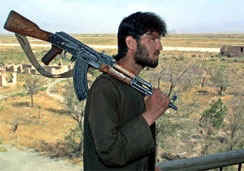 Here
is a summary of the latest events in our region in the context of the recently
declared “war on terrorism.” I know there is a concern that the Afghan
refugees will flee from their country and try to cross borders of the Central
Asian states. I’d like to point
out that at the moment Afghan refugees are working their way toward the
Pakistani border and probably only protracted fighting or the collapse of the
Taliban’s civil war opponent, the Northern Alliance, will cause a major exodus
toward Central Asia. Therefore, a
refugee crisis in Central Asia is not a threat.
Here
is a summary of the latest events in our region in the context of the recently
declared “war on terrorism.” I know there is a concern that the Afghan
refugees will flee from their country and try to cross borders of the Central
Asian states. I’d like to point
out that at the moment Afghan refugees are working their way toward the
Pakistani border and probably only protracted fighting or the collapse of the
Taliban’s civil war opponent, the Northern Alliance, will cause a major exodus
toward Central Asia. Therefore, a
refugee crisis in Central Asia is not a threat.
As this article was being written the latest news was that Northern Alliance is reinforcing its positions around the airbase Bagram, which is only 40 km away from Kabul and may serve well in the US operation on capturing Osama Bin Laden. According the US president, twenty-nine thousand of American soldiers, several air force divisions, and other troops were sent to Afghanistan. At the moment they all are concentrated around the country and are waiting for an order to start military action. G. Bush emphasizes that the US takes will be patient in its fight with the terrorists but will act for sure.
About one hundred fifty individuals were arrested throughout the world because of possible connections to the terrorist attacks in New York, Washington, and in Pennsylvania. Many bank accounts in different countries have been frozen on suspicion that the money was used for planning and supporting terrorist acts. Almost all the Central Asian countries have agreed to cooperate with the US and open their airspace to the US air force. The US announced that it would support any movement opposing the Taliban. On October 1st, the Minister of Defense of the Taliban movement called all its forces to get ready for Afghanistan’s defense. He also made a statement that “the war is getting closer.”
The United Nation is planning to return to Afghanistan. This issue was discussed at a meeting on October 1st with the ambassador of the Taliban in Pakistan. Another interesting statement has been made by a representative of the Taliban movement, “We’ll not give out Osama Bin Laden even if Afghanistan will be completely destroyed.” The conflict can last much longer than it seems at first. In that case a chance of rapid spillover onto Central Asian states is considerable if not inevitable.
In this issue of the Star we begin this page where we will be updating you on the fight with terrorism that has been initiated by the US. We consider it to be one of the most important issues at the moment and we want you to be aware of what is going on and what we should we expect.By Elena Shul'zhenko
Students are dissatisfied and distracted with the departure of foreigners from AUK. Some worry that without foreigners our university will lose its credibility and status as one of the highest universities in Kyrgyzstan. “It is difficult to get used to another person, to his language, to his manner of teaching. From the perspective of language it is more useful and better to speak with native speakers then with non-native speakers”, said Medina Aidarova, AAS 199. Some students are sure that foreigners will return as the situation in Central Asia calms down. In the faculty of Law only one foreigner is leaving, so students are not very upset. Aliya, a freshman, told that if AUK loses its reputation as the best university she would transfer to Slavyanic University together with her friends from AUK. Freshman Aleksandr Bogachev from SFW-101 said that Americans don’t have a choice and have to leave in order to save their lives. Senior Taalai Nasirdinov said that his education would suffer because of the departure of foreigners. “I don’t prefer long-distance education, it is more useful to speak with instructor personally then write by e-mail”. Some students are not taking classes with foreigners and are not affected by these problems. Tomorrow Dr. Huwiler will meet with students to find out their opinions and attitude to the departure of foreigners.
Last issue’s front-page article “Security Concerns Force Some Professors to Leave AUK incorrectly stated that Mr. Petrich is a direct employee of the US Government. Mr. Petrich is employed by the Fulbright program, which is funded by the US State Department. The Fulbright program sends scholars and professors on exchanges to and from the former Soviet Union.