 The Star
The Star
The Official Newspaper of the American University in Kyrgyzstan
September 25, 2001 - Volume 3. Issue 1
Some Foreign Professors to Leave AUK (John)
Time Limit System for Computers (Ieva)
Obituary for Elena Infante Santiesteban (Veta)
Student Affairs Coordinator? (Vika)
Shocking Day in the US History (Kadyr)
The Terror of Today (John)
Does Student Government Need Changes? (Bota)
The Forgotten Student Government
Велкам (Tania)
О бедном сенате замолвите слово
Independence Day in Kyrgyzstan (Anya)
Law and Order in Room 105 (Vika)
First CIS Student Group to Help Habitat (Anya)
Deans List of AUK (Kyial)
Surprised in the Library (Fatima)
Q & A (Oleg and James)
Security Concerns Force Some Foreign Professors to Leave AUK
By John Atwood
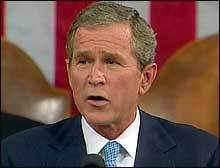
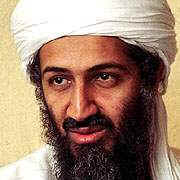
CEP fellows, and Indiana University professors in the Kyrgyz republic have been asked to leave by their organizations. Fulbright lecturers have no plans yet, but are preparing to leave if they need to. CEP decided to send its lecturers home late in the evening on September 22nd. This decision was based largely statements issued by the US, and Canadian Embassies. The statement of the US embassy read, “the September 11th terrorist attacks in the United States and the continued presence of indigenous militant groups in the Kyrgyz Republic have significantly added to the concerns about the security situation for Americans residing and visiting there. …the US Embassy in Bishkek has requested the authorized (voluntary) departure of non-emergency personnel and family members of US Embassy personnel in the Kyrgyz Republic. All American citizens in the Kyrgyz Republic are urged… to take those measures they deem appropriate for their well being, including consideration of departure from the country.”
 CEP
fellows already hold tickets for British, Turkish and Aeroflot airlines. On
Monday September 24th the CEP office will book
flights for all its fellows. These airlines are rapidly filling up due to the
large number of foreigners trying to leave. As of Sunday, September 23rd British
Airlines is full until October 7th.
If a CEP fellow does not leave, they will then assume full responsibility for
their own departure. However, as of 8:00pm on September 23rd
Dr. Huwiler said that AUK would provide limited funds so that foreign professors
could be evacuated if necessary. At stake is the possibility that international
airlines would stop flying to Bishkek due to insurance reasons. In this unlikely
event were to happen the American embassy would evacuate embassy personnel,
American citizens, and citizens of other countries with whom the US has
treaties, space permitting. Due to the high level of risk in such a mission,
evacuation to London or Frankfurt would cost approximately $2000 per person,
according to the consular office of the US Embassy. Norma Jo Baker and Dr.
Huwiler have consulted with each other, but CEP’s position has not changed.
CEP
fellows already hold tickets for British, Turkish and Aeroflot airlines. On
Monday September 24th the CEP office will book
flights for all its fellows. These airlines are rapidly filling up due to the
large number of foreigners trying to leave. As of Sunday, September 23rd British
Airlines is full until October 7th.
If a CEP fellow does not leave, they will then assume full responsibility for
their own departure. However, as of 8:00pm on September 23rd
Dr. Huwiler said that AUK would provide limited funds so that foreign professors
could be evacuated if necessary. At stake is the possibility that international
airlines would stop flying to Bishkek due to insurance reasons. In this unlikely
event were to happen the American embassy would evacuate embassy personnel,
American citizens, and citizens of other countries with whom the US has
treaties, space permitting. Due to the high level of risk in such a mission,
evacuation to London or Frankfurt would cost approximately $2000 per person,
according to the consular office of the US Embassy. Norma Jo Baker and Dr.
Huwiler have consulted with each other, but CEP’s position has not changed.
Dr. Huwiler said that he is not leaving. Mr. Hansen said, “I see no reason to leave.” Norma Jo Baker, as the director of CEP Central Asia will stay, as will Chad Thompson. However, most other professors were undecided. Many still had to consult with family back home. They are all very disappointed about possibly having to leave Kyrgyzstan. Madeleine Reeves, Sociology, is undecided as to whether she will go or not. She says she needs to talk to her family. She would very much like to stay, and said that because she has no dependants, she could possibly stay longer than other lecturers could. Barrie Hebb, Economics, said that he would like to stay if at all possible, but if he had to leave he would probably remain in the former Soviet Union. Louis Petrich, Fulbright professor in the AAS department, said that because he is a direct employee of the US government he still has some time. Although he and his family currently have no plans to leave they are ready to go if the situation changes. Herbert Terry, a Visiting Professor from Indiana University, said that he, along with all other Indiana University professors, have been asked to leave by IU Bloomington, and will leave on Thursday. Dr. James Mitchell, ICP, left on the 22nd. He had a wife and a two-year-old daughter. Evangelia Papoutsaki has a ticket booked for October 7th. She has assured students that she will continue to advise the newspaper and offer individual consultations via email. She assured her students that they will receive full credit for the classes she is teaching.
The potential departure of many foreign professors from AUK will indeed have a serious impact on many students. However, CEP, Indiana University and the Fulbright program will remain deeply committed to AUK. They will return lecturers to Kyrgyzstan as soon as it is safe to do so. Many professors are preparing plans to teach their courses via email, Internet chat, and other distance learning technologies.
The ICP department, which will be the most effected by the departure of foreign lectures, is currently working on contingency plans to cover the courses that might be affected. Askat Dukenbaev and William Hansen plan to either find a substitute, or teach themselves, courses that will be abandoned. John Clark, who is currently working at the Ministry of Education, has already agreed to teach some classes. “We will do what we need to keep up the integrity of the department,” said Mr. Hansen. The University and individual professors will do all they can to continue teaching and finish the semester. “We will be making every effort to minimize the consequences for students,” said Dr. Huwiler. He assured students that everyone would be able to graduate on time and as planned.
Time Limit System for Computers Still Has Some Problems
By Ieva Sture
“A time limit is the only fair opportunity for every student to use computers. The new program has some technical difficulties right now but we hope it will be improved in a couple of weeks during its test period, and then it will be set up officially,” says the Co-Chair of the IT Department, Nancy Leland.
At the beginning of this semester AUK
students had to face the annoying time limit system at the computers. It caused
many errors, and together with problems
stemming from the incorrect use of AUK web mail (see the notice from the
computer staff), caused much irritation among students.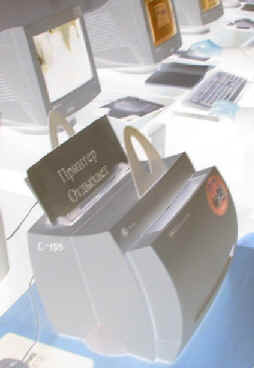
The Star turned to Nancy Leland to find why the time limit system was established. N. Leland explained that as early last year AUK’s computer technicians along with David Huwiler were looking for different alternatives to ensure equal working time on computers for all students, “because everyone pays tuition.” The old signing up system was not effective, and the problem promised to become even bigger at the beginning of this year since the number of students has increased. Considering the number of students and computers, and the time that the labs are open, the solution that was reached was a 1.5-hour time limit for every student per day.
AUK students who were surveyed for this article admitted that the old system of signing up was much better because, even though there was a limit to the number of times you could sign up for, you could use the computers as much as you needed if there were still free computers. Nancy Leland explained that the old system was not fair as it was severely violated by dishonest students who signed up using fake IDs and sat at the computers for many hours a day.
The majority of students questioned by
the Star agreed with the principle behind the fair time limit system but were
irritated by the number of errors encountered while using the system. N. Leland
explained that program has not yet been set up officially and is still in a test
period. If the students encounter any problems they should turn to Maxim
Upolovnikov, System Engineer of the IT Department of AUK, in room 212 or 205. He
will fix the problems with the students’ accounts immediately. He has been
working with this program all last year and is eager to know about any problems
with the system.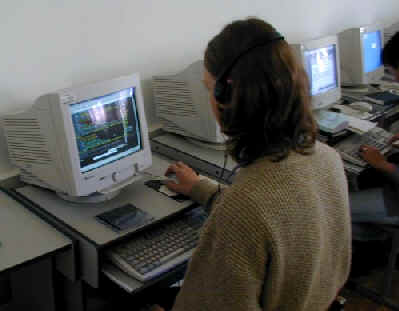
Most of students asked by the Star were anxious that at the beginning of the semester the time limit of 1.5 hours would not be enough at the end of the semester when a lot of research papers would be due. Nancy Leland said that the time limit would be in place only during the computer rush hours. The technicians have planned the system to be as flexible as possible. If there are enough free computers the time limit system will be turned off, and besides there is no time limit in the computer lab #207 where there is no Internet. N. Leland promised that next semester the time limit would be extended for those students who would be working on their theses as well for the computer department students who had to work on their programs.
Simakov Andrey, Head of IT Department of AUK, explained that the new time limit system will be introduced officially in a couple of weeks when the official announcements about the system will be posted. He also stressed that the system has been created to be flexible and to give equal working time for every student, but students are welcomed to propose the improvements. A. Simakov admitted that the best solution would be if the student government would collect the student opinions and create the most appropriate and most agreeable time limit system that could be later introduced in the computer labs.
|
Уважаемые студенты! Используя Web-mail mail.auk.kg, НИ В КОЕМ СЛУЧАЕ НЕ ЗАКРЫВАЙТЕ Internet Explorer, не произведя предварительно процедуру Log Out, так как если вы не производите Log Out, Mail-server считает, что вы не вышли из Вашего почтового ящика и НЕ пытается проверить и отобразить вашу новую почту. Спасибо
Dear Students! While using Web-mail mail.auk.kg, DO NOT CLOSE OR QUIT the Internet Explorer without having previously Logged Out, as if you do not make Log Out, Mail-server considers, that you have not quitted your mail-box and thus DOES NOT attempt to check and display your new mail messages. Thanks, System Administration Team |
Obituary for Elena Infante Santiesteban
By Veta Shapkina
Some people go, some people stay. This person has left us forever. Elena Petrovna Infante Santiesteban, professor of the Spanish language at American University in Kyrgyzstan died on Tuesday evening, September 18th from an attack of asthma. She passed away at age 42, leaving behind two children of 17 and 6, Maxim and Anton, the younger one has not even started school yet. Her last years of life were dedicated completely to her sons and her students at AUK, KGNU and KRSU. There has bot been time yet to realize that she is not here anymore. We are still in shock. It still seems to be a nightmare because such people just cannot disappear. I still see that Friday afternoon, when she was laughing inclass, having fun so that students could relax and feel better. She was much more than simply a professor, Prof. Elena.
Her lectures and seminars were incredibly exciting to attend because she shared the moments of her extraordinary life. She spent her youth in Russia where she finished school and received musical education. She was then a teacher of piano and solphegio in musical school. She used to travel around the world visiting Cuba and Spain. Being married to a Cuban man she lived in communist country of Fidel Castrol for seven years. In Cuba she worked in music school and conservatory as a professor of music theory, there she gained knowledge of rich Latin culture that she later transferred to us while teaching us Cuban folk dances and songs in Spanish class. Sometimes she would tell us scary stories about Cuban witches and all of the fantastic powers that exist in the fertile imagination of the Cuban people. After the break up of the Soviet Union she came back to Kyrgyzstan and started teaching at different universities around Bishkek until she came to AUK, where she stayed since January 14th, 1999.
For me, she was always a bright ray of sunlight coming to AUK with a big smile on her face open to everyone. She shared her smile and her heart, her kindness with everyone. Prof. Elena knew the inner side of her students. For some she was almost a mother who they valued and loved so much. The family problems of her students, their love stories and broken hearts went so close to her heart and with all her kindness she tried to help as much as she could. She knew everything about every single one of her students. For them she was a spiritual doctor who they will always keep in their hearts and minds.
“She was a person of a big heart, kind and loving. Conversations with her brought joy. She could understand all problems of the students who were friends for her.” “AUK is not the same without prof. Elena without her laugh and smiles,”said Renat Deushev. “I cannot believe it could happen to her, there is no person like her in the world and I still cannot fully comprehend the situation, I just cannot believe...” said other students.
The people really closest to her said that “she loved mango, she loved Twix, loved her life and appreciated every single moment of it, enjoyed till the end.” I could add that she was not afraid to share herself with others. Elena Petrovna was a believer, very much fond of God, every single Sunday she spent in the church and nothing could change her mind not to go there, even the tearful begging of students to go with them to the mountains.
It is so sad to see her leave. Elena Petrovna had so many plans for the future that she cannot fulfill anymore. All her life and several years that she spent in AUK she was trying to unite people, trying to bring something new and valuable to their lives. She organized joint projects of students from different universities KGNU and Slavonic university. Thanks to her, students could go to study in Spain. She had long term plans on students exchange between Spain and Kyrgyzstan.
She was always searching for more beyond the border spreading love and support. She was a love herself and the students and people who were close to her will never be the same without her.
Who Is Student Affairs Coordinator?
By Victoria Lavrova, Student Affairs Coodinator
Through this article I would like to inform students about the Student Affairs Coordinator’s job. First of all they should keep in mind that they are not alone and that there is someone who can help them to handle their problems and to answer their questions. Student advising is one of my most important functions. If you get in trouble or you have some complaints, queries or ideas on how to improve something in AUK you don’t have to insist on going directly up to the third floor (although sometimes it can be really useful – loosing weight climbing the stairs), because you have a mediator and advisor in academic, personal or internal AUK problems in the person of Student Affairs Coordinator.
My second
task is to serve as a student advocate in various situations. This year the
Student Affairs office plans to organize a new Disciplinary Committee which
would deal with different disciplinary questions, like violation of AUK’s
Disciplinary Code, etc. We also plan to create something like a Public Court
system, with a Prosecutor, a Judge, Juries and an Advocate. We are still
thinking over this idea (by the way, your suggestions and help are really
welcome), but the one thing we know for sure: the role of students’ advocate
will be always played by the Student Affairs Coordinator.
One of my main official responsibilities is to work with the Student Government. I go to their meetings and take part in making collective decisions; I assist in performing their actions and sometimes give advice. Working with student clubs and organization is my job as well. My next responsibility is to supervise and assist the Career Service Coordinator (Ruslan Yakhtanigov).
I also perform various everyday tasks – helping out with translations for the Student Affairs Office, writing recommendations for students, “spravka’s” for the clubs, and memos for the administration; I help to organize miscellaneous cultural events and do administrative duties when asked.
Besides organizing different holidays and university events, and raising the common school spirit of AUK students, we plan to undertake various charitable projects. Recently, on Saturday, 8th Sep, together with a group of active students we went to Mayevka village to help Habitat for Humanity build houses. We plan to continue this kind of activity as long as we’ll have such volunteering and cheerful students.
This academic year we hope to get a grant for making a “Yearbook”. If we manage to do that, then every student of AUK will have a chance to buy a real Yearbook, which will contain not only pictures of the graduates, like last year, but the pictures of every student and every event of AUK.
The Student Government elections this year promise to be much more interesting than ever before. The current Student Senate has got some really outstanding ideas, and I hope together we’ll manage it.
Some words from myself
Whenever you have got problems don’t hesitate to catch me and ask me if I can help. In most of the cases I can promise I will. Bring me your ideas about anything that concerns AUK’s life and together with the Student Affairs Office staff and the Student Senate we will think how we can implement them.
Shocking Day in the US History
By Kadyr Toktogulov, The Star's Correspondent in the US
Last Monday I
was so happy that U2 was coming to New York City to perform live at Madison
Square Garden. All that happiness was suddenly gone when I came down to the
dining hall to have my lunch on Tuesday at 11:00 am. I said ‘hi’ to a friend
of mine from India. I sat at his table. He asked me, ‘Have you heard the
news?’ I said, ‘No.’ ‘Terrorist attacks on Pentagon and the World Trade
Center. The WTC is gone, both towers.’ I was shocked. It was such a beautiful
day. Birds were singing; the sun was shining. But New York City and Washington
DC were in panic and chaos. Everybody on campus was depressed. A lot of
Americans were angry about what happened. Most of them were talking about
military response to these terrorist attacks. Those who had family and friends
in NYC tried to reach them via phone, but all the lines in NYC were down. Seemed
like the whole world was trying to call NYC. I personally have three friends in
NYC. I could not reach any of them via the phone. I got e-mails from all of them
later that day. I haven’t met anybody who lost anybody in the tragedy. But I
have heard of a lot of people who either had a family member or a friend who was
in the area or worked in the WTC. As soon as the first tower of the WTC was
attacked, the College opened up all the big auditoriums and set up TVs tuned to
CNN. People were watching TV and every time they saw how the plane hit the
second tower and how both towers were ruined, they found themselves in fear.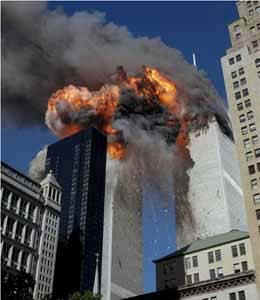
The only topic for the day and the rest of the week was Tuesday’s events. Some classes at Ithaca College were cancelled, but some professors decided to have classes to talk about the tragedy, so that students do not feel depressed and share their thoughts and opinions with other students. People in the USA felt very insecure. They were afraid that there would be another massive attack on the country. Almost everybody was sure that foreigners carried out the attacks. Nobody ever thought that American citizens might have done it. After the terrorist attack in Oklahoma City everybody thought the same way. But it turned out that the white American guy, Timothy McVeigh, who fought in the Gulf War, carried out the attack.
Later that day I had a class - International Conflict. Everybody in the class, with the approval of the professor decided to talk about the incidents of the day. Many American students said that the US government was partially responsible for what had happened. Though there were some students who thought that it was an attack on freedom and democracy, and not a response to US foreign policy. The majority of the US citizens don’t even suppose that the terrorist attacks had some meaning for those who carried them out. Americans think “they were senseless.” Many people want a military response. Some want it to be hard. But nobody knows how ward it could be: “to erase a country from the world’s map?” or what? Already some Arab-Americans have been attacked as “revenge” for terrorism. A lot of international students are afraid that they might be physically attacked, as Americans cannot really make distinctions between peoples of the world. In the Friday’s issue of the New York Times there was just a small note that Osama bin Laden was supported by the US military to fight against the Soviet army in Afghanistan in the 1980s. Nobody asked where the “hell” did this bin Laden dude come from anyway? Why does he hate the US so much? There was just a small note on that. The western media has asked very few of these questions and probably will not do so in the future.
It has been a hard week. It has been hard to predict what would happen next/ War? Where? Against whom? Nobody knows.
I am still planning on going to NYC to see U2 live in a month. I am sure that they will dedicate their great show to the victims of recent terrorist attacks. U2 loves New York City. They even dedicated one song from their recent album to New York City. As a good fan of U2, I can expect that U2’s concerts in the USA and Canada will be a tribute to the victims of terrorism all around the world.
There is still no fun in the air, only sadness, fear, and anxiety.
By John Atwood
I came home around 8:00 pm on the night of the terrorist attacks on the US. When I arrived my mother greeted me at the doorstep. She looked worried. She proceeded to tell me in a voice she uses only when something is very wrong that the US embassy had sent out a security warning for all Americans because of terrorist action in the US. At first I couldn’t believe her. But, when she kept insisting that she wasn’t playing a joke on me I realized that something was terribly wrong.
I sat in anxiety unable to do anything until 10:00pm when our Internet connection would come on so that I could read the news. When I did read the news I was in disbelief. I kept thinking that this was all a big hoax, a big, intercontinental miscommunication perpetrated by clever hackers. Still, the possibility that the suffering in New York and Washington DC could be real kept me awake most of the night.
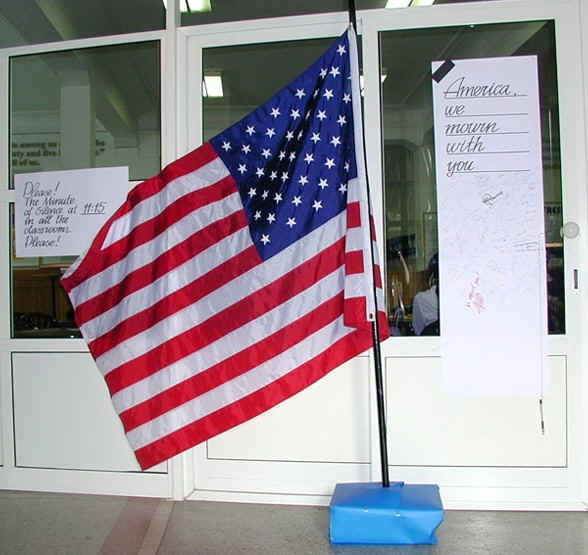
The next day I came to AUK. BBC was playing that grainy video of an airliner being steered with calculated precision into the upper half of the 2nd World Trade Center building. Then the building collapsed at painfully slow rate. The building almost flowed into a pile of rubble and dust, sending a cloud of debris in all directions. What was once the lynchpin of the New York skyline suddenly became the jaws of a terrible monster closing down on thousands of tiny human beings inside. This image and its meaning was so terrible I knew that it had to be real.
In the collective minds of those who realize the horror of this tragedy, the limits of what was possible and what was conceivable have collapsed. What is left is a confusing mixture of conflicting emotions that provide a dangerously shaky and impulsive foundation for a response. People were quick to call for retaliation. Others started saying that America was reaping what it sewed.
I began to imagine a world where terrorists and “good guys” traded injuries in response to previous wrongs, till everyone was blind and toothless. Although I am not religious I began to remember what I learned in Sunday school as a child. I began to wonder if “one nation, under god. Indivisible, with liberty and justice for all” could “turn the other cheek.”
Retaliating against an unknown enemy that has proven itself capable of exploiting the myriad weaknesses of what some people would call a far stronger opponent, seams fraught with danger. Could America, the gun toting behemoth, learn to think and act like a terrorist? I certainly hope that America is not capable of a fanaticism so powerful that large groups of citizens would be able undertake the suicidal attacks that are so commonly used by terrorists. Turning the other cheek is not such a good idea either. Whoever perpetrated the attacks on the US obviously has no problem taking large numbers of innocent lives and probably could and would do so again. I think it is imperative that these people not be given another opportunity to do the same thing again. But how can this be done without bolstering the ideology that made these people capable of such destruction in the first place.
We now live in a world where to be an American means that someone somewhere hates you and will probably try to kill you, simply because you are an American. Should we retaliate and prove the terrorist’s point, or should we do nothing and risk another attack. Nothing, short of drastically reforming America’s policy and image throughout the world will end the threat of terrorism. To do this would be to bend to the will of the terrorists. George Bush, and many other Americans, have resolved, publicly and privately not to do this. In so doing they have chained America to a long list of bad options for dealing with this threat. Our only hope now is that the best of these less than satisfactory choices will be good enough.
Does Student Government Need Changes?
By Botagoz Kassymbekova
This article tries to draw your attention to the current structure of the Student Government’s representation and its effectiveness. It does not intend to doubt the importance of representation of student rights and interests in the governance of the university, but the efficiency of the existing official SG and its structure in presenting students’ voices to the AUK community and the administration.
|
The Senate will consist of three elected Senators from the Freshman, Sophomore, Junior and Senior classes, and one Senator from the Preparatory program.’ from Student Senate Charter |
According to the university charter, the Student Government (SG) is “the body elected by the students of the American University in Kyrgyzstan to represent students’ interests in administrative matters, including but not limited to communication with administration, allotment of the Student Activities budget, and organization of student events.” Student Senators have “the responsibility to find out about the expectations, wishes, and issues of his or her electorate, attend every official and urgent meeting, protect students’ interests in the university, and undertake a reasonable number of administrative responsibilities.”
Although the official mission of the Student Government sounds very encouraging, it seems that most AUK students forget to bring university issues through this body. Most students who actually raise issues either try to address them in the administration directly, or through their departments, or the newspaper. Why is it that students prefer to take Student Senators’ responsibilities for themselves? Why don’t students delegate their issues to the Student Government? Do AUKers, then, need student government at all? If yes, then, what changes does the Student Senate need to be able to exercise its direct responsibilities?
One of the problems that the current SG faces is that it does not accurately represent the makeup of the student body. At AUK departmental affiliation is very important for the reason that departments at the university are relatively autonomous in their decision-making and different policies are adopted within each department. Currently, the SG is made up of representatives of every class. Thus, because students in different departments face different problems many departments and their students were never represented. Vika Lavrova, Student Affairs Coordinator said, “The current structure of the SG definitely needs changes. The idea of departmental representation sounds more progressive in terms of fair and effective representation.”
|
Vika Lavrova, Student Affairs Coordinator: “The idea of departmental representation sounds more progressive in terms of fair and effective representation.” |
Here is a suggestion on how to bring departmental representation into student governance. It is to have SG representation based on departmental affiliation and class of graduation. It would leave the existing SG structure to deal with general community issues (clubs, cafeteria, public events, safety, common departmental problems) and create a branch to deal with departmental matters. This is a suggestion for every department to have its own representative(s) to raise issues within department and then to address them in the administration themselves or through their chairperson. This will not only delegate students’ issues of every department to the administrative units, but also it will make students feel responsible for the development of their departments and thus increase students’ interest in participation in university governance.
One might suggest that students do not need any government at all, however there is AUK government and whether students’ opinions must be included or not is for students to decide. This article is an attempt to solicit different opinions and suggestions. Senators for this year are to be elected on November fifth. “Before the election day we promise to introduce meetings with the Student Body to discuss their questions/concerns and the nature of the SG openly. I hope that the new system will encourage students to participate and make them feel that this university is for them and that students can really improve something,” Anna Kirey, a Senator.
The Forgotten Student Government
We feel that there is discontent among students about the work of the Student Government (SG). Therefore we would like to comment on relationship between the SG and the students.
|
There is a student government at AUK. It was elected in November 2000 by a popular vote. 7 students were chosen out of 11 candidates to represent the will of AUK’s student body in front of the university’s administration and departments. |
One of our missions was to help resolve the misunderstandings between teachers and students. The current SG (don’t call it the SS [Student Senate] – we are not THAT scary) has existed for 10 months and it is still arguable whether it is effective or not. We are working on solving computer problems and we also give money to clubs, but it seems that students are not interested in expressing their will through their government. Only 20 people showed up for the trip to the mountains that the SG organized out of 60 who signed up. The bus cost 2500 soms and it took time and effort to put this thing together.
We can hardly find things to do because nobody comes to us. Only one person asking for garbage cans in each class turned to the SG during these first five weeks of studying. What should we do? There are certainly many things to change at AUK and it is disappointing that we have to come up with proposals and complaints all by ourselves. Students do not read announcements, they hardly ever come to meetings and discos.
How else can we reach YOU? Please, help us to find meaning in our work and contribute to solving AUK’s problems. Write to us [email protected], stop by at 105, come to our meetings on Tuesday at 17:30. We are here to serve you.
Cordially, Your Student Government
P.S. Here is the latest news from the student government:
We are preparing a huge election campaign with videos from the TV club, interviews, posters and as many candidates as you can produce.
The charter – our Constitution – is expecting to have a bunch of changes. It is in the student handbook and any ideas are welcome on its policies. We will introduce the new system of two-chamber parliament, which Botagoz is writing about.
There is a spirit week coming up and we desperately need ideas and people to help out with this activity (feel free to email us).
Food Tickets issue is hot. Please, let us know what YOU want for lunch… [Plov forever, a comment from the Editor!]
By Tatiana Pesina
Прошло теплое лето. И сменилась жизнь веселая, спящая такой обыденной и скучной жизнью, когда хочешь-не хочешь, а надо вставать, да ещё в такую слепую рань, и медленно, печально брести, спотыкаясь, в универ. Эх, жизнь – жестянка! Но никуда от неё, увы, не денешься.
Но студенты – на то и студенты ,чтобы уметь разнообразить жизнь и превратить серые учебные будни в яркие праздники. Дерзайте, ребята! А мы вам поможем.
Кстати, ради чего, собственно и затевалось всё это – ради вас, ребята. Ради того, чтобы сказать вам: «Здравствуйте, родные! С новым учебным годом вас!» Чтобы улыбнуться и пообещать сделать жизнь студенческую (ой, нелегка она) хоть чуть-чуть веселее и разнообразнее, чтобы предоставить вам место для мыслей, для ворчания и для пожеланий. Чтобы напомнить вам, что «Стар» - с вами :-)
«О бедном сенате замолвите слово» или Забытое Студенческое правительство
В Ауке существует Студенческое правительство (СП). Всеобщим голосованием оно было избрано в ноябре 2000г. Из одиннадцати кандидатов семь студентов были выбраны для того, чтобы представлять интересы студенчества АУКа перед университетской администрацией и кафедрами. Еще одной из важнейших задач сенаторов было выявление и решение разногласий между преподавателями и студентами. Нынешнее СП (не путать с СС – все не так плохо!) стоит во главе студенческого сообщества АУКа вот уже 10 месяцев, и многие сейчас спорят о его эффективности.
Мы, СП АУКа, работаем над решением проблем с компьютерами и мы выделяем деньги клубам, но так или иначе создается впечатление, что студентов не инересует тот факт, что они действительно могут выразить и осуществить свою волю через их правительство. Последний пример: только 20 человек собрались для поездки в горы, организованной СП, тогда как изъявили желание поехать и подписались больше 60. Аренда автобус обошлась СП в 2500 сомов, а организация этого мероприятия стоила многих усилий и времени.
Вряд ли мы найдем для себя занятия, если никто к нам не обращается. За прошедшие пять недель учебы только один человек подошел к нам с предложением поставить мусорные корзины в каждой аудитории. Так что же нам делать? Несомненно, в АУКе существует масса вещей, требующих изменений и довольно странно, что нам самим приходится придумывать заявки и жалобы. Студенты не читают объявлений, они редко появляются на встречах, и даже на дискотеках вместе.
Как еще нам до вас докричаться? Пожалуйста, помогите нам найти смысл в нашей работе и внести свой вклад в решение АУКовских проблем. Пишите нам auksg@yahoo.com , заходите в ауд. 105. Мы здесь чтобы служить вам.
С уважением,
ваше Студенческое правительство
P.S. Несколько планируемых событий от СП:
· Мы готовим масштабную предвыборную кампанию с привлечением видео и ТВ-клуба, интервью, постерами и с таким количеством кандидатов, сколько АУК в состоянии предоставить.
· Нашей Конституции (она же «Устав Студенческого Правительства») предстоит увидеть серьёзные перемены. Если вам интересно, что в ней написано, найдите Student Handbook. Мы рады любым идеям что до изменений нашего «основного закона». Мы приняли во внимание пропозицию Ботагоз и хотим преобразовать наш однопалатный сенат в двухпалатный.
· Приближается Спирит-неделя… и нам очень нужны творческие люди для её проведения (пишите-приходите)
· Актуальна также проблема с талонами на еду. Пожалуйста, обращайтесь к нам с жалобами и предложениями… А что ВЫ хотите на ланч?
Independence Day in Kyrgyzstan
By Anna Kirey
“Askar Akaevich, we believe in you, in your wisdom, we appreciate your effort in making Kyrgyzstan a prosperous democratic country. We swear to do our best to raise Kyrgyzstan and multiply its richness, we swear to be obedient citizens, swear to protect our land from the enemies and follow the seven commandments of Manas”.
Where do you
think this oath took place? Around 150 AUK students were supposed to show up at
a concert in Spartak stadium on August
29th
to celebrate the 10th anniversary of Kyrgyzstan’s
independence or as the order from the State Committee of the Kyrgyz Republic for
Tourism, Sport and Youth Policy said: “to fill the background of the eastern
tribune of the Spartak stadium”.
Each university had to make sure that a certain percentage of their students
show up to prove to Askar Akaev that they are loyal citizens and are happy to
celebrate the “long-fought-for” independence. However, AUK was privileged
not to make students attend the event but to invite them to attend because our
extracurricular activities director Nikolay Grigorievich Shulgin spent a long
time preparing the torch parade.
Only one-third of planned number of students came to Spartak stadium and waited for an hour or so before the honored guest showed up. While waiting for the concert to start AUK students’ spirit was being raised by performing the famous Funky Chicken (orientation cheer), making a wave and singing the Kyrgyz national anthem. As usual, AUK was the only university to make noise and we were yelled at by militiamen. “ AUK, sit down, sit still and be quiet”. Students at the stadium were treated like a bunch of sheep. Militia people directed everyone to their seats and did not allow people to leave after the concert started.
The torch show was supposed to be the final act of a relay in which all Bishkek universities took place. A week before that there were urges at AUK to recruit 40 students to carry torches but it never hapenned ecause we are way too busy to spend long hours rehearsing for some official event. Some students expressed their gratitude to whoever prevented them from participation in the event because they had enough of required participation in different events during high school years (where do you think hundreds of children at Nooruz celebration come from?). The good thing about the recruitment is that some of the students received free bus passes for the last week of August.
Hundreds of boys in blue shorts and white t-shirts ran around the stadium in groups representing different universities. The show itself was magnificent. It was already dark and hundreds of torches making up huge “10” and “Kyrgyzstan” on the tribunes were truly grandiose. The concert started and it turned out that all the performers stood with their backs to majority of the students because the main figure of the concert, Askar Akaev, was sitting opposite from us. We do not doubt the beauty of the performed “Kyrgyzstan-our common home” dance with whatever number of national dances involved but it would be better to see the faces of the dancers instead of their back parts. My favorite parts of the show were the oath to the President (very typical Kyrgyz leftover of Soviet Union) and the silent singing of the national anthem (I wish I could take a survey on how many people actually know its lyrics).
After that 30-minute torch show, a concert of the very famous Kyrgyz singers started. That was the time when tens of rows of people stood up and made their way to the exits. Some AUK students were stopped by militia while trying to escape from the boring show, there was almost a fight. Unfortunately the Star reporter was not able to sit through the show till the end due to the above-mentioned reasons so the concert description stops for now. There were couple parties afterwards but the main idea of this whole event was that we are forced to celebrate freedom and independence – the paradox of this country.
Ieva Sture Vidzemes Augstskola, Latvia on independence day: “I can’t comment on the concert because I did not go there as I heard it was compulsory. As for the Independence Day, it was a very beautiful site at the square, I felt that people are celebrating. But why was there so much militia – 200 militiamen on a small street all day long around the square, what about people who live there? And this concert for VIP people… Kyrgyz taxpayers should not pay for the performances that only President watches. In Latvia we celebrate Independence Day with fireworks, concerts and the celebrations in Riga are shown on TV live for people who do not live inside the capital. For Latvians independence day means a lot. I like it when children wave small flags. Here I saw tens of pieces of a torn small flag laying on the streets on the evening of independence day. This shows that the flag does not mean much.
As a student of a unique school called American University in Kyrgyzstan, I have to share my thoughts about it with our university community. What makes AUK special is this combination of the two completely distinct educational approaches – American and post-Soviet. Despite the fact that our old educational system is believed by some to be one of the best, I would argue that its time is over and AUK in particularly does not need it anymore.
There are a number of teachers at AUK who, from my point of view, contradict such university principles as individual value, freedom of choice, and respect to the others regardless their age, status or knowledge. In their classes a student is supposed to stand in front of the class (which I myself find very uncomfortable) and retell the lecture or the article word by word. As I see it, the teacher does not require any analysis of the material, but just memorizing it. Such teachers often think they know the Truth and in case a student’s opinion contradicts the professor’s s/he may hear something like I did in one of my classes: “It is stupid, it is crazy!”. Some professors say that this university is too democratic and they do not like its spirit. Or if a student sits with legs on a chair, certain professors say they are superior and a student has to behave properly.
In short, my point is that AUK students often have a hard time taking classes with such teachers. The students have to subdue their personalities and their opinions in order to get good grades in such classes. Personally, I do not think that AUK students should tolerate the above treatment from those who are supposed to help them to form their independent personalities.
Anonymous
Law and Order in Room 105, Please...
By Victoria Lavrova, Student Affairs Coordinator
My beloved Students! I appeal to you all and especially to those who consider to be the members of any student club or organization. It is indeed NOT my pleasure, but rather my DUTY to announce the major changes in the Student Affairs Office. No, it hasn’t moved to another room. It is still in famous 105. Yes, it remained the office that works WITH the students and FOR the students. But in order to make this work more effective and to save the health and nerves of the people who WORK in this department, there is a set of rules of use of the room 105.
The following set of rules was discussed and approved by the Student Senate. I want to underline that it was a collective decision, and my role in this case is to be an executive of the Student Government’s decision.
These regulations are nothing more
than a necessary condition for the effective work of the department of
extracurricular activities, which functions
on behalf of the students only.
What we do by setting these rules is try to organize and get in order the
Student Affairs Office for you to make YOUR university lives
more interesting and enjoyable. 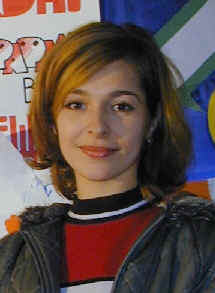

Finally, these are the Rules of 105 Room (Student Affairs Office)
1) Room space for meetings Please, do not appoint meetings in this office. There are five people who work their constantly, and if you gather their with at least four or five more people the room gets way too crowded, and you make it impossible to work and concentrate. In case it is really something urgent and important and you can’t fine a room anywhere in the building, then PLEASE inform the office staff IN ADVANCE. We hope that after the new building will be added to AUK campus we will get the separate room to be occupied only by the clubs and organizations, and another separate one for “The Star”. But till then, we have to share Student Affairs Office fairly
2) SAO Computers There are two computers that are to be used by SAO staff and “The Star” newspaper only. The “Star” has a privilege not only because they are the official university newspaper supported by SAO, and they are extremely important for AUK, but also because one of the computers in room 105 officially belongs to them and they have a right to use it anytime they need. However, the members of “The Star” will not be allowed to use these computers for their personal needs, like checking emails, playing games, preparing home tasks, etc. Other clubs and organizations are NOT allowed to use SAO computers for any needs. This is what the labs’ computers exist for. Last year because of the uncontrolled use of SAO computers somebody broke one of them, and all the important information was lost. Therefore we should establish some kind of control under computers so that this kind of situation would never repeat again. However, in some really exceptional cases (like making annual report) clubs can use computers in SAO with the special permission of the Student Affairs Coordinator and with a full report about the work that is going to be done on that computer. In any case, nobody except SAO staff, Student Senate and “The Star” staff is allowed to install any programs or save any files on these computers (they will be instantly deleted).
3) Telephone There will be definitely NO personal calls permitted. The members of the student clubs and organizations can use telephone to make the phone calls related to the club activity only.
4) Room supplies and equipment Anything of SAO’s equipment, facilities or supplies should be used ONLY with the special approval of at least one person from SAO staff. It is forbidden to take away from the room 105 ANYTHING that belongs to SAO without informing its staff and getting their permission. We want to prevent the acts of stealing like those that took place last year, and establish the control under the use of things that we are materially responsible for.
5) Book shelves There is a bookcase with a few bookshelves available in SAO. As long as we do not have a separate room for the clubs and organizations, these shelves are to be fairly shared by the SAO staff, the Student Senate, “The Star” , and some of the most active student clubs. If you want to take something to read out of these bookshelves, please ask the person/or group of people it belongs to, or anybody from SAO staff.
6) The Key There is the new list of those who have a right to take the key from vakhtyor (the guard). This list was made up and approved by the Student Senate.
This is about it. Some details can be further negotiated. And the last note: I hope you will all find these rules quite fair and reasonable. Regarding all the rest, the SAO is always friendly and opened up to your questions and problems. You can always, anytime come up to me to share your ideas, queries, and concerns, and I will be happy to help you and to be your advisor and advocate. That’s what I am here for.
On November 14, the freshmen will be officially welcomed by AUK Administration in a ceremony called Initiation. In the Initiation there will be a concert and an official part. Students are asked to contribute to the Ceremony about one month before. So keep watching the wall for the notices that invite students to the meetings and rehearsals.
Amnesty International group in Kyrgyzstan - Press Release
In August AIK hosted Heather McGill, AI London Headquarters Development officer for former Soviet Union and Turkey. She evaluated two years of work of our group and gave some advice. This year AIK is planning to work hard on registration (we were refused registration last time) and expanding. We have over 15 new members and a lot of project plans. During fall semester we will be showing movies on different human rights issues, holding workshops on skills we learned at human right trainings and continue on with “I love you the way you are…” project for homosexual rights. If you feel like joining AIK in any activity, feel free to come to any of the announced meetings and help us to promote the universal ideas of human rights.
First CIS student group to help Habitat
By Anna Kirey
What do AUK students do on weekends? Some of them have fun, some study and some…Well, 11 AUK juniors and seniors and our fearless student affairs coordinator Victoria Lavrova spent Saturday 8th Sep. carrying bricks, trying to make the earth flat, and mixing cement.
It was a fun activity. It is impossible for something not to be fun when there are AUKers with jokes, songs and stories to tell. We worked for 6 hours or so. Our group was the first group from AUK to help with building houses. Also we filled out applications for different volunteer activities at Habitat. Habitat is an international non-profit organization that builds houses for poor people who can not afford that themselves and it fully depends on volunteer work. Usually families that are in need of a house build it themselves but of course there are people needed at the site. There are 20 houses, which already look like houses and 30 more will be built hopefully by winter of 2002.
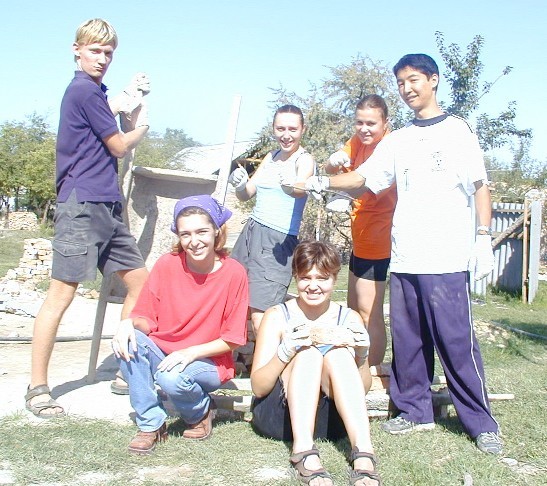
The best way to present a diverse picture of this way of spending your weekend is to make the participants talk. Comments about the event come from Anna Dovgopol AAS 199 (Ukraine): “I think it was a good way to spend a day off. Working physically I let my brain rest. It was great to feel that you can contribute to somebody else’s well-being.” Veta Shapkina (Uzbekistani ICP junior): “We work a lot with our top part of the body (the brain) at AUK. Helping Habitat brought some stretching to my other parts as well!” A group of AUK professors went to Maevka to help out at the construction site as well on Saturday 15th of September. Their impressions were similar: Svetlana Kulikova, co-head of the journalism department said: “I was familiar with Habitat’s programs and therefore I wanted to help. I think what they are doing is very important for Kyrgyzstan since there are no other NGOs or governmental programs that build houses for people in need. I am glad I contributed to something like that.” Tynara Ryskulova, Kyrgyz Ethnology professor: “There were two sessions and nine teachers at the site. The organizers told us they were surprised that AUK students thanked them for the opportunity to help. Before they asked many people at different organizations to come but seems like work without payment is not very appealing to people. AUK was the only one to come and do it. It was a pleasure and we are going this Saturday again, with students this time. ”
Since 1976, Habitat has built more than 100,000 houses in more than 79 countries. A couple other interesting facts about it is that Kyrgyzstan was the first post-Soviet country to invite Habitat to build houses here. That happened 5 years ago and construction has been going on since summer of 2000. It took a year to get approval from the mayor’s administration to get the land and thousands of spravkas but finally the land in Maevka was given to Habitat as a gift and now it is being used for a good cause.
The group which was making a piece of land flat was impressed by the results – we covered a huge hole with soil and got steel muscles – so you get to feel good because you have done something significant and spent time with your friends and learned some new skills. Volunteering is a new concept for post-Soviet countries but just imagine that you can come to Maevka in 5 years and say: “I helped to build this house.” There also volunteers needed for translations and fund-raising, volunteer and PR committees in Habitat. Their email is [email protected]
A secret revealed: there will be more activities available at the site soon: painting and stuccoing (shtukaturka) and other jobs are about to start.
Recognition of AUKers with Outstanding Academic Achievements
By Kyialbek Toktosunov
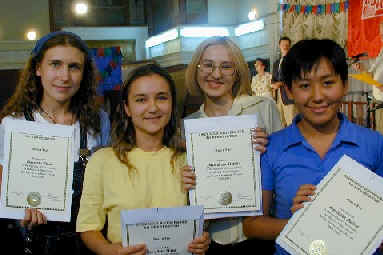
“Let us hope that some of our graduates will not confine themselves by becoming the President of the Kyrgyz Republic, but go beyond and become the Secretary-General of the United Nations,” said Camilla Sharshekeeva, the Minister of Education and Culture of the Kyrgyz Republic during the President’s List and the Dean’s List ceremony on September 7, 2001.
Although the ceremony was a success, it raised some issues, namely students who qualified for recognition due to outstanding academic achievements were not recognized, and if they were then improperly.
|
Any school encourages students to excel in studies by recognizing students’ outstanding academic achievements through various honors and awards. Thus, annually students with high academic records for the previous academic year are honored by being listed either on the President’s List and the Dean’s List during a ceremony of the same name. Those with a GPA of 3.70 – 3.79 are listed on the Dean’s List, while those with a GPA of 3.80 – 4.33 find their names on the President’s List. |
 Recognition
of students with excellent academic achievement varies from university to
university, thus AUK had it in its own way. Out of 103 honored students 25 were
listed in the President’s List and 78 in the Dean’s List. Thus, only seniors
were “fortunate” to find their names in the President’s List, though some
had a GPA lower than 3.80 and thus were eligible only for the Dean’s List.
While those juniors and sophomores with a GPA of higher than 3.80 were awarded
by the Dean’s List. Some students claimed that they were eligible for either
of the Lists and blamed the Registrar’s Office for failing to include them in
either of the Lists. Later under the pressure from program heads, some of the
discontented students got their recognition. Some critics said that such
ceremonies level all students by ignoring the rigorousness of studies. That ones
have to write constant papers and take “tough” classes, while others either
never write papers or take “easy” classes.
Recognition
of students with excellent academic achievement varies from university to
university, thus AUK had it in its own way. Out of 103 honored students 25 were
listed in the President’s List and 78 in the Dean’s List. Thus, only seniors
were “fortunate” to find their names in the President’s List, though some
had a GPA lower than 3.80 and thus were eligible only for the Dean’s List.
While those juniors and sophomores with a GPA of higher than 3.80 were awarded
by the Dean’s List. Some students claimed that they were eligible for either
of the Lists and blamed the Registrar’s Office for failing to include them in
either of the Lists. Later under the pressure from program heads, some of the
discontented students got their recognition. Some critics said that such
ceremonies level all students by ignoring the rigorousness of studies. That ones
have to write constant papers and take “tough” classes, while others either
never write papers or take “easy” classes.
As soon as Kyrgyz-American Faculty of the Kyrgyz State National University became an American University in Kyrgyzstan it started holding this tradition that is since 1997. But there were students wondering why there was not such a ceremony last academic year. The Registrar’s Office says that there was recognition of the excellent academic achievements of graduates during the last year commencement ceremony. Why only graduates? As for the reasons, before AUK had no document regulating this kind of procedures; there was another Registrar; and simply, the Registrar’s Office was unable to process the spring semester results of all students. According to the Registrar’s Office, the document called “Regulations for student placement on the President’s List and Dean’s List” is functioning as of April 25, 2001. It would be desirable to have the information on this procedure either in the University catalog or the University web site. Anyway, all the student body of AUK – work hard towards your President’s List and Dean’s List! Good luck!
|
Each of the recognized receives a corresponding certificate, which attests to the outstanding academic achievements of the student. Some universities publicize the Lists throughout the campus, make them available on the university web site, and send them to different organizations thus helping students with prospective employment. Unfortunately, AUK does not yet practice this. |
CEP Announces Updated Rules for Conferences
By Norma Jo Baker, Central Asia Country Director, CEP
The Civic Education Project (CEP) is a not-for-profit organization devoted to assisting with higher education reform throughout Central and Eastern Europe, the former Soviet Union, and Mongolia. CEP Central Asia is one of the ten “country programs,” and our regional office is in room 223 (New Building) at AUK. CEP Central Asia is a large program this year, both geographically and numerically. CEP Central Asia works in five different countries: Kazakhstan, Kyrgyzstan, Mongolia, Tajikistan, and Uzbekistan. CEP Central Asia will have 31 Fellows in four different fellowship programs this year, Visiting Faculty Fellows (VFFs - formerly the Visiting Lecturer Program), Local Faculty Fellows (LFFs - formerly the Eastern Scholar Program), SCOUT Fellows (Support for Community Outreach and University Teaching), and we have one Faculty and Network Development Fellow in the Central Asia program this year, whose primary task is to coordinate teacher development and networking amongst teachers in the region.
CEP works in 24 different countries throughout Central Europe, Eastern Europe, and Eurasia, and many of our events extend well beyond the individual country programs. One of the most popular activities we hold are student conference events, including activities such as the Debate Forum and the Model United Nations. Students from throughout all of CEP are invited to apply for conferences outside of their home program, but there are two conditions through which student participation is organized. First, only those students who have a CEP fellow mentoring their work may apply to the conference. Students do not need to be registered in a CEP course, but they do need to consult with a CEP lecturer on their participation in CEP events.
Second, students are encouraged to apply to all conferences in which they are interested, but CEP will only fund one conference event per student during the academic year 2001-2002.
There are three main student events planned for the 2001-2002 academic year in CEP Central Asia; the CEP Central Asian Regional Student Conference, the CEP / IDEA Central Asia Debate Forum, and the CEP Central Asia Model United Nations Simulation Forum.
CEP Central Asian Regional Student Conference
Our regional student conference will be held 22-24 March 2002, in Kyrgyzstan.
To apply for a conference, students submit a proposal, and are mentored by a CEP Fellow. The deadline for proposals is 22 November, and you must submit them to your CEP Fellow. The CEP Fellows will then submit the applications to the CEP Selection Committee.
After the selection process is completed, successful students (with the supervision of their CEP Fellows) write complete academic papers (usually 10-15 pages in length) based on their proposals. At the conference itself, each student makes a 10 minute presentation on the paper. Fellows are responsible for overseeing and assisting the students in all stages of this work, and if necessary, pulling students from the conference who are not prepared. In the past, selected students have not been able to participate in the conference as a result of failure to write the final paper, the failure to write a credible academic essay, or in cases of plagiarism. CEP Central Asia has adopted a policy that students found plagiarizing conference papers or proposals are ineligible for any CEP conferences for one full calendar year.
CEP / IDEA Central Asia Debate Forum
CEP Central Asia and IDEA will organize and host the second annual Central Asia Debate Forum. This Forum will include students from throughout Central Asia in a 5 day event devoted to promoting discussion and thoughtful debate on pressing issues facing the contemporary world students selected to participate will be required to intensively prepare and master the materials required in order to debate. This popular event will be held Wednesday, 14 November to Sunday, 18 November 2001.
CEP Central Asia Model United Nations Simulation Forum
CEP Central Asia will organize a Model United Nations (MUN) conference from Wednesday, 24 April to Sunday, 28 April, 2002, in Osh, Kyrgyzstan. The MUN will host students from throughout the Central Asian region, selected students will be required to prepare materials in advance relevant to the theme of the MUN, prepare students with the academic content of the MUN, and assist in the coaching and adjudicating required for the MUN.
CEP Central Asia works in very diverse sites, and with very diverse students. These events are designed for all CEP students, and part of the mandate of Fellows involved in planning these events is to devise procedures that will reflect this diversity and allow an equality of opportunity for all students.
CEP Central Asia has a large number of fellows based at AUK, and if you are interested in participating in a CEP event, we would encourage you to contact one of them. Please come down to our office for further information, and a list of Fellows is posted on the bulletin board. There is also a student information bulletin board outside our office, where the latest information on CEP student events can be found. CEP has a shelf full of information outside the office doors as well, and students are encouraged to have a look and help yourself to information about our organization.
Have a good academic year, and we hope to see you soon!
By Fatima Gayazova
As usual in the beginning of the academic year library becomes very important not only for students but also for AUK in general and particularly for the librarians. This semester our reporter had an interview with the Director of AUK library and member of expert commission of program “Support to libraries Soros-Foundation,” Iosipenko Natalya Victorovna.
Concerning the mission of AUK library, she said “the main goal of this branch is to create as much comfort for students in using books as possible.” The five staff members work officially in our library and their aim is to try to create all the possible conveniences for AUKers, of course, in cooperation with students.
|
Presently we have subscriptions for 48 newspapers and magazines most of which are local press, some are Russian, but only a few are from Europe and America. |
In general the rules will remain the
same as they were last year. However some changes will be made.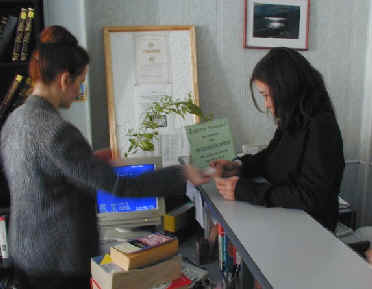
First of all, the penalty system: “Every year we have more and more newcomers and in order to regulate book usage and circulation we have to be more strict and cautious,” said Natalya Victorovna. “That’s why, right now, if a student does not return book on time he should pay a fine.” To make it more detailed: if you do not bring a dictionary or reference book back on time (before 9:30 a.m. next morning), the fine is 50 soms. If you do not return an ordinary book on time, you should pay 10 soms for each belated day. Concerning single copy or valuable books, you can use them only in the Reading Hall and do not have the right to take them out. Regarding plans for the future the Director said that we will witness new reforms in the library: we are expected to have the whole first floor of old building for the library as soon as the library gets additional financial donations. The present Reading Hall will be a ‘books registration section.’ A ‘reading hall for books with a limited number of copies and printing press’ is to be placed in four classrooms. Additional desks will be fixed in the corridor. There then will be enough space for 120 students, in comparison with the present volume of 70 seats. Another reading hall will be only for dictionaries and reference books. The final step is having a Media Center with computer, audio, and video equipment. Theoretically in the Media Center, students would work with audio/video materials including CDs. Judging by the fact that establishing only a Media Center requires 30,000 USD, we can assume how huge this project is.
Right now the budget of AUK library cannot afford to start even the first step. But according to Natalya they “are ready to move to the other rooms even at thismoment.”
Every summer, the budget of AUK library is considered by Board of Trustees, taking into account all the applications for new books from teachers and students.
Natalya once again, asked students to keep silence in the Reading Hall for it is really hard to work when it is so noisy. She also promised that all the librarians would do their best to meet all the AUKers’ needs.
|
The general collection of AUK library is more than 48 thousand books and consists of three sorts of books: dictionaries, core collection, and ordinary academic literature. 44.5 thousand of them are registered in computer database and available for student usage. Moreover approximately 30 books (from different fields) are added to the storage of our library each day. |
Hello, everyone! Despite the recent happenings in the world, AUK remains a cosmopolitan institution. This page is called “Education without borders” and is intended to inform you about different opportunities to go abroad for conferences, seminars, exchanges and other exciting events. It also will contain information about people who already went somewhere and want to share their experience with Star readers. If you have events to put on this page, or questions about published announcements, feel free to contact Anna Kirey by email [email protected].
We start this September with summer events which AUK students attended
Interviewed: Aminat Chokobaeva ICP junior, Yulianna Khilazheva ICP freshman, Kyialbek Toksonbaev ICP junior
Exact name of the university/organization that was your host and event:
Aminat: University of Helsinki
Yulianna: ACCELS, FSA and Soros Foundation Summer Leadership Camp
Kyialbek: The Baltic International Summer School (BISS) at Vidzemes Augstskola, Valmiera, Latvia
If we ever want to go to Helsinki/ Leadership camp which three things should we keep in mind?
Aminat:
Don’t drink Salmiдkki, which is Finnish “spotyjach” or “samogon” or
something like that! 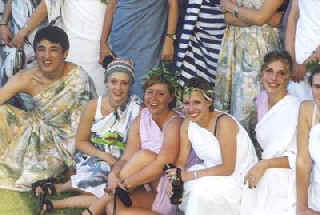
Yulianna: To identify what is leadership, what makes a good leader, if you are going to get a skill of being a perfect leader what should you do with it.
Kyialbek: Well, first of all, make sure you will able to decently represent your culture: your food, national costumes, images of your country, etc. Secondly, be in no doubt that you will spend one of your best summers by having a tour of Latvia, of places like Jūrmala, Rīga, and the Baltic Sea. And finally, the chances are pretty high that you might be the only Central Asian at the school as most of the BISS students come from Western and Central/Eastern Europe, so take your chance and…:)
What did you study/learn/teach?
Aminat: I took 2 courses “Gendering globalization” and “Finland for foreigners”
Yulianna: We (exchange programs’ alumni) taught kids from rural areas of Kyrgyzstan how to develop leadership skills and why they should do it. Also we taught those kids some English. We showed them educational and fun games.
Kyialbek: I tried to “discover” Latvia, to learn more about the way of life Latvians lead, what and where they are compared to us. My “exploration” turned out to be a success, given that I took a course on Politics of Transition last semester, where I had a chance to focus the entire course on the Baltics. As for the formal schooling (quite rigorous), I took four courses: Northern European Nationalism and Identity, Northern European Foreign Policy and Security, Russian Foreign Policy in the Baltic Sea Area, and Latvian for beginners.
Your funniest experience there…
Aminat: it was funny and sad at the same time to see people’s faces stretching down while trying to guess what Kyrgyzstan is and where it is.
Yulianna: I think KVN was funniest part of my experience there, was that when you were trying to do your best to explain or show certain things
Kyialbek: Well, my friends know that I am a poor “cook,” but it was The International Student Food Party that turned me into a “decent chef”:) While this party was approaching, I was feverishly e-mailing my friends over here to send me a recipe of at least one Kyrgyz national food. So, I got one for plov, but I did not venture to cook it. Instead, I fixed something like a ‘potato-pie’ and a watermelon cut both in slices and as a bowl. As we started eating, in some two-three minutes the table allocated for Kyrgyz food was empty!:) Though, there was not any Kyrgyz alcohol, people were saying that both my ‘masterpiece’ and watermelon were delicious.
What was the most confusing and weird about your experience in HSS2001/Latvia?
Aminat: When one of our lecturers started talking about Derrida. The way she explained Derrida’s position was so complicated that one could barely understand what she meant . Moreover, when I asked whether she is an essentialist, she got offended.
Kyialbek: The oddest experience I had in Latvia, especially in Valmiera with a population of some 25.000, was to see people staring at me all the time and thus, feel myself an alien. It happened that here were only two Asians in the city, me and Misa Fukui from Japan. So, whenever I would walk in the street people, mainly kids would confuse me with a Chinese and ask to speak some Chinese.
Words/phrases you vividly remember from the country’s language…
Aminat: hei (hi), moi (hi too), moi-moi (bye), kiitos (thanks), nдkemiin (good-bye), hyvдд yцtд (good night), nimeni on (my name is).
Kyialbek: Hi! – Sveiki or Čau!;You look great! – Tu loti labi izskaties!;Please – Lūdzu!; What is your telephone number? – Kāds ir tavs telefon numurs?; Thank you! – Paldies!; Haven’t we met before? – Vai mēs jau neesam tikušies?; What is your name? – Kā tevi sauc?; I love you! – Es tevi mīlu! :-)
Couple words about locals/participants:
Aminat: very nice and polite people, even though not very talkative unless they are drunk
Yulianna: the alumni who prepared all the materials and organized it all were very energetic and just great people. They were doing their best to give the kids as much information about exchange programs as possible.
Kyialbek: Latvians appeared to be very polite and helpful. Since nearly half of the country’s income comes from the service sector, they have to treat tourists well. As for the BISS 2001 participants--the coolest dudes I have ever met.
Contact information of the place you visited and basic requirements for participation + where did you get funding?
Aminat: http://summerschool.helsinki.fi; requirements – statement of purpose, essay for financial assistance, 2 recommendations; I was funded by Nokia corporation.
Yulianna: A special grant from ACCELS and Soros Foundation
Kyialbek: Just visit www.va.lv/biss . Funding was a problem as neither AUK nor the Soros Foundation provide scholarships. So, owing to CEP Summer School translations I could find some money to cover my trip to Latvia.
Transforming Higher Education and Civil Society
Alliance of Universities for Democracy
Belgrade, Federal Republic of Yugoslavia
November 4 -7, 2001
Deadline: 5th of October
Web site: http://www.aubg.bg/audem
Email: [email protected]
Some financial support will be available to cover attendance-related costs of participants from countries of Central and Eastern Europe who are not funded from their institutions or other sources within their countries. AUDEM will review applications from CEE candidates and make decisions regarding the exact amount of need-based funding to be awarded to individual applicants.
Requirements: full papers to be submitted on the following topics:
o The Challenge of Inter-Ethnic and National Relations
o Higher Education and Opening Society
o Higher Education and Civil Society
o Humanistic Education: Education and Citizenship
o Global Migration of Students and Faculty: The Problem of Brain Drain
o The New Technologies and Higher Education
o The Role of Professional and Educational Associations
o The University and the Community
o Balkan Dilemmas and Crises
o The EU, Central, Eastern and South Eastern Europe and the NIS
o Thinking About Democracy: What Have We Learned Since 1989?
o Higher Education in Post-Communist Society and the World Higher Education System
o Theoretical and Practical Issues: New Approaches to Reforming Higher Education
 |
|
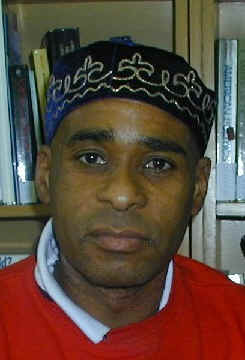 |
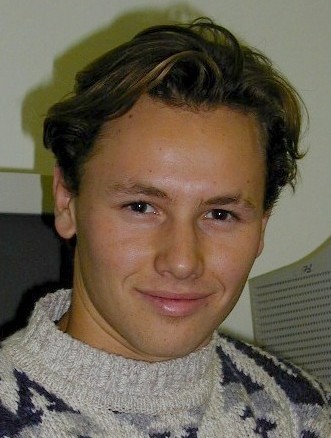
| Oleg Valiev, student of AUK, BA | Name and Position: | Dr. James Mitchell Visiting Faculty Fellow, Department of ICP, AUK |
| Aries | Horoscope Sign: | Aquarius |
| Because several great people love me. | Why are you important? | My only importance is for the survival of my family |
| 1. A CD of the Prodigy 2. a book called "How to survive on a desert island" 3. And a Bible | If you were stranded on a desert island, what 3 CD's or books would you take? | CD's: Achtung Baby U2, Amnesiac/Kid A Radiohead; Book: Journey to the East by Herman Hesse |
One girl invited me to her birthday. It was a great b-day but I forgot her name and had to ask my friends what her name was. |
What is the most embarrassing situation you have ever been in? | not rated PG for the AUK crowd |
| Nothing in particular. Actually, I would try to solve the problem of "lunch tickets" | If you were president of AUK, what would you do? | Dismiss me before it's too late |
| New York | What is the most interesting place you have ever been? | Grimsey, Iceland |
I don't think I have a favorite one. All authors have something interesting to say. |
Who is your favorite author and why? | Umberto Eco. So many layers of knowledge available |
| I wish I didn't take this life so seriously. | What would you change about yourself? | I wish I was left-handed |
| Knowing that everyday is unpredictable. | What excites you? | See [question] number 5 |
| Life itself. | What is the meaning of life? | Being conscious |
| A place where every person finds an application to his/her abilities. | AUK is... | AOK |
| In the long run, probably yes. | Do people get what they deserve? | Yes |
| Indifference. | What scares you? | nothing that I have encountered as yet |
| Do you think that AUK's policy is built on democracy? |
Your Q for the next interview: | Why? |
Editor-in-chief: John Atwood
Web and Layout Manager: ahoura afshar
Editor Assistant and Photographer: Anna Kirey
Staff who contributed to this issue: John Atwwod, Tatiana Pesina, Fatima Gayazova, Ieva Sture, Botagoz Kassumbekova, Kadyr Toktogulov, Veta Shapkina, Anna Kirey, Kyialbek Toksonbaev
Special Thanks: Natalia Andrianova, Victoria Lavrova
Contact: Student Affairs Office, 205 Abdumomunova str., Bishkek 720000, Kyrgyzstan
Advisor: Evangelia Papoutsaki