 The
Star
The
StarThe
Star
The Official Newspaper of the American University in Kyrgyzstan
October 2000 - Volume 3. Issue 2
Inauguration Raises Many Questions (John and Kon)
AUK Students Bring Human Rights to Elementary School (Sasha)
The Green Defenders (Galina)
Youth Conference in Moldova (Anna)
Feminists, AUK’s Endangered Species (Jessica)
Let's make Things Efficient (Saltanat)
AUK Football Toutnament (Yulia, Sasha)
Youth Parliament Brings Students and Rectors Together (Tania)
Take a Step to Stamp Out Torture (Kadyr)
Education Sans Frontiers (Anna)
Потанцуем? (Anton)
Greetings and salutations, dear readers of The Star! There have been several changes in the organization of our newspaper. John Atwood and Konstantin Sudakov are the new co-editors. With the help of Evanglia Papoutsaki, our new advisor, and our readers we hope to make the star even better. We aim to provide succinct and fair coverage of issues relevant to the AUK community, and a forum for debate within the university. We promise to abide by principles of good journalism and publish a high quality newspaper worthy of the university we serve. We will not be afraid to publish controversial information and will cover all possible aspects of a story. We hope that you will be a central part of the changes we are making. Please share your ideas, questions, comments, suggestions, editorials, articles, etc with us. Remember the star is your student newspaper.
The President’s Memo on Freedom of Expression
- Dr. David Huwiler
I am a little disappointed that the freedom of expression is even a question on this campus. However, since this issue has been raised by students, I feel that I should address it. I will make this as clear as I can:
As long as I am President of AUK, no student will be punished in any war for expressing any idea or opinion whatsoever. It makes no difference whether the opinion is opinion is unpopular, offensive, or critical of AUK and its administration. As we all know, popular ideas do not need protection. Anyone on this campus is free to express any idea without fear of reprisals or intimidation of any kind.
Let me add two comments: my use of the word “anyone” above was deliberate. Members of the administration, the staff, the faculty, and others also enjoy the freedom to express their views. This means, for example that if a member of the administration feels that a view expressed by a student is irresponsible, inaccurate, or unsupported, he or she may say so publicly—again, without fear of reprisals.
Secondly, I would hope that all members of the community would use their freedom responsibly. If are going to criticize one another publicly, we have an ethical obligation to make every effort to ensure that what we say is accurate and complete, that we have gathered full information from all sides and that our criticisms are expressed in a positive and constructive way.
Please let me know if you have any questions.
Inauguration Raises Many Questions
By Konstantin Sudakov and John Atwood
On October 13th, Dr David Huwiler will be sworn in as AUK’s president in a ceremony which will be Kyrgyzstan’s first ever presidential inauguration.
Initially the inauguration was to take place outside in the square in front of AUK. According to the original plan the ceremony would have started with a band playing marches and jazz. The faculty would then enter in procession. Honorable guests, department heads, AUK’s Vice President, and the Provost would then be invited and introduced to the spectators. The president would then enter amid a fanfare of drums. After the Kyrgyz and American national anthems there would have been several speeches. Aaron Brudny would then have administered the presidential oath to Dr. Huwiler. He would have placed his left hand on the AUK charter and his right hand on his heart as he read the oath. The “symbols of power”, a ceremonial key and necklace would then be given to Dr. Huwiler. The president would then have goon to the doors of AUK and present the symbols of power to the ceremonial guards. The guards were to let him in and the inauguration banquet would have begun.
On Tuesday, October 11th the plans were changed. The ceremony will now be the CH of the main building. The program will be shorter. The orchestra will be smaller. Fewer people will be present and only 50 selected students will be invited to attend the inauguration. Exact details for the ceremony are still being finalized. The inauguration comes at a critical time in AUK’s history. It will mark our first change in presidents. Dr Huwiler sees the inauguration as an event to help AUK make the transition from one president to another. He plans to present an inaugural address which will explain his plans and hopes for the future of the university.
The total cost of the inauguration is currently unknown. Nikoli Grigorievich said that the final cost would be around $1300. $1000 will be spent on the banquet. When The Star tried to get the exact figures from the university administration it was unable to. When we asked Camilla Dushebaevna for a copy of the final budget she refused because she felt that it might be disrespectful to the president. Dr Huwiler seemed unconcerned about any potential disrespect saying “I have no problem with anybody seeing that [budget].” This lack of official information has created a flurry of rumors and speculation. Questions have been raised such as “What is the role of tradition in AUK?”, “How much money should be spent on ceremonies?”, and “How should traditions be formed considering AUK’s unique background?”
Many people feel that the inauguration will help form AUK’s future traditions. Louis Petrich, the Co-Chair of the Anglo American Studies Department, expressed his support for traditions that allow AUK to build up academic seriousness. Like all events it will help to boost moral and create a sense of community. “Many of the things people remember from school are the traditions,” said Dr. David Huwiler. The inauguration will also help to publicize AUK. The event is intended to attract possible donors and future students. Camilla Dushebaevna said the inauguration is an important public relations issue. AUK has invited many important people to the ceremony, among them, Askar Akayev, the Ministers of Education and Culture, and rectors of other major universities.
“The question is, considering our current lack of resources, can we afford all of these events?” said Deborah Eisenberg, the AUK Student Affairs Coordinator. For others this was not even a question. “It’s a horrendous waste of money,” said Tom Wood a Civic Education Project (CEP) lecturer. “The money would have been better spent on one or two scholarships for deserving students.” There is also concern about how AUK’s traditions will be shaped by the inauguration. AUK has to balance American and Kyrgyz cultural forces. This situation allows us to create totally new and unique forms of tradition. “Traditions are good, as long as the reflect our own cultural identity ,” said Evangelia Papoutsaki, CEP lecturer and adviser to the Star.
This debate will continue throughout the year and center around all our ceremonies until the AUK community comes to an agreement on this issue. We need to work together to come up with a solution as unique and diverse as all our constituent parts.
Conference Creates New Anti-Drug NGO, Government in an NGO’s clothing
By Tatiana Pesina
Not so long ago there was a meeting of students from different universities at the Ministry of Foreign Affairs (MFA). The meeting, officially called a “conference” was devoted to a very good subject, students against drugs. Despite the important theme, the conference was not very productive.Having entered the room I was surprised to be informed that everyone who was sitting there automatically became members of the newly formed NGO “Students of Kyrgyzstan are against drugs”. The idea itself was fine but as usual it was vague and undeveloped. The organizer of the meeting had no concrete plan of action and, moreover, he couldn’t even answer such a simple question as what is the NGO going to do in future. Oh, sorry, he could but his answer was very unclear: “Well, we must meet and make some decision…”
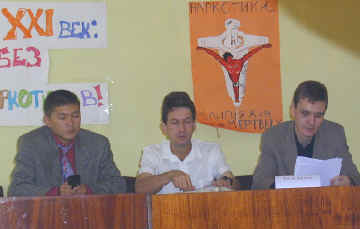
Everybody who was there was given a list of rules written specially for members of the NGO. Here are some of them.
Purpose: The NGO is organized to struggle against drugs.
Rights and duties of members of the NGO:
They have right to take part in NGO’s administration;
to elect and to be elected;
to get all necessary information about NGO’s activities
Members of organization are to follow these rules and the administrating office decisions. Then the “leaders” of the “conference” held elections for the board of the new NGO. Tell me, how is it possible to elect somebody you were seeing the first time! I’ve never seen those people before – and I was to make a choice. As I understood it, the chairman of that NGO, the person who had proposed the idea to organize it, was not interested in sharing the organizing experience with others. All the words about the efficiency of the future NGO was just a bluff! We need such meetings and also such organizations. Drugs is a problem, which must be solved. However I don’t think inert people will be able to do it. Guys, if you have any bright idea about the NGO’s possible program – contact us, if you want to enter this organization contact us. Let’s save youth from drugs, not just talk about it.
AUK Students Bring Human Rights to Elementary School
By Alexandra Shpakova
Amnesty International opened a kick butt year with one of their best projects ever. AI members, lead by Ibragimova Lola went to Voenno-Antonovka school #2, to introduce Human Rights Declaration to the pupils.
When we walked into the school we felt like we had gone back in time. We were in a typical Soviet secondary school of 1970’s: big stature of Lenin in front of the main building, huge stengazety (newsletters) hanging on the walls proclaiming heroes of Great October Revolution and World War II. Anna Kirey got it right straight away: “We need to do something, we must draw posters and make kids to change it…?!” Things started to go downhill from here. We came into the classroom and understood right away, that children we were to work with were the “chosen” ones. It turned out, that this school had a functioning student government, and the students we had a seminar with were senators or made straight “A’s”. Even this fact didn’t help them to feel free and relaxed. All doors to them seemed to be shut.
After introducing ourselves, the Amnesty group, with great effort, got the students to say their names and talk about their plans for the future. Then we asked about human rights…. It would be not honest to say that they didn’t know anything. The main problem was that many of the students thought that human’s rights were the same as the Criminal Code. More than 75 % of them were sure that parents had a right to beat their children. All of the male students agreed that a man had a right to beat his wife.
We played different games and had debates and talks. It seemed that the ice between our democratic AUK community and the outside world was melting. At the end Veta Shapkina and I sat and just chatted with the kids, promising them that we would come back. We eventually did. We left them markers, paper and paints, expecting for the next visit to find a couple of posters and also fresh ideas. Well, these meetings are to be continued. You can read about them in future issues of the The Star.
By Galina Kravchenko
On Friday 29th there was a seminar about ecological journalism organized by UNESCO. The organizers and speakers of the seminar were two “Green women” Svetlana Bortsova, the author of the radio program “Vertical” on radio “VOOST” and Ludmila Sapojnikova, the leader of TV program “Bioritm” on NBT. The participants were students from BGU, AUK, KGNU, KTU and KRSU. It was really interesting to see that the conference was attended by students in all majors and not just journalism students.
The seminar lasted for almost a day. It included hot debates between students and the organizers about the goals and perspectives of ecological journalism in Central Asia. The students actively participated in the debate. They were divided in several groups and each of them drew an outline of the problems that clarified the term of ecological journalism. Then each group exchanged their ideas and opinions. Students were also given the articles about ecology written by “green women” and students criticized the style of the articles and the competency of the author.
During the much need breaks students were able to get to know each other in a casual atmosphere. The seminar was very successful with all the aspect well developed. Moreover, the organizers of the seminar offered students to collaborate with them. So, students, if you have some ideas or suggestions about ecological journalism come to ask me how to get in touch with “green women.” Trust me, it can be really interesting.
The Star Celebrates Its First Anniversary
By Zima
Do you know what Askar Akaev has in common with Amnesty International and St. Valentines Day? It'’ easy. The Kyrgyz President along with the holiday of love and an active human rights organization was once on the front page of the newspaper you are holding in your hands. A whole year has passed since the very first issue of AUK’s Official Newspaper was released on October 13th 1999.
We had our ups and downs, we received our share of healthy criticism and praise. We survived no matter what happened and hopefully stayed fresh and interesting for our readers. Accidentally this happens to be my last issue as an Editor in Chief. In a way I am sad because it feels like I am leaving my baby. But on the other hand, I know that the people who will be in charge from now on, have a lot of energy and potential to produce the best possible newspaper.
Actually it is already happening. I will tell you a couple of inside secrets. It is possible that the day when The Star will receive it’s official license is not far away. And perhaps sometime in 2001 you will be able to see the new incarnation of our newspaper (which will be published on A2 format). But apart from all this technical stuff, I hope you have noticed the slow increase of the quality of the journalism we provide. The new unofficial policy inside the paper is “to be on the edge” and provoke discussions and debates inside and maybe outside the University.
When I came to study to Kyrgyzstan and AUK, I was justifying my choice by the numerous possibilities for getting experience in the field I love so much – journalism. But it was theory. To my great surprise theory was soon followed by the real practice, when our professors, Raushana Bulatova and Scott France invited me to participate in this project. I received a lot of experience and in a way it helped me to move to the next step of the journalistic ladder.
Here I would like to thank Scott and Raushana Hasanovna, all the people I have worked with, our provost Camila Sharshekeeva for the support and freedom she gave us and also the new adviser – Valya Papoutsaki. Long live the newspaper (and I know it will).
Cheers everybody! And keep reading. Zima.Some interesting trivia facts:
Diploma Disease, or a Plea to the Teachers
By Merdan Halilov
The human society has reached homogeneity on at least one issue – the issue of education. People no longer recognize skills or knowledge obtained in a “non-traditional” way. The universities have become the tradition. Vive l’univeritй! The only way one can join the civilized world is through education. If you get a specialized training, you get a good job. If no, go and sweep the dirt in the streets of Bishkek! Simply to say, go and get your diploma. The society is infected with a Diploma Disease, as analyzed by Ronald Dore (Ronald Dore. The Diploma Disease. London. 1976)
Don’t hurry to blame me that I detest studying. Wrong! I love it. I don’t go to all classes because the teacher takes attendance, and I get dropped if I don’t come more than three times - a conventional technique of teachers. But I go there because it is interesting! One can learn something there! Don’t think that the students are slackers, who try to get the best grade for the least amount of work.
Two weeks ago, I was running around in AUK and gathering signatures in order to get rid of the attendance policy at this university. I suggested not having any requirements to attend the classes. But the idea didn’t go through on the third floor. Martha Merrill said that the university would loose its integrity in this case, and that she would not legislate on these kinds of issues from the top. Great, I said . That’s a very democratic approach to deal with problems. Go to the teachers and talk to them directly. There are some teachers at AUK, who don’t care about the attendance of the students as long as they complete the other course requirements in time. Therefore, I am addressing the teachers who check student attendance. I see the approach “You come or you are dropped!” as a problem since it creates an illusion that all students always DESIRE to attend all classes during the whole semester. If to simplify it, it would mean chauvinism! All students of AUK always study good as they come to all classes! What a nice model! Other universities could use it as an example!
The teacher’s main argument would be, “Don’t want to attend, don’t sign up for the class! Don’t want to study, don’t go to the university at all!” No, it doesn’t work this way in reality. Even if the student doesn’t want to study, she or he wants the diploma! This is the first thing. Second, may be the student could take another course, but the choice of classes is not very big here to gather the necessary amount of point towards graduation by taking classes that do not strictly require to attend all the classes. Third, the choice of the class does not matter, since hating a certain course, or the way it is taught is not always the reason to miss the class.
Daily I see many students who attend a certain course and just SIT there, and DON’T CARE what’s going on in the class. I see students who make “spravkas” themselves and show it to teachers, if they ask for it. I see students coming to the class ten minutes late, and going out of the auditorium for ten, twenty, or even an hour, and coming only to the end of the class. I see students who prepare for others courses during the class. I see students just chatting through notes, or reading “cool” magazines. Now let me ask you, is that what AUK wants? Is that what teacher wants? Is that a good way of keeping “the body of a student” in a class?
This problem can be easily solved. Just don’t require the student to come to the class. The teacher could say that on a certain day she or he wants an essay, a paper, or a presentation from the student; that on certain dates there are such things as mid-term and final exams, and that these exams would indeed ask for the information given in the lectures, or discussed in the seminars. It is least likely that a student would get his or her “A” not attending the class, and not doing the readings. The teacher could write in the syllabus that 100% of the grade is based on the participation of the students in the class, and not just on the fact that a student physically shows up to the class every time. Sometimes it happens so that a student does not feel like sitting in a class due to some, let’s say, family problems. Then why is it necessary for the student to go to the class on that day, and just stare at the teacher, when she or he cannot concentrate on the class?
Attendance should be based on the will of the student. If the student does not have this kind of will, then the tuition that the student is paying to study at AUK will make the student to have such a will. Maybe the student who is not attending does not want to get a good grade? Maybe “C” or “D” would do fine? Don’t drop the student for not attending the class, please. Let them get their bad grade; let them spend their money on tuition any way they want. Instead drop them for not implementing other requirements, such as not turning in essays or papers in time, and not only because of attendance.
By Anna Kirey
“Bona Devinicia!”, people in Chisinau where I arrived late on 25th of September for a youth conference, spoke Romanian to me but I could only say «не понимаю». It didn’t seem like the Soviet Union: Latin font everywhere, police with European hats, people speaking language much more similar to Italian than to Russian.
The conference was about the role of youth in post-totalitarian society. To start we sang Moldavian national anthem - Limba Noastra. It felt like these people are very proud of their country. Among the participants there were 40 Moldavians. Lukasz from Poland and myself presented papers at the conference.
My interpreter, Sanda, a girl who has just come back from the US on an FSA Undergraduate exchange did her best to bring the message of the participants to my attention. Now I seem to know much about Moldavian youth. Of course, they have the same problems and the leftovers of Soviet Union mentality. Participants talked about frustration and aggression that people experience because of the financial crisis. They also discussed issues related to AIDS, drugs, religious groups, youth projects and problems of self-expression. Lukasz and I asked numerous questions. I was always trying to find the solution to the problems. I understand that there are many problems, but I wanted to talk about what could we do to solve them. The main complaint was that government is not financing youth projects. When I presented my paper about the youth exchanges and wonders we do here at AUK without support of the honorary government, I had a wave of questions coming from the floor. People came to me during the farewell party and asked for advice on how to get students interested, how to write proposals, and how they can reach more young people. They told me that it was always a problem to motivate fellow students to get involved, especially to volunteer. That made me realize how lucky we are at AUK to be encouraged and supported by what I would call the spirit of this university.
This conference gave me a new perception of reality. The world we have created at AUK is so different from other universities. In a typical CIS state university students are the last priority. They cannot speak up and have to follow the rules even if they contradict students’ beliefs, needs and interests.
This conference was an attempt to hear from the youth. We never came to any agreement about possible solutions but at least we shared our concerns, experience, and decided to cooperate. So if you have any ideas for any Kyrgyzstan-Moldova youth projects, please, tell me and I can give you all the contact information. They are very active in the judicial field. Older students provide professional help as lawyers. They also have strong NGOs focusing on civic education and homosexual youth.
Feminists, AUK’s Endangered Species
By Jessica Buckingham
There is a course being offered at AUK that deals with the history of feminism. This is not a very popular course. The ideas around feminism in Kyrgyzstan and AUK remind me of ideas of feminism in the 1950s in North America, think dark ages. The idea that feminists are all man hating, brutish women who think men and women are exactly the same is outdated and unnecessary. The fact that the course I speak of has only three students confuses me, and the fact that male and female students recoil if even the word “feminist” is even spoken bothers me. Unfortunately, the religious beliefs that are fairly predominant in this country understandably make belief in such a notion taboo. This is difficult for me to understand because I was brought up to believe that being a feminist was a noble thing. The knowledge that I was surrounded by women who thought freedom and equality were important to me was comforting and encouraged me to do things I wanted regardless of my gender. As I got older I understood that not everyone thinks this way, especially here. Ignorant views of feminism still remain, and are widely accepted. It will probably always be this way. I was also brought up to believe that feminists are for the idea of equal rights of men and women, such as equal pay for equal jobs and opportunities in anything they want to do. Men and women are different but deserve the same rights and privileges.
At AUK, mostly due to the cultural landscape, ideas are outdated, and women who call themselves feminists are often the subject of misunderstanding. I am not attempting to single handedly stop ignorance about feminism, but simply raise awareness. This is an important issue to me because I feel I should have the right to call myself a feminist without fear of backlash or be misunderstood. There is a class taught by Jarkyn Mambetova that deals with the history of feminism. It is an incredibly interesting course that deals with topics that include female pioneers if the feminist movement and slavery. She said the course was supposed to raise awareness among students. However interest in the class was low. Colleagues even suggested she change the name of the course, to Women’s History, but she thought this might be dishonest. The course is about the History of Feminism. Many hours of preparation were spent on getting this particular course ready and I find it sad that more people haven’t taken an interest. I am trying to understand, along with other facets of Kyrgyz culture, why this is so.
By Saltanat Berdikeeva
Having studied two years at AUK and a junior year at Indiana University-Bloomington (IUB) I have been able to compare two systems. It is funny to say “two systems” since they are both American. Although both are identical, there are still differences, primarily in the area of requirements and distribution of points (credits in American terms) to successfully graduate from AUK. Although I am happy that I am receiving the best education that offered in this country, I think it is useful to know how things could be even better and efficient.
It is not news that an AUK student studies the most. Every student is told from the very beginning of his or her college career that 4800 points should be completed before the graduation date. So everyone aspires to this wonderful goal. The only problem with such a requirement is that there are just too many courses to take care of.
I remember from my freshman and sophomore years that I got up very early to come at AUK by eight, had classes for very long, most of the time until 4 or 5:30 pm, and eventually came back home exhausted. Then after a short break resumed studying until very late. Such a routine goes on every day. The point is that there are many courses to take per semester and class periods are lengthy. An AUK student who wants to succeed spends almost all the daytime at the University then comes home just to continue or finish the daily loads or homework. There is virtually no time left for extracurricular (which are by the way also encouraged in order to graduate with a degree) or just simple fun time with friends. I do not want to it to sound like a complaint but I am sure many AUKers would back my claim. Once my dad noted having seen me reading long hours after a regular school day-“It’s impressive that you read a lot. I wonder if you as well think much about what you have read.” He had a point: when a person accumulates information, he/she must think over the acquired news. But with my busy time schedule I do not think I have had enough time to fully absorb or analyze what I have read. By the end of the semester I has so much readings that I had to go back to read over many of them for I did not remember what they were about.
My experience at Indiana University was much more different. IU uses credit systems. Each class has worth different credits, depending on a difficulty level. For instance, a political science course is usually worth 3 credits; a basketball class is worth 1 credit. If one takes, say, 17 credit hours, that’s way too much. Although
Freshmen take primarily required courses, the study load is not as pressuring as at AUK.
Taking fewer courses at IU to compare with AUK does not mean one does not study intensively. On the contrary, the concentration on classes is far deeper and thorough. At least, I had to use many sources on a particular subject that I now deem to know better than any other course I have taken at AUK. It’s fully understandable that AUK lacks many desired sources but an AUKer should be able to thoroughly learn from what we have. With the IU system I many times caught myself that I was not as stressed out as I was at AUK, because I spent fewer hours in classes, studied mainly on my own and spared some time for fun. The bottom line of an IU system is making possible for an intensive individual effort. There are indeed a lot of readings, far more than at AUK (particularly at the Political Science in which I majored), but the system considers a student’s capacity and drive to work efficiently, therefore requiring fewer credit hours unlike at AUK.
The most interesting point is why AUK, being an equivalent to a real American university, has not adopted a similar system as the one at IU? Are there any plans to reconsider the point system, if not radically change it but at least to loosen the pressure on students? Most importantly, are students happy with the current system? Is there a point of changing it at all? I think that the current system will do, but it is not as efficient as it could be.
AUK Football Tournament, Teachers Pitted Against Students
By Yulia Balybina and Sasha Shpakova
AUK’s football tournament ended with a big scandal. The match was held on Sunday, the 24 of September on the football field of “Trudovye rezervy” stadium. Four teams participated: a joint team of the 1st and 2nd year students, Business Administration 3rd year team, International Relations 3rd year team, and a team of AUK professors. In the first round the team of the first and second courses played against the International Relations team. Before the game Ababakirov Azamat (IR 199) participant of the Freshmen-Sophomores cut his finger. Luckily, there was a girl, Shpakova Sasha, a former soccer player, who assumed the role of nurse, and run to his rescue. She carefully, with a tender smile, dressed a wound and put some “zelenka ” on it. So our local “Bay Watch Team” representative saved Azamat, and the Gladiators fight began…
The other members of the team were extremely envious of the care that Sasha provided to Azamat, and obviously were concentrated on the “nurse” and not the game. So the game ended with the victory of International Relations. In the second round Business Administration played against the AUK Professors. Guess who won?… Of course professors!… Between the games Nikolay Grigorevich Shulgin, our local Maradonna, was hanging out with the spectators, telling them, that when he would get on the field, he’d tear his opponents like a dog would tear an old rag. Also those words were accompanied by the weird act of Shulgin trying to eat his shoelaces. Give him some slack; Nikolay Grigorevich had a high temperature, caused by bronchitis.
After a small break a new competition started, for the honor to be a host of the third place. Business Administration team played against the Freshmen-Sophomore team, which by that time was refreshed and cheered by the “nurse”- Superstar. Well, of course they won, but the most important fight was ahead. A huge scandal took place during the last minutes of final match. From the very beginning the International Relations team was leading 2-1, but soon the score evened out. Here comes the most interesting part of the story. At the very last minute of the game, the International Relations team scored a winning goal, but professors claimed that the ball was out of bounds before it reached the goal.
However, the students stated this situation in the another way. Maksim Popov the main forward was sure that the ball was not out and that the team of students won. He also says that one of the professors told the judge that the ball was out, when the judge didn’t see it himself. Well, it is still not clear, what happened in the corner of a soccer field. This fact led to a verbal battle between students and professors, with the latter abandoning the battle field. One of the teachers, Zaicev Alexander Nikolavich, said “ The behavior of the [students] team was not proper to the code of any sportsmen. They showed disrespect to their opponents and also to the game itself.” It is hard to tell who won the match. The Star gives its readers the opportunity to find the winner and contact us. Remember, the truth is out there.
Students Compete in a Street Ball Competition
By Yulia Balybina
On Saturday the 23 of September a street ball competition was held between different schools and university teams in the square in front of AUK. Kalyzhin Anton (BA 198) and Maksim Kenaev (BA 297) represented AUK in the competition. Their team was called Homosapians. “Our guys played very well”, said Pasha Milutin (IR 100), “ and competition in general was extremely interesting and exiting!” Homosapians won two matches and lost three. Fellow students did not support our team. However girls from the other universities made them feel better. J
The event was sponsored by radio station Europa Plus and sponsored by the Coca-Cola Company. This sport event gave an opportunity for teenagers to use and express their energy in healthy and peaceful way. It’s also nice to mention that not only boys competed there. Girl teams were also represented. They showed that street ball and basketball in general are also popular among females. ( Good example for AUK girls, Huh!)The winners got free Sprite and T-shirt from the sponsors. Lets hope such competitions will be common in the future.
Youth Parliamnet Brings Students and Rectors Together
By Tatiana Pesina
A seminar of the Youth Parliament entitled “relations between students and authority” was held at AUK on Saturday the 7th of October. The Youth Parliament was formed 2 months ago and isn’t well known yet. It’s purpose is to solve the problems of youth, especially student problems. Relations between “students and professors” is one of the most important problems for students. Who is the owner of the University? Whether it is the pupils or rectors or professors, should students obey their professors and do they have the right to do what they want? More then 100 students and professors from different universities gathered together at AUK to decide these questions.
The meeting consisted of three parts: two of them were like a debate and the last one was a small group discussion. Representatives from other universities could choose one of the three groups: student organizing themselves for solving their own problems; cooperation of university and students ; and state support to student organizations. During the first and second parts of the seminar we heard reports about student – professor relations. Interesting questions were raised there. One of the students asked Kamilla Dushenbaeva, after her report which raised the issue of academic fairness, who would win a discussion between a student and a professor at AUK? She answered that the victory would go to the one who was right. Another problem that was covered during the seminar was a report on the university’s responsibility for the education they give. This topic is connected with finances. Maybe professors would teach better if they were paid more. Students might be more responsible if they knew they knew they were paying for their own education. When teachers are paid more they will not need to take bribes thus they will grade students fairly.
During the discussion groups every group had to make a decision about their chosen topic and make a small presentation. Then the whole group reviewed the reports, and made a decision as to what principals should be used in making students and professors equal. Unfortunately the ending of the meeting wasn’t as good as the beginning. Our people even advanced in democratic lifestyle couldn’t stay non-bureaucratic and the final of the meeting was boring when everyone come and started saying very banal things such as:
-necessity of organizing student senates, parliaments, clubs;
- creating student newspapers;
- turning to relations: student plus professor equals partners;
- putting students into authority.
However, the meeting was educational. It was unique in that lots of universities had their own free organization. It was also nice to see that students are starting to fight for their freedom and rights.
Take a Step to Stamp Out Torture
By Kadyr Toktogulov
On October 18, 2000, Amnesty International launches the worldwide one-year campaign against torture. The campaign will start simultaneously in more than 60 countries around the world. Kyrgyzstan will be among these countries too. AI Bishkek will join the campaign. Torture is very wide-spread around the world. According to research of Amnesty International in this field, torture is used in more than 150 countries, it is widely used in 60 countries.
On September 15 Kumar and I went to Moscow to participate in the seminar held by the International Secretariat of Amnesty International. The Amnesty groups from CIS attended the seminar too. There were also members from the British and Dutch sections of AI, who came to Moscow to help the IS representatives with the seminar. Dan, a member of the British AI section, told us how the public actions in Europe are organized, what methods the groups use in order to hit the goal of the actions. Josien from the Dutch AI section gave out the banners that the groups in CIS could use in their activities and shared her experience with the participants.
Julia and Heather, staff of the department responsible for the CIS region, said that the Bishkek group of Amnesty International is one of the best in CIS due to our fundraising and activities held. We were much happy to hear that. During this academic year we will continue to work in promoting the human rights in Kyrgyzstan. We plan to gold a public action, analyze the Kyrgyz legislature related to torture, draw public attention to this cruel, inhuman treatment which has to be eliminated.
By Anna Kirey
The Globe is there waiting for you to explore it!
Now! If you have some interesting information you want to share with your fellow students or ideas for improvement of this page, please, let me know via email [email protected] or phone- 43-41-82.Антон
Ключкин.
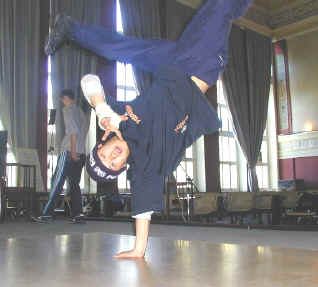
Наконец-то
и в АУКе
появился
брейк. 18
сентября
открылся
новый клуб,
который
будет
представлять
в нашем
университете
это
танцевальное
направление хип–хоп
культуры.
Благодаря
своей
красочности,
зажигающему
ритму брейк–бита
и моде на
широкие
штаны – клубу
можно
предсказать
блестящее
будущее.
 Идея нести
брейк в массы
пришла в
головы
Виктора Цоя (классно,
да!) и Михаила
Шатова еще в
начале лета
этого года. С
первого июня,
в подвале
АУКа
начались
каждодневные
тренировки.
Парни
трудолюбиво
протирали
пол своими
задницами и
результат не
заставил
себя ждать.
Сейчас
протереть
что-то уже
трудней. Во-первых,
в команде уже
не двое
брейкеров, а
пятеро. А во-вторых,
в подвале (ну
в спортзале,
хотя с этим
можно и
поспорить)
нет места –
там пол
университета
корректирует
свою фигуру.
Пришлось
оттачивать
свое
мастерство в
большом
здании, в CН.
Тяжело дыша,
наша теперь
уже
официальная
брейк –
команда,
выполняет
акробатические
трюки под
строгими
взглядами
Ленина,
Маркса-Энгельса
и когда-то
замазанного
Сталина.
Впрочем,
смотрят на
них не только
партлидеры с
фресок.
Многие
приходят
оценить
искусство,
именно
искусство,
танцоров. Тем,
кто хочет
поспорить с
этим,
предлагаю
попробовать windmills.
Объяснить,
что это такое
- тяжел❦;, тем
более, когда
это делает
такой чайник
как я. Просто
придите и
посмотрите, а
может и
попробуйте.
То, что это
вас увлечет,
несмотря на
все синяки и
ссадины,
гарантия
стопроцентная.
Идея нести
брейк в массы
пришла в
головы
Виктора Цоя (классно,
да!) и Михаила
Шатова еще в
начале лета
этого года. С
первого июня,
в подвале
АУКа
начались
каждодневные
тренировки.
Парни
трудолюбиво
протирали
пол своими
задницами и
результат не
заставил
себя ждать.
Сейчас
протереть
что-то уже
трудней. Во-первых,
в команде уже
не двое
брейкеров, а
пятеро. А во-вторых,
в подвале (ну
в спортзале,
хотя с этим
можно и
поспорить)
нет места –
там пол
университета
корректирует
свою фигуру.
Пришлось
оттачивать
свое
мастерство в
большом
здании, в CН.
Тяжело дыша,
наша теперь
уже
официальная
брейк –
команда,
выполняет
акробатические
трюки под
строгими
взглядами
Ленина,
Маркса-Энгельса
и когда-то
замазанного
Сталина.
Впрочем,
смотрят на
них не только
партлидеры с
фресок.
Многие
приходят
оценить
искусство,
именно
искусство,
танцоров. Тем,
кто хочет
поспорить с
этим,
предлагаю
попробовать windmills.
Объяснить,
что это такое
- тяжел❦;, тем
более, когда
это делает
такой чайник
как я. Просто
придите и
посмотрите, а
может и
попробуйте.
То, что это
вас увлечет,
несмотря на
все синяки и
ссадины,
гарантия
стопроцентная.
Брейк –
это не просто
танец.
Постоянные
тренировки,
выступления
на
соревнованиях
(“battle”
по-брейкерски)
под гордым
названием AUK
Flying
B-Boyz,
вечно
грязные
футболки (если
конечно их не
стирать) и
многое
другое
составляет
образ жизни а
ля брейк. Если
вы
закомплексованы
по самые уши -
это
проверенный
способ от них
избавится (не
от ушей,
естественно).
Попробуйте
протанцевать
перед толпой
из трехсот
человек – там
не до
комплексов.
Кстати на
посвящении
наши “летающие”
би-бойзы
покажут свое
мастерство.
Обещают, что
будет просто
супер.
Впрочем, не
будем
загадывать.
Двенадцатое
ноября
покажет. Там
мы посмотрим,
оценим. А наша
команда пока
готовится,
прогрессируя
и
качественно,
и
количественно.
Остается
только
надеяться,
что это
начинание не
канет в Лету.
|
|
DURING THE BREAK
|
|
| Boris Pilipenko, IR 199 | Name and Position: |
Deborah Eisenberg, Student Affairs Coordinator |
| Leo | Horoscope Sign: | Leo |
| None | Home Pet: | I don't really like animals, I'm a people person |
| Beer "Sibirskaya Corona" | Favorite alcoholic drink(s): | Scotch (very little ice), midori sour, blackthorn, sex on the beach, and chocolate port. |
|
Eurosport, soccer |
Favorite TV program | In US that 70s show; in Kyrgyzstan, any show where AUK students are in the audience |
| I would sell it and buy an apartment | If I had a machine gun... | I would melt it down and turn it into art |
|
Life is good: Хвост пистолетом |
Life Motto(s): | 1) The unexamined life is not worth living 2) Do what you love, the rest will follow |
| What a stupid question | I love myself because | What the # kind of question is that? Who the # said I love myself? |
| Because I am interesting in discussion | I am an interesting opponent in discussion because | I don't give up without a fight |
| My classes start at 1 and there is no "plov" in cafeteria | I hate Mondays because | I have to stop my drunken debaucherous orgy and dtag my sorry "popka" back to work |
| Teacher Douglas A. Homer; Student, none. | The ideal student/teacher is | Open minded and dedicated to the pursuit of knowledge |
| Getting to know students and staff | The Star is: | A beacon of light; the only truely free, uncensored paper in Central Asia |
| When
you depart from AUK, what will you leave behind? How will AUK be a better
place when you leave? Four years of respect and happiness, joy, hard work, good friends, AUK soccer team champions. |
Q from the last interviewee: |
Who would you choose as a future spouse: very handsome but stupid, or smart with unpleasant appearance?
Smart and ugly, I don't sleep with people who have an IQ below 3 |
| What is life? | Q for the next interviewee: | What exites you? |
| I want to get knowledge that I will use throughout my life | Bonus Question: What am I doing here? | I ask myself that everyday |
Co-editors - John Atwood, and Konstantin V. Sudakov
Photographer – Anton Kluchkin
Adviser - Evangelia Papoutsaki, Deborah Eisenberg
Staff who contributed to this issue: Anna Kirey, Tatiana Pesina, Anton Klyuchin, Julia Balybina, Jessica Buckingham, Sasha Shpakova, Zima.