 The
Star
The
StarThe
Star
The Official Newspaper of the American University in Kyrgyzstan
November 3 2001
In this issue you read:
AUK's New Building (Bota)
Class Meets in Computer Lab (Yulia)
Coming Initiation (ahoura & Fatima)
AUK Hits the Reformation Road (Sasha)
From Spirit Week... to Dying Spirit... to Halloween (ahoura& Sasha)
Baby Boom in AUK (Bota)
Fake Diversity (Ieva)
Kyrgyz's Attacks on Afhgan Refugees (Bota)
Valia Talks about AUK from Mongolia (Ilgyz)
CEP Regional Director Visits AUK (John)
Announcements (Vika)
Conference against Intolerence in Russia: Truth or Dare? (Anya)
ICP Discussion Series (Merdan & others)
Central Asian "Peace Games" (Nuriya)
Q & A (Miodrag and Svetlana)
By Botagoz Kassymbekova
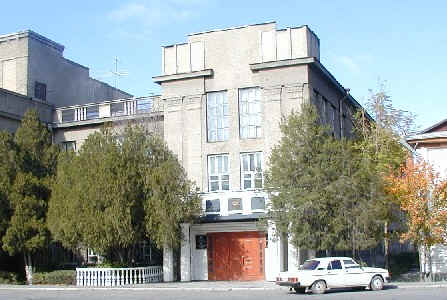
On August 21 of this year, the Kyrgyz Government under president Askar
Akaev issued a decree that gives the entire building situated at Abdumomunova
205 to the American Univeristy in Kyrgyzstan free of charge.
That means that the part of building that is currently occupied by the
Chui administration legally belongs to AUK.
However, nobody knows when we will be able to move there.
This depends on when the Chui administration will repair the building,
which it will occupy. Their building was recently vacated by the Alamedin Rayon
administration. Since the Chui
administration has not yet received funds to make the repairs, everyone has to
wait.
 Boris
Borisovich, director of the Physical Plant Department, thinks that someday in
December AUK will get at least a part of the building.
His suggestion is to partially repair the other part of the building and
to start having classes there next semester.
Boris Borisovich believes that it is better to leave full renovation for
the summer and not to waste time in the winter.
Boris
Borisovich, director of the Physical Plant Department, thinks that someday in
December AUK will get at least a part of the building.
His suggestion is to partially repair the other part of the building and
to start having classes there next semester.
Boris Borisovich believes that it is better to leave full renovation for
the summer and not to waste time in the winter.
Although the university administration has some plans concerning the
changes connected with the addition of the building, those are not final because
the administration does not know the precise condition of the 'other new' part
of the building and how much funds AUK will receive for its reconstruction. However, one of the objectives is to turn the entire first
floor of the old building into the library, and the second floor into computer
laboratories. Clubs do not have to
worry about CH II, because it will stay their CH II.
Since the computer network is already connected between the two buildings
of AUK and it is difficult to enlarge the network, it is expected to move
departments from the second building to the first building and to have lecture
halls primarily in the new building. AUK
administration has not forgotten the 'cafeteria problems' and promises to do
everything possible to solve them when we get more space.
AUK administration will be glad to receive any help from those students who want to 'build AUK with their own hands!' It will announce paid jobs if there will be need for such. Talking about AUK buildings, Boris Borisovich asks students to respect university property wherever it is, for the simple reason that it is 'our home.'
By Balybina Yulia
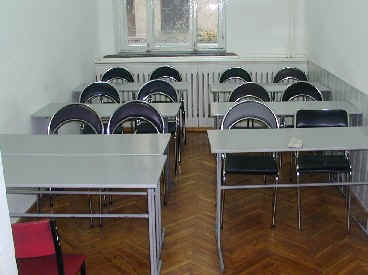
Due to tragic events of September 11th in USA, several of the foreign professors of AUK had to leave the country, the courses they taught, and their students. The solution to this problem was to either substitute foreign instructors with local professors or keep on teaching courses on-line. For those students who will have web courses, there is the possibility that they will need more time on AUK�s computers, making the labs even more crowded and confusing. The possible options for them in distant learning are to get the assignment from the professor via e-mail and then to send it back or to meet with the professor on-line on a week for getting lectures and tasks. The second variant is allied with difficulties.
 This
potential problem was addressed to Computer department and to the Director for
International Relations Biarslanov
Nikolay Borisovich. According to the computer department, there are some
problems with the operation of web-classes. First of all there is not enough
time in the labs for doing this. The only time available is after 19:00, which
is inconvenient for most of the students and professors. �It was an
extraordinary situation and after consultations with leaving professors and
Heads of the effected Departments, AUK Administration decided to try this
experiment in distance learning in order not to cancel classes. The Computer
Department is not ready for such an increase in the user load. But they are
trying to do their best�, said Mr. Biarslanov.
There is also a problem with the lab assistants. At the
moment the Computer department has two shifts of lab assistants and they are
fully occupied, so it is possible, that there will not be enough people to
manage the computers during web-classes. That is why, the computer department
asked to be informed about the possible web-classes beforehand. This is mostly
addressed to heads of all AUK departments, �which must provide the list of
professors, who will have their courses on-line�, said Nikolay Borisovich.
This
potential problem was addressed to Computer department and to the Director for
International Relations Biarslanov
Nikolay Borisovich. According to the computer department, there are some
problems with the operation of web-classes. First of all there is not enough
time in the labs for doing this. The only time available is after 19:00, which
is inconvenient for most of the students and professors. �It was an
extraordinary situation and after consultations with leaving professors and
Heads of the effected Departments, AUK Administration decided to try this
experiment in distance learning in order not to cancel classes. The Computer
Department is not ready for such an increase in the user load. But they are
trying to do their best�, said Mr. Biarslanov.
There is also a problem with the lab assistants. At the
moment the Computer department has two shifts of lab assistants and they are
fully occupied, so it is possible, that there will not be enough people to
manage the computers during web-classes. That is why, the computer department
asked to be informed about the possible web-classes beforehand. This is mostly
addressed to heads of all AUK departments, �which must provide the list of
professors, who will have their courses on-line�, said Nikolay Borisovich.
Most of the students are also worrying about the time limit system, especially at the end of the semester with deadlines for research papers and all the paper work required for final exams. Obviously one and a half hours will not be enough for students to deal with online exams, lectures, and correspondence with professors, plus on-line assignments. �On our mid-term exam,� said Tatiana Pesina, MM199 �which was on-line, the time limit system was taken away, but instead all the computers were constantly hanging up.� According to Computer department, they can change this policy, if the Student Government will have its decision on it. So, if you, students of AUK, feel that this is the problem that needs an immediate decision, address it to Student Government.
Meeting the needs of students in on-line communication was made the AUK chat. It would make easier communication process with the professors abroad, just make an appointment and go for chat.auk.kg.
As Nikolay Borisovich said, � In the most difficult times, is extremely important to be together and solve the problems together. That is how we managed to stand on after the disaster of September 11
th.�By ahoura afshar and Fatima Gayazova
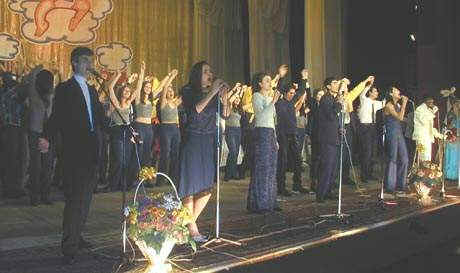
The Initiation is going to take place in the Opera Ballet Theater on 14 November at 3:00 p.m. All the freshmen and their parents are invited. So is the entire faculty. There are only 200 other invitations for other students because the space is very limited. On that date the classes last only for 50 minutes so that no one misses classes. Nevertheless there will be journalists who will tape the events and make a lasting remembrance of it.
|
Initiation 2000 |
|
|
On 12 November 1997, the Kyrgyz American Faculty officially became American University in Kyrgyzstan. Since then the Initiation is s0cheduled on that date. In Initiation the freshmen are officially welcomed to the university. The Initiation consists of two parts: the official part and the concert. In the official part a lot of important authorities will deliver their welcome speeches and wishes to AUK freshmen. Among them are John O�Keefe, Kamila Sharshekeeva, head of Soros, the representative of the Board of Trustees, and David Huwiler. Also the result of Student Senate election will be announced in the official part and Student ID will be given to first year students. The Initiation ceremony will last one hours. Plus there will be extra time for reception and communication. There will be a special place for photographers during the reception.
After the official part the concert starts and will last for one hour too. The preparation for the Initiation has been going on for almost a month. According to Nikolai Grigorivish, the main organizer of the Initiation, the second half of the program is a talent show, with students performing many songs, dances and skits (musical). Students were called to do so by announcements in late September. Unlike last years, there were less initiative ideas from the part of students. The second part will start with scenario about a freshman that came to AUK having only a suitcase and a pillow� From this scene the main story starts.
Expectations of freshmen basically divide them into two groups. On one hand, some freshmen want to get to know other first year students and make friends with them. But on the other hand, others do not expect too much from the Initiation. �I think there won�t be anything interesting. As usual! But a good reason to go to a disco.�
By Sasha Shpakova
It has been four years since AUK became an independent institution. At first there was not very much which both teachers and students were satisfied, especially, the tricky situation of being an American University with a post-soviet curriculum. However time passed and AUKers have noticed great changes since the last semester and during the beginning of this academic year. These changes are both positive and negative. The main reforms are, the Credit Hours System, Lunch Tickets, the Academic Senate, and the Time Limit System for using the computers.
The first change that occurred was the Time Limit System for using the computers. The lack of computer access in AUK started long ago. In 1999 there were only 11 computers available for 700 students. During the last year we have seen the tremendous change in both computer policy and usage. Right now each student of AUK gets an equal opportunity to use the computers in the lab, because everyone has limited time. The restrictions on usage were proposed last year by the students, due to rampant dishonesty in the signup system and the �chat virus.� Students would be using computers for their entertainment while others needed them to write papers. However, �We still have the problem of space�, says president Huwiler, and indeed it is true. AUK does not have enough space to place more computers to satisfy student�s needs. Next year, when AUK will have a bigger building, the administration plans to turn the whole second floor of the old building into computer labs. It is just a matter time and funding.
Another change that AUK experienced last semester was the transformation of an old curriculum and point grading system into Credit Hours. The AUK teaching faculty did a humongous amount of work during spring, transferring credits, changing curriculums, and developing a new elective system. The main reason why the AUK administration and Department Heads made this crucial change, is that our University is a perspective place for people to study and a chance to continue with Masters abroad. Another thing is that the Credit Hours system pushed us far away from the soviet type of learning. College education is voluntary and students have to put as much effort into it, as much they want to learn. New system makes you practically independent from the class and responsible for your studies. However there was unsatisfactory element for students during the switching period- an increased number of required General Education courses. As AUK president said: � Students, have to be not just professionals in their major, but also have to be well educated�. During the interview, Dr. Huwiler said that education comes in stages and studying in college is basically a self-learning and developing stage.
As AUK student take an independent approach to their studies, another collaboration of the student and administration body can help to find the way out of confusion. Probably all of you noticed two weeks ago an election campaign for Academic Senate. Those were the first elections into Senate, because before it existed only in the University�s Charter. What is Academic Senate dealing with? The main and primarily obligations of this body are Curriculum changes and academic police decisions. This year Academic senate has two student representatives and this fact in some way builds a letter for students to claim up an administrational changes. Academic Senate is a valuable body for an Institution like AUK. It is at some point our Council of Europe, where students can resolve different problems within the area of Senate�s influence.
And the last thing, which I would like to discuss in this article, is a touchstone of the first semester, 2001 �Lunch Tickets. The problem of lines in cafeteria occurred every year, it was merely impossible to eat after 12:30, not spending from 20 to 30 minutes in lines. The major reason of this problem is space shortage in AUK and increasing number of students. Lunch tickets are an experiment, and so far it was one of the most debatable issues in AUK. At first students were very against it, and had a lot of complaints. However their plea was heard and immediate changes took place. Right now it is actually possible to buy a ticket each day for any other day those are not dated. �But the problem is� says Ieva Sture, � there is no much to choose from and some times, the dish I want to get is already gone�. With the opening of the FATBOYS, this year, Auk tends to create a competition and give students more choice. However students complain about high prices, but it is reasonable to say, that FATBOYS is a profit organization, whether AUK�s cafeteria is heavily subsidies but the Budget.
So the main problem of AUK seems to be space shortage and we keep waiting for the new building. But even now changes take place and it is a pretty good fact to see and know that we grow and develop.
So the main problem of AUK seems to be space shortage and we keep waiting for the new building. But even now changes take place and it is a pretty good fact to see and know that we grow and develop. So the main problem of AUK seems to be space shortage and we keep waiting for the new building. But even now changes take place and it is a pretty good fact to see and know that we grow and develop.By ahoura afshar
It started in 1997, when the first Spirit Week in AUK was initiated. I was in prep year then and found it fun to see many people dressing in a unique and sometimes unusual way. According to Victoria Lavrova, it is meant to �support the spirit of AUK students' and help them 'interact closer�support'
One
week before the Spirit Week Victoria sent an email to all AUK students, telling
them about the Spirit Week and asking them to come up to her and deliver their
ideas for making it more interesting and fun.
No one did. Later during the
Spirit Week students complained about the assigned days and wanted to change
them. Why did they not do it in
advance when they were encouraged to do so?
During the Spirit Week a few students followed the
instructions and dressed accordingly. It
was apparent from the beginning that many students do not wear what was
expected. Victoria commented: "The idea is great but somehow not all the students support this."
There were only about 20 students who dressed as assigned.
AUK has around 950 students. That
makes about 2 % of the students. Many objected that they did not have the right
attire to follow the week.
Some said that cross-dressing day was embarrassing
for them and that was why they did not dress that way.
But that day was the most popular with the largest number of
participants. Contrary to common complaints, many borrowed the clothes they
needed. Of course there were very
few people who had the clothes to follow the suggested dress code for the entire
week. I would like to thank all
those who took part in the Spirit Week.
By ahoura afshar
Did you count the number of those who participated in the Spirit week? Not too many of them were around. The longer students stay here, the more 'academic' Academic’ Did you count the number of those
 If
you have been in AUK long enough, you start to see patterns in students' attitudes toward studies, university and life in general. The first year
students are learning how to be a student. There is a lot of noise, headache,
and fun. The second year they have already learned how to work within the system
and get around AUK rules fine, they have made good friends, and they are active.
By the third year they are already thinking about their life after graduation,
full time jobs... In the forth year they have become Academic, serious and
Mature. But they do not look like interesting people any more. They want to get
out of AUK and study further. They don't interact much any more. They behave
too much like adults. They don't laugh all that often, don't make fun all
the time, don't go to parties...
If
you have been in AUK long enough, you start to see patterns in students' attitudes toward studies, university and life in general. The first year
students are learning how to be a student. There is a lot of noise, headache,
and fun. The second year they have already learned how to work within the system
and get around AUK rules fine, they have made good friends, and they are active.
By the third year they are already thinking about their life after graduation,
full time jobs... In the forth year they have become Academic, serious and
Mature. But they do not look like interesting people any more. They want to get
out of AUK and study further. They don't interact much any more. They behave
too much like adults. They don't laugh all that often, don't make fun all
the time, don't go to parties...
Hey, we've gone too far! We are still young. If wee don't enjoy life now, when will we? Just pay attention to what we always tell our friends: "Hi, I'm sorry I have a class" "Hey, I'm very busy now" "Can we talk later?" The more you stay in AUK the more often you say and hear such statements. Once we open our eyes and find a PhD diploma on the wall, good salaries coming every month, a success... But we'll never get our youth back. We won't forget that we spent all the nights reading.
But will we ever realize how our spirit was stolen and our hyperness taken away? Will we ever find ourselves stiff in the wall: 'Another brick in the wall'�Another
By Sasha Shpakova
On the evening of October 31, AUK held its traditional Halloween celebration. Not a lot of great adjectives can be used to describe the event. First of all it lacked preparation and participation. AUKers tend to be passive and not participate in contests. Traditional celebration of Halloween always had been a freshmen initiative. Student Government made an attempted to organize this holyday, but it turned out to be a solo of Marat Usupov. Maybe it is a heavy preparation to Initiation ceremony, which didn�t let freshmen to spend more time and prepare big show for Halloween, or it is a lack of enthusiasm and spirit. Another important thing was that some students did not follow the basic university rules, coming inside with the cigarettes. The stripping contest turned out to be very �weird�, but one thing that it proved, is that we have some very open minded and sexually free people. Anyways, newspaper says special thanks to Lavrova Vika and Student Government for organizing the Hollidayween.
By Botagoz Kassymbekova
Thousands
and thousands of questions, lots of attention, compliments and just smiles I got
to receive this year from almost all AUKers. What is my secret? I
am pregnant!
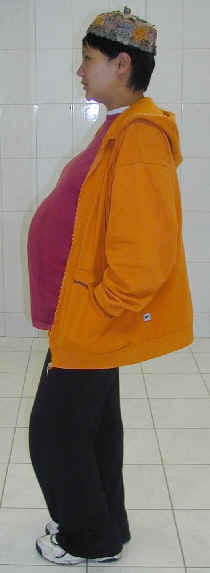 For
the past 9 months I have got to realize that whether a pregnancy is a pleasant
experience or not, often depends on how people surrounding a pregnant woman
treat her. This year, there are
quite few of us, pregnant AUKers. How
our kids will like us, our world, no one really knows; but I can say a little
bit of a new world each of us found for ourselves while being pregnant.
First
reactions are not
always like in Hollywood movies, especially when you are 19.
For my partner and me it was a mixture of feelings.
But for the doctor from whom I found out about my pregnancy it was a
simple question: 'will you make an abortion or not?
Decide whether you want a kid or not, come to me in two days and we will
see.' It was similar to the
question one hears at the bazaar when choosing apples: green or red.
In AUK almost everyone is really nice and caring.
For
the past 9 months I have got to realize that whether a pregnancy is a pleasant
experience or not, often depends on how people surrounding a pregnant woman
treat her. This year, there are
quite few of us, pregnant AUKers. How
our kids will like us, our world, no one really knows; but I can say a little
bit of a new world each of us found for ourselves while being pregnant.
First
reactions are not
always like in Hollywood movies, especially when you are 19.
For my partner and me it was a mixture of feelings.
But for the doctor from whom I found out about my pregnancy it was a
simple question: 'will you make an abortion or not?
Decide whether you want a kid or not, come to me in two days and we will
see.' It was similar to the
question one hears at the bazaar when choosing apples: green or red.
In AUK almost everyone is really nice and caring.
Bermet
Tursunkulova (CEP Lecturer): 'My partner and I were glad, but pregnancy was not
a surprise, since we planned it. In AUK I just saw surprised looks.' Irina
Dotsenko (ICP sophomore): 'At first I was confused. My partner was silent. My
parents were surprised and then very glad.
In AUK I did not notice any bad reaction, just surprised looks.
Some doctors when find out that I am a student, just admired me.' Gulnaz
(LAW senior): 'I was glad. My
partner's reaction was: 'Cool!'. Boys
and professors at AUK became especially nice, this was surprising.
Boy
or a Girl? is
probably the most popular question I have been asked.
At the beginning I wanted a girl, but now I want a boy.
For my boyfriend it does not really matter whom will we have.
I remember how he was shocked when doctors congratulated him after ultra
sound saying that he will have a boy and not a girl.
He did not like gendered bias towards boys.
Bermet:
'I asked not to tell me the sex. Most
of my friends want to have girls.' Irina: 'My husband says that we need
only a boy. He does not refuse from
a girl, but wants a boy very much. My
mother wants a girl. I do not know
whether I will check the sex or not.' Gulnaz: 'Ultra sound said it will be
a boy. My husband wants a boy; I
think that is why I also want a boy. Although
it is more important whether baby is healthy or not, rather than his/her sex.'
| Funny Story
Bermet: 'My husband
and I were going somewhere by car, when a policeman stopped us.
When policeman came up to my door, I suddenly opened it and puked
on his shoes. He thought that
I was drunk. It took us quite
a while to explain that I was pregnant, since I did not have a belly yet.'
|
First
Kicks Irina:
When s/he made his/her first moves inside me, I started laughing.It was
like a fish swam in my belly!
|
Internal
Change of a
pregnant woman is not only physical but also emotional.
My friends say that I became calm.
After talking to me some of them even wanted to sleep!
Pregnancy got acquainted me with myself from a different angle. Difficult situations with my parents, scary stories of my
doctors plus strange comments of some 'friends' made me really robust.
Now I can deal with all of this with a smile.
Bermet:
'Probably I became picky, more sensitive and emotional.
I want to add that husbands change as well.' Irina: 'I became more
tolerant towards different situations and people's decisions, for example
towards abortions. I think that
pregnant women become mature very fast. I became more responsible.' Gulnaz: 'I
became more responsible in a sense that I do not do some things because of
someone else inside me. I value my
mother more now. I judge people's
actions differently, I look if I want my baby do what they do or not.
I constantly think about my baby.'
| The author of this article gave birth to her son Monday night, 29th October. The Star staff would like to congratulate Bota and Kai with their new baby: David Daniar. |
By Ieva Sture
Tolerance, mutual understanding between nations and open society � claim for these ideas are so common in modern world, and the terms appear even more often after the striking 11th September attacks.
No doubt, that if there exists at least something akin to these ideals in real life, then I should find it in the most appropriate form at the universities in the former USSR region (like AUK, American University in Kyrgyzstan or ViA, Vidzeme University College, Latvia). Where both the West and the East best teaching practices are combined, where great number of students have been studying abroad (means � they should have become more opened to diversity of ideas) and where they meet each other in conferences at least once in a year to discuss problems of developing democracies. Due to these privileges students, the products of these educational institutions, feel like the future experts of mutual understanding and critiques of current situation, when term �tolerance� is often ignored. Unfortunately the same students these ideas often violate a lot.
Once discussing political issues with my friend, student of AUK we touched also the relationships between Latvian and Russian speaking people in Latvia. I decided to make a joke and told him that as a sign of difference Russians have to burn a star on their shoulders, they are not allowed to use the public transport and Latvians tend to look at Russians as the lower class people. I would have gone even further if I could keep my face serious, but I burst out laughing and then immediately stopped when realized that he had believed me! He explained me later that because of the negative information coming from the Russian news channels he thought it could be possible. No wonder to me later, when I told this �joke� several other students of AUK, and they all believed me. I am also pretty sure that my friends at ViA would have believed me as well if I told them that there is only one computer at AUK, located at the president�s office and available to me only because I am an international student. Moreover, I am living in a yurta, and ride a horse on my way from the living place to the university and then have it for lunch as horses is the most common food here (some of my friends even now ask me how things are going in Kazakhstan, as there is no great difference for them between states of Central Asia).
Most of us could bring more and more examples of what kind of stereotypes or lack of knowledge people from other countries have had about our countries and this is the reality the small countries have to face with. This is understandable that people have no knowledge about things they are not particularly interested in and therefore an average student of Kyrgyzstan or Latvia probably will never know what is the major business company or the political system of the other country. But the examples provided are the most extreme and also most offensive for the involved people. I as a Latvian don�t want to be treated as a bloodthirsty Nazis and think, actually, how impossible it would to implement such like traditions in the 21st century Europe. AUK student feels even more offended if someone thinks about his/her nation, as nomads not changed much from the previous centuries (in fact, AUK is better equipped with the computers and other studying facilities that ViA has ever been).
The thing is that we, fluent English language speaking students, bright in knowing the details of the USA history or EU law, believe in the most unbelievable things about each other, although we used once to belong to one common society. What kind of judgments then we are ready to make about countries that is more far away or are hostile and unfriendly disposed against us? Too often we think that we have the full rights to criticize others for not being tolerant and ignoring the ideas of others. Doesn�t the above-mentioned examples actually show our complete ignorance to any other values than ones coming from the West? Then the unproved expectations of the bright future of our open society do not sound so promising any more.
P.S. this article is going to be published both in �The Star� (AUK newspaper) and �Viadukts� (ViA newspaper).Kyrgyz Police's Attacks on Afghan Refugees
By Botagoz Kassymbekova
How the
political minorities live in a society can tell us a lot about that society.
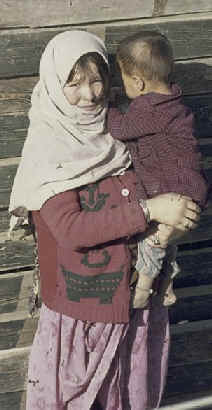
This article looks at our society through the lives of Afghan refugees
who came to Kyrgyzstan during the 90's for various reasons, but mostly because
of wars, starvation, lack of political freedom.
What did this minority find in our country, what is their everyday life
like here, in Kyrgyzstan, in 'our common home?'
There
are about 1,500 Afghan refugees in Kyrgyzstan.
According o the Kyrgyz Committee on Refugees, none came because of the
recent war with the U.S., which means that most have lived here for years.
The following information is based on interview with 9 male refugees,
conducted in the NGO 'The Fund to Support Refugees.'
All of them came from Kabul, where some of them worked as doctors,
military officers, pilots, one was an official in the Ministry of Foreign
Affairs and one just finished high school.
Most of them still have close relatives in Afghanistan.
Here they work at the local bazaars as sellers, two receive money from
brothers who could get to Europe also as refugees, and one works as a teacher.
Militiamen
are the main source of their suffering in Kyrgyzstan.
For the past 20 days the police checked all of them 10-15 times a day.
'They know us, our home addresses and often come to our houses at 5:30 in
the morning to check our documents; they know that at that time men go to work
at the bazaars," said Said, one of the refugees.
'They ask documents in Russian and swear at us in Kyrgyz,' adds Oshan.
Those who know Russian, according to others, at least can verbally defend
themselves, those who do not suffer a lot. Nevertheless, some militiamen do not
know the intent and difference of various documents that their administration
issues. 'These militiamen take our
documents, crumple them and throw our only registrations down, saying that those
are not enough,' continues Alisher, who arrived in Kyrgyzstan in 2000.
This is when there is no difference whether one has documents or not,
speaks Russian or does not.
According
to Article 31 of the International Convention on the Status of Refugees, which
Kyrgyzstan has signed in 1996, the country 'shall not impose penalties on
refugees who enter or are present in their territory without authorization
(registration), provided they present themselves without delay to the
authorities and show good cause for their illegal entry or presence'.
But� On 26 September, as RFE/RL reports, security officials arrested
Afghan refugees all of whom had registration or applied for such, searching and
interrogating them, which is an act of human rights violation. Moreover, for the past few months it became very difficult
for refugees and Afghan citizens to get any kind of registration from the
government. 'I have been in
Kyrgyzstan since 1994. I always got
multiple entry visas to live here. For the past 4 months, however, I cannot get
any document except some 'spravka' that confirms that I actually exist,' said
Said.
 Alas,
no law was issued in Kyrgyzstan to protect refugee's rights.
The only document that the country has is so-called Temporary Measure.
According to the coordinator of the Bishkek Bureau on Human Rights and
Rule of Law, Zulfia Marat, there are three disturbing features in the document
(TCA Vol.3 #42). First is that
refugees in Kyrgyzstan cannot automatically register their application; secondly
the government has no duty to legally assist refugees and the latter mostly do
not speak the language and are extremely poor.
Finally, any refugee can be expelled from the country if discovered to be
a threat to 'national security', which, according to Marat, explicitly expresses
distrustful attitude towards any refugees.
Whether the new law will be issued to deal with the issue is a difficult
question, knowing that Kyrgyz government obtains no funds to support refugees.
It is only left to hope that the government will not use time of crisis
to try to interrogate or even get rid off those who lived here for already
several years.
Alas,
no law was issued in Kyrgyzstan to protect refugee's rights.
The only document that the country has is so-called Temporary Measure.
According to the coordinator of the Bishkek Bureau on Human Rights and
Rule of Law, Zulfia Marat, there are three disturbing features in the document
(TCA Vol.3 #42). First is that
refugees in Kyrgyzstan cannot automatically register their application; secondly
the government has no duty to legally assist refugees and the latter mostly do
not speak the language and are extremely poor.
Finally, any refugee can be expelled from the country if discovered to be
a threat to 'national security', which, according to Marat, explicitly expresses
distrustful attitude towards any refugees.
Whether the new law will be issued to deal with the issue is a difficult
question, knowing that Kyrgyz government obtains no funds to support refugees.
It is only left to hope that the government will not use time of crisis
to try to interrogate or even get rid off those who lived here for already
several years.
Common
people in Kyrgyzstan, on the other hand, are tolerant towards refugees.
'There are only few who look at us as masters do at slaves.
For them, the word 'refugee' became synonym to the word 'beggar,' said
Habib, another Afghan refugee who fled Afghanistan in 1996.
'People in the streets do not tell us to get out, no, and we thank them
for that. Common people here are poor themselves, they do not have jobs
and we ask nothing from them except treatment as human beings,' continued Zulmai
Ibragimhel.
'Some
people from the streets and security officials when hear that we are from
Afghanistan immeditately ask us to what ethnic group do belong to: Pashtun or
Tajik. They think if some of us are Pashtun, those are
Talibs/killers; if others are Tajik those are the Northern Alliance and
therefore good guys. Here, in the
foreign country we do not affiliate ourselves as Pashtun or Tajik, were we are
all Afghans with all the same problems. We
do not like when people try to split us with their questions,' said Habib.
To label some essential features to an ethnic group is a dangerous thing to do, for it can lead to ethnic tensions, unfair treatment and xenophobia. Observing the attitude of police towards people coming from Afghanistan and constant mass media broadcasting of them being arrested for obtaining no documents, hopefully will not essentialize people from Afghanistan as criminals and beggars among the population and favourite formula of 'divide and rule' will not work.
The war
in Afghanistan is a test for a whole world to take.
It is a very important period of time for Kyrgyzstan and the whole
Central Asia. In the media it is
often referred to refugees � people fleeing death - as to the 'expected
threat' or 'destabilizing factor' for the region.
The question arises then of whether the real threat is but our tendency
to label people and put them into the categories?
While some try to take out attention to the 'expected threats', we tend
to forget how often we look for a refuge from the state (propiskas, taxes,
etc.), poverty and ethnic tensions. Will
we ever be considered as an 'expected threat' or 'destabilizing factor?'
We all have dreams, so do the Afghan people. 'Our concern is that our children do not know their native language, traditions, culture,' complained refugees. All men said that they want peace in their country, for nothing is better for them than their homeland. Here is one of refugee's dream, who worked till 1992 in the Ministry of Foreign Affairs in Afghanistan: 'Our dreams we want to realize in our homeland. Here we just do not have such opportunities. I want to become a diplomat in the Ministry of Foreign Affairs so that to conduct close relations between Afghanistan and neighbouring countries. I have a dream that people who humiliated us here would come to our country and we would welcome them with our open hearts so that they knew what it is like to be in foreign state.'
Valia Talks about AUK from Mongolia
By Ilgiz Kambarov
The tragic events of September 11th made a significant and sizable impact on most of nations around the Earth and will go on doing so. AUK was affected as well when event forced a number of CEP lectures to leave. One of CEP lecturers is Valia Papoutsaki- co-chair of Journalism department. She was at AUK for about a year and served as the Star�s advisor. She agreed tell the Star about her experience in AUK and what she thinks about us and our university.
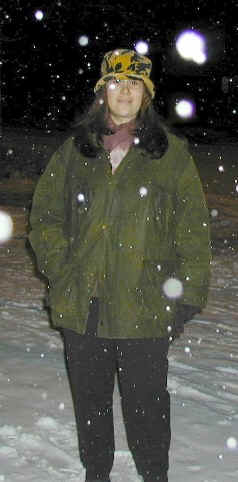 Ilgyz: You worked about a year with AUK students. What would you like to tell about your experience here?
Valia: AUK is a special institution and I was so lucky to work with some of the most brilliant students I have ever had and probably will ever have. It was a very intensive experience, full of great but also very stressful moments as I was trying to get used to an new culture and system. But AUK is a big family and makes you feel part of it very quickly.
Ilgyz: What is your brightest experience in AUK?
Valia: What I appreciated most was my special relationship with my students who made the whole experience worthwhile and my stay in Kyrgyzstan a wonderful one, a memory to keep close to my heart forever.
Ilgyz: What you will miss about AUK and KGZ most of all?
Valia: My students! I have a picture of them stuck on my fridge to remind me that those are my children (sorry for the cold place i put you guys but this is mongolia, the fridge door is probably one of the warmest places in this country!) I left in October when Bishkek was at its most beautiful colours. I have kept this image in my mind. I will miss the easy going atmosphere of the town and the wonderful bazars.
Ilgyz: How do you think your work with students was?
Valia: The most rewarding experience in my life! There were times I felt so proud of them, especially as I was seeing them opening their wings to professional paths, carrying a confidence I wish I had when I was of their age.
Ilgyz: Is there anything you learned form AUK and Kyrgyzstan?
Valia: A whole new world! It has been an adventure. Working with people from so many other cultures teaches you to be more tolerant and flexible and it has been a privilege to have the opportunity to meet and work with all these extraordinary people.
Ilgyz: Your wishes to students and AUK.
Valia: You are all very special and I am sure that one day you will be doing wonderful things with the knowledge you got in AUK. You are very privileged to study in this university and I hope that when you finish your studies you will return this privilege by helping your countries and fellow countrymen for a better future. You carry an immense responsibility. Meanwhile, I hope to keep in touch with many of you and continue working as the advisor to the STAR (if I
do not freeze to death in UlaanBaatar when the Siberian winds arrive!)
CEP Regional Director Visits AUK
By John Atwood
Jeff Meyers, Regional Director for CEP, has been in Bishkek
for the past week. The purpose of his trip was to support CEP staff and fellows,
reinforce CEP�s commitment to AUK, and to gather information to present to
CEP�s Board of directors regarding their decision to withdraw foreign
lecturers from Kyrgyzstan.
As part of this trip Mr. Meyers met with teachers and
students at AUK on Friday, October 26th, to discuss the situation and
ask questions. He started by emphasizing CEP�s continuing commitment to
Central Asia, Kyrgyzstan, and AUK. �AUK is often cited as an example of a
successful institutional partnership,� he said. That having been said Mr.
Meyers proceeded to give a detailed explanation of how CEP made the decision to
withdraw foreign staff from Kyrgyzstan. Basically the Board of Directors made
their decision based on the voluntary evacuation orders and travel warnings
issued by the US and Canadian Embassies in Kyrgyzstan the week after the attacks
on the World Trade Center. At that time the threat that military action in the
region would create a dangerous situation for foreigners in Kyrgyzstan was very
real. �I was making plans to leave on my own,� said Barrie Hebb, a CEP
lecturer, who decided one week later to stay, is still teaching in the economics
department. Most of the Board�s members were either in Washington DC or New
York and were much closer to the attacks than were lecturers and administrators
in Central Asia and Budapest. In addition to security warnings, and their
proximity to the attacks the Board made its decision based on legal liability
that CEP could if foreign staff remained in Kyrgyzstan.
Despite its decision to get foreign CEP staff out of
Kyrgyzstan as soon as possible, CEP made every effort to give lectures as much
choice as possible. Lecturers were given the chance to either take another
position with CEP, go home, or to break their contract with CEP and sign a new
contract with AUK. The Open Society Institute, which funds both AUK and CEP,
worked with Dr. Huwiler, and CEP to make funds available to support lecturers
who wished to remain at AUK. Although the lecturers who stayed had to break
their contracts with CEP, Mr. Meyers emphasized that, �this will in no way
affect their future relationship with CEP.� Should CEP return foreign lectures
to Kyrgyzstan these lecturers will be able to sign new contracts with CEP.
Several weeks have passed since the initiation of military
action against Afghanistan and there been no incidents reported involving
foreigners in Kyrgyzstan. �The initial period of uncertainty has ended,�
said Mr. Meyers. The board is now ready to reconsider its decision and sent Jeff
Meyers to gather information on the situation in Kyrgyzstan. Mr. Meyers has been
gathering information on what similar organizations, like ACCELS, IREX, and
others, have done. He met with officials at the US Embassy in an effort to
better understand the intent and basis of the voluntary evacuation and travel
warning. Mr. Meyers, who is also a lawyer, plans to do a thorough investigation
of any legal liability that CEP may face and make suggestions as to how it could
be reduced. One option that he favors is to have returning staff sign a waiver
of responsibility acknowledging that CEP does not have direct responsibility for
their safety in Kyrgyzstan. The Board did not have enough time to investigate
all legal options before making its decision.
Mr. Meyers plans to recommend that CEP return to Kyrgyzstan. He is optimistic that Board will look favorably on his recommendation. �The more time passes without incident the stronger our case is,� he said.
Announcements from Student Affairs Coordinator, Victoria Lavrova
|
|
|
Conference against Intolerance in Russia: Truth or Dare
By Anna Kirey
Amnesty International-
Kyrgyzstan has been here at AUK for ages as it seems. There is always something
going on and someone running around. This year is no different except for the
fact that we are immensely expanding. During this term break the word about our
organization reached the ears of 70 people - participants of a very special
conference - from around 22 countries.
 The
conference took place outside of the magnificent city of St. Petersburg in
Pushkin - a place where Russian tsars spent their summers and famous Russian
poet got his inspiration. It was devoted to solidarity between East and West in
the struggle against intolerance. We lived in a palace of Kochubei and often got
lost in the traps of the twisted ancient halls.
The most interesting thing about the conference as it seems to me now was
its diverse group of participants. At the very first day it was obvious that
issues brought up would come from very different backgrounds. 90% of the
participants considered themselves a part of minority. There were blacks from
Finland, Russia and Italy, Hungarians from Romania, Roma from Moldova and
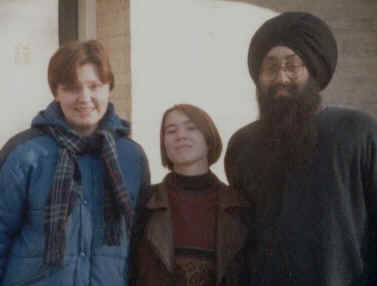
Romania, half Tatar- half Ukrainian from Latvia, Russian from Chechnya, singh
from Great Britain (yeah, that is him on the photo), refugees, migrants, gays
and lesbians and vegetarians.
The
conference took place outside of the magnificent city of St. Petersburg in
Pushkin - a place where Russian tsars spent their summers and famous Russian
poet got his inspiration. It was devoted to solidarity between East and West in
the struggle against intolerance. We lived in a palace of Kochubei and often got
lost in the traps of the twisted ancient halls.
The most interesting thing about the conference as it seems to me now was
its diverse group of participants. At the very first day it was obvious that
issues brought up would come from very different backgrounds. 90% of the
participants considered themselves a part of minority. There were blacks from
Finland, Russia and Italy, Hungarians from Romania, Roma from Moldova and
Romania, half Tatar- half Ukrainian from Latvia, Russian from Chechnya, singh
from Great Britain (yeah, that is him on the photo), refugees, migrants, gays
and lesbians and vegetarians.
My favorite activity there
was eating at the vegetarian table (3 out of 8 tables were set for vegetarians)
and listening to Sarabjit's jokes about hiring a militiaman in St. Petersburg or
asking us to take a picture with him to receive an award for knowing where Bin
Laden is. Sarabjit is a singh, his religion requires him to wear a turban and
have a beard. Since the September events, he often faces very awkward moments
especially on the planes. But he is indeed delighted to receive so much
attention, he is not afraid to talk to people about different lifestyles. After
the conference he was planning to stay in Russia and talk to neo-fascists.
Also vegetarian table was one
of heated discussions about vegetarians in former Soviet Union republics (there
were surprisingly a lot of those) and cooperation between East and West.
And there really were
differences. I understood that in my first work group with a discussion on
Islamophobia� this group was mostly focused on European scare of Muslims which
also derives from the dreadful 11th of September. A participant from
Holland shared her experience with trying to smoothen the scare. Their
organization published a poster of a Muslim girl with veil on her face that read in
3 languages (Dutch, Arabic and Turkish) "Just as you know that every
Christian is not a murder, every Muslim is not a terrorist." We came to a
conclusion that there should be more information about Islam and maybe even
excursions to mosques in Europe. In Ukraine there was a problem with Muslim
women not being able to receive passports because they had their hair covered
and according to state law that could not be a legitimate photo.
Another truth that I was
fascinated to hear was that in Holland (The Netherlands) drugs like marijuana
are sold in coffee-shops. And that in translation from one of the African
languages Kofi means "born on Friday" (guess on what day Kofi Annan
was born J). And also that using
violent methods against fascists is effective because the neo-nazi groups are
very similar to fanatics (in a sense that there is self-sacrifice, loyalty and
courage and, for example, imprisonment is taken as a way of serving the good
cause and giving up freedom for your principles).
I also dare to tell you the
snake story as an indicator of differences between East and West. On one of the
evenings the whole group went to Armenian restaurant. The owner, who felt that
the guests from such a variety of places were truly distinguished, asked for a
special performance that evening. There was an eastern magician showing
different tricks with a huge snake. People from the East applauded and
appreciated his mastery. But some of the Europeans were very offended. "We
care for the rights of humans but torture animals", said one of them. The
owner was asked to apologize publicly and was very upset. That reminded me last
year's initiation incident with Maksat coloring his face black in order to act
as Louis Armstrong. Americans were shocked while majority of the audience did
not notice.
What I liked about this
conference was also that it was action-oriented. We carefully planned activities
for various internationally recognized days - 9th of November -
International Day against Fascism and Anti-Semitism; a week im March against
racism; June 20th - Refugee Day. I presented the situation with
assembly in Bishkek and asked for advice. Europeans were quite surprised to hear
that we can only assemble in one little Gorky square and suggested to talk local
NGOs into having a festival of cultures on Nooruz in support of cultural
diversity (or anti-racism). As for November 9th - Amnesty is planning
a number of activities. A movie "Life is beautiful" revealing facts of
Nazi concentration camps will be shown in AUK cafeteria on that day. There will
also be a skit and discussion. All Amnesty members will be dressed in black and
wear triangles of different colors or Jewish yellow stars like in Nazi camps.
This is done show disapproval of "Kristallnacht" (night of broken glass) - terrible
Nazi pogrom with 30 000 Jews arrested, 7000 Jewish businesses attacked, 200
synagogues destroyed, 91 Jews killed in 24-hour period that happened on November
9th 1938. If
you want to join this campaign -dress in black, we will give you a triangle or a
star, a very special card and a sticker.
By Merdan Halilov, Boris Bityukov, Yulianna Khilazheva
One of the main pluses of being
situated in the capital, as Dr. Huwiler stressed when he introduced the
guest-speakers, is that it opens up the possibility of inviting prominent people
to the university. The ICP Discussion Series is a significant step forward in
establishing such a tradition. Mr. Om Prakash, the Indian Ambassador to
Kyrgyzstan, and Mr. John O�Keefe, the US Ambassador to Kyrgyzstan, gave the
first two discussions.
The Series, titled
�Discussions in International Politics,� features speakers with a wide range
of topics to present. Mr. Prakash spoke about historical and contemporary India,
and its extraordinary role in the international arena. For a person who was not
well acquainted with the political history of the world, the impression was that
if there were no India, the world would be a horrible place to live in. The US
Ambassador had to stick to one topic, the US-led anti-�terrorism� campaign
or war in Afghanistan. He did slip in a line that the students came to listen to
him in CH2 of AUK were there partly because the US government supports the
university, but this didn�t stop the students from controversial or critical
comments. The atmosphere was uneasy and Mr. O�Keefe mostly listened to
students rather than giving any new information or explanations to their
questions.
By Nuriya Kurmanalieva
In 1998 the US General Larry Sequest visited the International Relations department of Kyrgyz State National University. After crowded meetings and protracted conversations with IR students, he offered to play a game among students. During the meeting of the US General and IR students of KSNU, Mr. Sequest pointed out that he was the founder of �Peace Games� in Latin American countries. Then he offered the Dean of IR Dept. to play those famed �Peace Games�. The IR Department of KNSU has been gathering advanced students from Central Asian Countries ever since. The purpose of Peace Games lies in preventing all kinds of conflicts. There are three stages to this game. The first two are based on theoretical issues. Simply put, they determine the history, the cause, the course and the aftermath of conflicts. And the last stage is aimed at solving conflicts peacefully. Students are to devise real and workable projects of solving problems, and offer their own strategies of doing that. The conflict solutions should be based on the three main pillars: political, economical and social.
Since 1998 students have come together to exchange not only academic, but also practical experience. They come together to show that they are able to bring some sense into social and political life at home as well as abroad. All throughout the recent years students have much debated on the conflicts between Afganistan and the Chuy Valley, water resources of Central Asia, and geopolitics of Central Asian Countries. Obviously all of us are hopeful that the �Peace Games� may greatly enlarge the number of its participants by including students from other Asian countries as well as European ones. There is much likelihood that some day they will come to be known as The World Peace Games.
P. S. The IR Dept. of KNSU is said to have allegedly invited AUK students three times, but not a single representative dared to show up. The students of AUK could meet Kazakhstan American University.
|
|
Questions and Answers |
|
|
Miodrag Stojnic, Sociology |
Name and position |
Svetlana Kulikova, head of Journalism Program |
|
Libra (more or less, I was born on 23 October at 23:32) |
Horoscope sign |
Aquarius |
|
Caribbean |
Where do you want to be exiled? |
Nowhere-would not be able to last even 1 day without communication |
| About the girl I like most at AUK |
If you were a member of The Star what would you write? |
Student/teacher descipline at AUK |
| Pajamas day | If you could select a day for the Spirit week what would it be? | Spring Birds Day |
| I don�t want to scare you | What is the naughtiest thing you have ever done? | Make silly faces in public |
| Nice girls are welcome to check it out. | What is on your room�s walls? | Family pictures, grandpa�s awards |
| Birthday parties | Fall is a time for... | Getting ready for cold, but short winter |
| Dial 911 | If the world went upside down, I would... | I wish I was left-handed |
| Watching fights for food tickets | What is the most fun part of AUK? | Students |
| Waiting in the line for computer in the lab | What makes you angry? | People�s indifference |
| Kabul | What is the most romantic place for a date? | Beach at Lake Issyk-Kul at night |
| Putting the physiological apects of it aside, I would say it doesn�t matter till someone asks about it. | How important is age? | Not at all. Some 70-year-olds may be younger than some 20-year-olds |
| Rumours about me | What is the best thing about you? | Nothing that I have encountered as yet |
| All you can dream about! | Describe yourself in 5 words | Born by the best mother |
| James Mitchell�s Q: Why? Because I want it that way | Q previous issue | Oleg Valiev�s Q: Do you think AUK�s policy is based on democracy? Can�t say firmly, but would lean to �yes� rather than �no� |
| What is the leitmotiv of materialis used to construct your identity? | Your Q for the next interview | How is the credit-hour system working for you personally? |
Editor assistant: Anna Kirey
Layout and web manager: ahoura afshar
Photographers: ahoura afshar, Anna Kirey
Advisor: Evangelia Papoutsaki
Staff: Ieva Sture, Botagoz Kasymbekova, Fatima Gayazova
Contact: Room 105, 205 Abdumomunova str., Bishkek
Special Thanks: Natalia Andrianova, Victoria Lavrova