 The
Star
The
StarThe
Star
The Official Newspaper of the American University in Kyrgyzstan
December 2000 - Volume 3. Issue 4 (English part)
 Happy New Year... and New Millennium!!!
Dear Star readers! The Star staff would like to congratulate everybody in AUK with the incredible event coming up! We are all going to have the experience of living in two (!) centuries and millenniums in less than 3 weeks! Let’s realize that and make this New Year unforgettable so that we’ll be able to talk about it fifty years after and there will be something to tell. We all hope you have a wonderful holiday, get some rest (we desperately need it right now because of exams), and just rock Bishkek over the vacation. We are always with you. We hope next millennium you will be with us!
(santa picture is drown by Natalia Andrianova)
The British And American Studies Department
Trying to Be Two Things at Once
By John Atwood, preparatory year.
 Students of the British and
American Studies department are caught between two very different ideas of what
they should be studying.
Nurilla Dushebaevna, head of the department, claims that students are being
prepared for the Kyrgyz labor market. This means that students will become
masters of English and a second foreign language as well as having knowledge of
Great Britain and America. They will be able to work for international
organizations or as translators. Louis Petrich, Fulbright Scholar and co-chair
of the department thinks that students should be taught how to think. Students
would be treated as young scholars pursuing education for it’s own sake. He
envisions the British and American Studies program as a liberal arts program
like those found in Europe and America. Students of this program would be able
to find work wherever intelligent intellectual minds are needed. These two
visions of what the department should be are very different and cannot coexist
easily. As Mr. Pertrich put it “The department has two goals which are hard to
reconcile.”
Students of the British and
American Studies department are caught between two very different ideas of what
they should be studying.
Nurilla Dushebaevna, head of the department, claims that students are being
prepared for the Kyrgyz labor market. This means that students will become
masters of English and a second foreign language as well as having knowledge of
Great Britain and America. They will be able to work for international
organizations or as translators. Louis Petrich, Fulbright Scholar and co-chair
of the department thinks that students should be taught how to think. Students
would be treated as young scholars pursuing education for it’s own sake. He
envisions the British and American Studies program as a liberal arts program
like those found in Europe and America. Students of this program would be able
to find work wherever intelligent intellectual minds are needed. These two
visions of what the department should be are very different and cannot coexist
easily. As Mr. Pertrich put it “The department has two goals which are hard to
reconcile.”
In May of last year a proposal to split the British and American Studies department into an English department and a British and American Studies department was given to teachers of the department and the administration by Louis Petrich. Under the proposal the British and American studies department would give students a “training of the mind.” In their first two years students would study the history, literature, and geography of Britain and America. Juniors and seniors would study more specific aspects of Britain and America. These upper level courses would draw upon the students experience in literature and history. Upon graduating, a student will have the skills necessary to continue their research and learning on their own. Students will learn how to learn. Students will be able to participate in the discourses of the social sciences and humanities. Students will be able to express their ideas clearly using their writing and thinking skills. Secondarily students will posses knowledge about all aspects of Britain and America. In order to reach these goals students would be required to take courses in politics, sociology, journalism, and philosophy. The teachers of the British and American studies program would work with other departments to teach courses that would be attended by students of both British and American studies and other departments. The English language department that would be created as a result of the proposed split would offer degrees in linguistics. Graduates would be able to work as translators and teachers. The English department would continue to teach English to all students of the university in order to develop their skills. This could be expanded to provide English classes for people from other universities or occupations.
 Many people expressed concern over
the proposal. Nurilla Dushebaevna said that splitting the department now would
hardly make a difference since many of teachers would teach both British and
American studies and English. “Would
I belong to the English department or to the British and American studies
program?” she said. Teachers worry that a split would make it harder to get
outside funds for faculty development. They worry that many organizations fund
faculty research and development in American Studies but almost no organizations
provide money to language teachers. A split would also be hard to implement
because the resulting British and American studies department would have few
highly trained professors. In order to survive it would need to borrow faculty
from other departments.
Many people expressed concern over
the proposal. Nurilla Dushebaevna said that splitting the department now would
hardly make a difference since many of teachers would teach both British and
American studies and English. “Would
I belong to the English department or to the British and American studies
program?” she said. Teachers worry that a split would make it harder to get
outside funds for faculty development. They worry that many organizations fund
faculty research and development in American Studies but almost no organizations
provide money to language teachers. A split would also be hard to implement
because the resulting British and American studies department would have few
highly trained professors. In order to survive it would need to borrow faculty
from other departments.
Under the current system students do not have enough time to take all of the courses needed to get a good liberal arts education. More than half of a student’s time is spent taking language classes. Most of these language classes are a required second language.
Many students of the department try to avoid taking courses like Contemporary American Politics and Western Civilization. These are rigorous courses that are directly applicable to the liberal education of British and American Studies students. Many other departments offer courses that would be of interest to students of British and American studies students. However the effort to make use of these courses has been met with strong opposition from both students and teachers. Students try to get out of these courses, advisors fail to promote these courses, and teachers say that these courses are to specific for British and American Studies students. Instead of having students attend these courses the British and American Studies department tries to offer too many courses for which they do not have fully trained teachers. “We must draw on the resources of other departments. We do not have the resources to offer a full American Studies program on our own” said Louis Petrich. Sometimes these courses duplicate courses offered by other departments. For example British Politics and ICP’s Introduction to Comparative politics that focuses largely on British and American politics and political systems. Knowledge of languages is a wonderful thing. But is it reasonable to expect students to be liberal arts scholars and masters of four languages at the same time? These are just some of the many questions that the British and American studies department needs to answer before they can move into the future.
Initiation Is a Big Success
Dear readers, as we all know the initiation was a big success. Everyone enjoyed the very talented performances. It was a wonderful way of welcoming the freshman into the AUK family. One of our photographers, Anisa Afshar, took many pictures that we wanted to share with you. Since many of you already attended the initiation we thought it would be better to publish a photo essay of the initiation rather than writing a long article. After all, a picture is worth a thousand words!
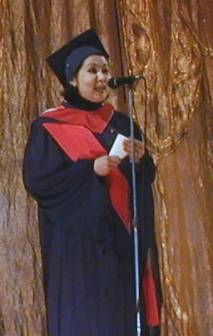


1) Kamilla Dushebaevna welcomes the Freshmen, 2)AUK's dancing chiken, 3) Fatimah and Sanjar singing "Something Stupid Like I Love You"
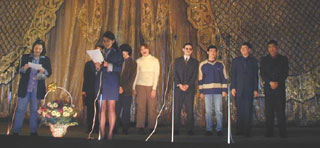
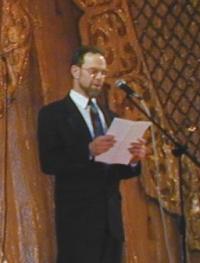
3) Deborah Eisenburg and Zarina Chekribayeva announce the new Student Governemnt, 4) US Ambassador hohn O'Keefe
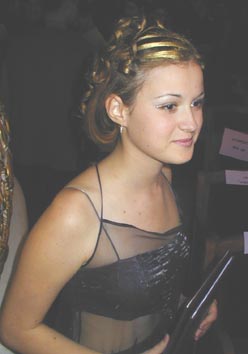
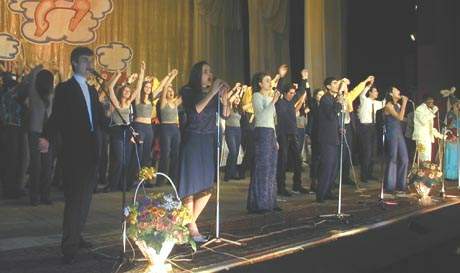
5) Announcer Yulia, 6) AUK's Anthem
By Anisa Afshar, International Relations, forth year
 Mr.
Wood left AUK for Yale University last November after being here for about four
years. He came here first in September 1997, along with Michel Gardaz as the
first CEP Fellows in Kyrgyzstan. If it were not for Michel maybe our dear Mr.
Wood would never have ended up in AUK: initially he was offered a position by
CEP to teach in Kazakhstan. But
when Michel decided to come to Kyrgyzstan the CEP country director was worried
about having Michel alone here, so the CEP offered Mr. Wood a position in AUK.
“I thought Bishkek was more interesting; it was little but farther out”,
said Mr. Wood. Like this the legend of Mr. Wood began in AUK.
Mr.
Wood left AUK for Yale University last November after being here for about four
years. He came here first in September 1997, along with Michel Gardaz as the
first CEP Fellows in Kyrgyzstan. If it were not for Michel maybe our dear Mr.
Wood would never have ended up in AUK: initially he was offered a position by
CEP to teach in Kazakhstan. But
when Michel decided to come to Kyrgyzstan the CEP country director was worried
about having Michel alone here, so the CEP offered Mr. Wood a position in AUK.
“I thought Bishkek was more interesting; it was little but farther out”,
said Mr. Wood. Like this the legend of Mr. Wood began in AUK.
Although most of us think of Mr. Wood as the initiator of the International Relations Program, he believes that the idea was not his. He commented: “Jeffery Olson was in fact the first chair of the IR department in AUK. When I became chair after him early in 1998, I extended the department, stabilized it, wrote policies, and made the department function’.
As most of you may know Mr. Wood has his own dialogue. We thought the best way to say goodbye is to have parts of our interview with him published so you can share with us enjoying the last interview with him for this year:
The Star: What was your first impression of the first class you taught in AUK?
Mr. Wood: My first class was IR-11. My impression was that they were very enthusiastic having no idea of what they were getting into. They behaved like high school students!
The Star: How has AUK changed during these years that you have been here?
Mr. Wood: AUK has changed beyond recognition. It has changed from being one-room outfit into a real university. It has changed from being nothing more than a faculty and became a real liberal arts college. But of course still there is a lot of work to be done.
The Star: How did AUK change your life?
Mr. Wood: Being involved in constructing AUK taught me a lot in my career. Regarding my personal life, as you know I married an AUK student!
The Star: What urgent steps you think should be taken in AUK?
Mr. Wood: Changes are always necessary. Urgent steps are needed to recruit more qualified local faculty, who will have an interest in making their careers at AUK. AUK needs local people interested in reform, innovation, who are interested to stay here and make a sustainable environment. While the Western teachers here are necessary, it is the local faculty who are ultimately going to shape this university in the long run.
The Star: What is your most funny memory of AUK?
Mr. Wood: When Mary Chekala had invited on behalf of Indian Club, the Indian Ambassador to come to AUK and give a speech on Indian-Kyrgyz relations. I changed all the announcements, including the one given to Dr. John Clark, then President of AUK, who was introducing the Ambassador. So when the Ambassador came, Dr. Clark announced that he was giving a speech on “India’s Role in Nuclear Non-Proliferation”! The Ambassador was shocked! Afterwards Dr. Clark was furious at me! Mary Chikila too, I assume!
The Star: What is your most boring memory of AUK?
Mr. Wood: Dealing with departments run by “Soviet” people who are not interested in reform and sabotage all that we do. The Registrar’s Office is a good example at times. Even the “3rd Floor” also has a few “Stalinists”. Many of the Westerners here at AUK, and in Bishkek generally, also like to behave in this way, - I’m not just targeting locals.
The Star: What is your plan for the future after leaving AUK?
Mr. Wood: I will be the CEP Director for University Relations in our US office located at Yale University in New Haven. I will recruit academics to go and teach at colleges in Former Soviet and East European countries for CEP.
The Star: Do you think you will come back to Kyrgyzstan in some point in future?
Mr. Wood: Definitely. I will come back because my wife’s family live here. Biyoorsa, I would also like to come back in three or four years as a Fulbrighter, teaching at AUK.
The Star: What would be your farewell to the AUK students?
Mr. Wood: I think lots AUK students’ problems have to do with uncertainness about their future, - not knowing what will happen to them after graduation from AUK. Well, you CAN predict your future. AUK gives you the best knowledge and training to shape your future. Go out and grab it! It is the squeaky wheel that gets the oil! Don’t be passive, don’t be Soviet! You’re the best!
AUK President Meets With ICP Students
By Anisa Afshar, International Relations, forth year.
On
Monday the 27th
of November at 5:50 pm all the ICP students were called for a meeting with the 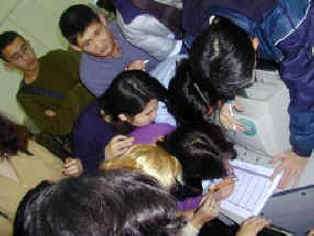 President
and the Provost.
When I got to the CH all the seats were full. President Huwiler was
standing in the front center of the hall, talking in the microphone. There were
three other microphones placed in the hall for the students to ask their
questions. President Huwiler told us about AUK’s plans for accreditation. It
will take one or two years before AUK is accredited but when it is it will
greatly benefit the university. Accreditation will make it easier for AUK
students to study. Currently when a student wants to transfer to another
university they always have to prove where AUK is, what it is, and is it a
qualified university. Accreditation will make AUK’s name known as a qualified
university with a standard credit system.
President
and the Provost.
When I got to the CH all the seats were full. President Huwiler was
standing in the front center of the hall, talking in the microphone. There were
three other microphones placed in the hall for the students to ask their
questions. President Huwiler told us about AUK’s plans for accreditation. It
will take one or two years before AUK is accredited but when it is it will
greatly benefit the university. Accreditation will make it easier for AUK
students to study. Currently when a student wants to transfer to another
university they always have to prove where AUK is, what it is, and is it a
qualified university. Accreditation will make AUK’s name known as a qualified
university with a standard credit system.
After this talk Dr. Huwiler asked students to express any problems that they have in school and to share their ideas with the administration. At first students were quiet and hesitated to ask any questions. But after Mirdan Halilov brought up the problem of computer labs every body got excited and jumped into the discussion. As we all know, the computer labs have always been a problem for AUK as long as AUK has been expanded. The hottest issues tackled were about using the lab 210 for computer classes, overcrowded computer labs, which are insufficient for students needs, and the inefficient sign up system. The corrupted sign up system made the biggest noise. Camilla Dushibaevna called up the computer department and in few seconds first the secretary and then Nancy joined our meeting.
“What solution do you have for the sign up procedure? There are lots of complains that students sign different names for many time slots and there is no monitoring from the lab assistants side,” asked Dr. Huwiler. Nancy explained to us that due to budget cuts the computer department has to employ lab assistants who are qualified enough to work as programmers at the same time. They have more duties than just sitting and watching every body and stopping them from cheating. Nancy said that the only possible solution she has for this problem is to limit every body’s time for using the computers. She is planning to use software, which would limit the computer usage time for every body. Each student will get a limited amount of time for computer usage in a week, and after he or she used up the time the computer will automatically sign him or her out! There were lots of complains by the students about this plan, but Nancy believes that it is the only possible way to be fair and stop students from cheating. Of course it is very shameful that students of American University, who claim to be open minded and understand the principles of democracy and a liberal society are so inclined to cheating that nothing but a strict authoritarian system can stop them from cheating each other.
Another big problem that was discussed was about the copy machine. As some of you might now, after ICP department was burnt down, one of the things that were melted was the ICP copy machine. Since that time ICP has been using the CEP copy machine in order to make photocopies of the readings for the students. The heavy load of the reading makes it impossible to make enough copies, so ICP students have to share their copies between two or three students. Camilla Dushibaevna suggested that ICP use typography instead of copying. The library has a budget to make typography. The only condition is that departments should give the material to be copied to the library before the beginning of the semester. Let’s hope these problems get solved.
The Initiation’s Unfortunate Mistake
By John Atwood, Preparation faculty.
 The
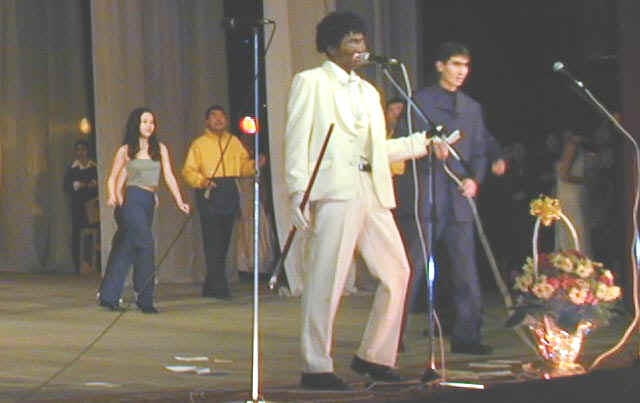
initiation was a big success except for one mistake. The song “Hello Dolly”
was performed by a student painted in “black face.” The way in
which his face was painted was an uncomplimentary characterization of a large
ethnic group. It promotes stereotypes of black people as simple minded and
silly. I want to make clear that no one is to blame for this. The people
involved were not aware of the significance of black face and its history as a
form of abuse in the United States. Also I understand that this type of
performance is rather common in the former Soviet Union. People even go so far
as to say that it is part of Kyrgyz culture.
The
initiation was a big success except for one mistake. The song “Hello Dolly”
was performed by a student painted in “black face.” The way in
which his face was painted was an uncomplimentary characterization of a large
ethnic group. It promotes stereotypes of black people as simple minded and
silly. I want to make clear that no one is to blame for this. The people
involved were not aware of the significance of black face and its history as a
form of abuse in the United States. Also I understand that this type of
performance is rather common in the former Soviet Union. People even go so far
as to say that it is part of Kyrgyz culture.
“Black face” entertainment was very popular in the United States during the during the 1800’s and the first half of the1900’s. It was definitely a strong part of our culture. Hello Dolly started as a Broadway musical. Bobby Darren, a white singer, made the song Hello Dolly popular. Later jazz great Louis Armstrong performed the song Hello Dolly for audiences in jazz clubs all over the country. In the 1960’s America became aware of how black face entertainment was an insulting, racially offensive, and hurtful portrayal of black people.
Many people referred to the performance as the “Black Clown Act.” These same people would then try and tell me that I was being insensitive to Kyrgyz culture because I was criticizing the black face act. I wonder how people would feel if I performed an Asian clown act. I would paint my face yellowish-brown, put on a white beard, wear a big kolpack, and play a khumis out of tune as I sang in a gravelly out of tune voice. Would that be offensive? People also say that the black face was acceptable because not very many Americans were at the initiation. The meaning of this statement can be described as “If they aren’t here let’s make fun of them.” By saying this you must acknowledge that the performance was offensive. It also belittles the Americans who were invited. They come, and are potentially offended. What kind of a welcome is that? What if the US Ambassador was an African-American?
In the future I hope that AUK and its students will have the good sense not to make unfair and stereotypical statements and performances of any kind. I hope that that is the last performance of its kind that takes place at AUK.
AUK TV PRODUCTION CLUB GOES ISSYK KUL
By Effim “Zima” Flippov, Mass Media, second year
You probably already heard of us. We are constantly running around with cameras and microphones, trying to film something interesting and useful. We are responsible for the first AUK horror/comedy AUK HALLOWEEN PROJECT. We were invited to film a Central Asian Debate Forum, which took place a few weeks ago in the Aurora resort on lake Issyk Kul.
Sounds fun, doesn’t it? Well, we thought so too… It is true Aurora is paradise. It is true that Issyk Kul is amazing, no matter if it is winter or summer outside. The participants were all amazing, open-minded, smart students. Thanks to the CEP, the cost of transportation, lodging and pretty much everything else was covered. So, why is my tone is oh so sarcastic? Because, the better reality seems for a journalist, the worse it will appear later.
For us (me and my cameraman Anton) it appeared at around 6 pm on the first day of shooting. We filmed LOTS of interviews and basically all the text that had to be said between the bits with interviews. When I accidentally decided to watch what we just film, my surprise went beyond the word ‘Oops!’ Apparently our microphone was broken. Meaning, 3 hours of tape had to be thrown out of the window.
Then, the problem escalated. We decided to re-film everything the next day and joined everybody (participants) in the bar. And, my god, did we forget about the effects of the bar on journalists! In the morning we woke with puffy faces, red eyes and hoarse voices. But we made it through! BUT. After returning from another dinner, we found out that our camera was locked in conference hall, the alarms were on and we couldn’t get it out. Oh mercy! I have no idea what Anton told the security guard, but they let him in somehow. We filmed everything again. And then again and again, just to make sure. Everybody went to the bar. We were filming. Everybody went swimming in the pool. We were filming. Everybody went to the sauna. We were filming. THEM!
I think we’ve done a pretty good job. The footage we have is funny, educational and… with sound! Only now we have run into other problems with editing it. But that is a completely another story. For now, allow me to thank the CEP for inviting us to participate in the debates and of course, all the people, who participated in the debates. Sorry for always getting in your way. But that’s our job!
AIDS Day in Kyrgyzstan
By Anna Kirey, Mass Media, second year.
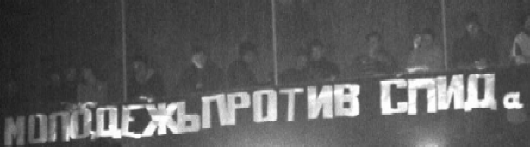
“Empty spaces, what are we living for…” words from a song by Freddie Mercury that ended the concert devoted to the international AIDS day and the victim of AIDS. The performing groups encouraged people to be more aware of AIDS even though there are only 49 HIV-infected people in Kyrgyzstan and only 11 of them are Kyrgyz citizens. AIDS seems to be so far from Kyrgyzstan, but the situation is getting worse every year. There are three major vulnerable groups in Kyrgyzstan – drug users, homosexuals and prostitutes. The United Nations Development Project works with these groups for AIDS prevention activities.
Right now according to center the “AIDS” there are up to 50,000 drug users in Kyrgyzstan and 70% of them inject drugs. Drugs in Central Asia are very cheap due to drug producers in Tajikistan and Afghanistan. A dose of heroin costs as much as a bottle of vodka and drug users would rather buy the latter. The center organized a special needle exchange for drug users in Bishkek and Osh. There are 700 persons presently using the services of the needle exchange. These measures help to identify how many drug users there are and to encourage them to undergo treatment. The biggest problem is that drug users cannot afford expensive treatment. Doctors use methadone a medicine, which drug users can take instead of a drug. Even though it is addictive it becomes a safe substitute for the dangerous drugs.
It is sad that we only think of AIDS on the first of December, which the international day of AIDS prevention. NGOs formed by most vulnerable groups – homosexuals and prostitutes – organized a press conference in order to highlight the situation of AIDS in Kyrgyzstan. Representatives of both “Oasis” Foundation (an NGO fighting for the rights of homosexual youth) and “Tais Plus” (dealing with prostitutes) talked about the activity of the NGOs and their plans for the future.
“Oasis” was formed in 1995 but registered legally only in 1997 with the help of the “AIDS” center. Homosexuality is still not acceptable in Kyrgyzstan even though the law that made it illegal was overturned in 1993. The mass media ignored the press conference and published rather hostile and insulting articles about both the clubs and homosexuals as a group. With the sponsorship of UNDP the Foundation was able to produce numerous brochures and seminars about the problems faced by homosexuals in a traditional society. Their material covered psychological pressure, AIDS, and STD prevention information. Oasis volunteers conducted numerous surveys about tolerance towards homosexuality in Kyrgyzstan and public awareness of AIDS. Vladimir Tyupin, director of Oasis Foundation, said that due to the efforts of the NGO on the AIDS prevention campaign there are no HIV-positive people in their focus group, which consists of 3000 people throughout Kyrgyzstan. The homosexual community is very informed about both STDs and AIDS. If anyone gets sick it very soon comes out and his fellows ask him to go to a special medical center to go through treatment. For AIDS day “Oasis” made a very impressive skit about having multiple sexual partners. They showed a sailor, a military guy, a prostitute and a celebrity all having unprotected sexual relations. One of them got AIDS and others ignoring him. Then he died and the performance ended with the reciting of statistics of the victims of AIDS. 5 million people a year get infected with HIV, every day the virus is transferred to 16,000 people who feel that AIDS is too distant from them.
“Tais Plus” was formed in February 1998, since then this NGO has achieved positive results. The focus group of the NGO is commercial sex workers. The activities of the NGO are similar to those of Oasis. They publish numerous brochures about STDs and AIDS written in very clear language so that any person in their focus group can get information about these diseases. The best result of their work is that comparing to only 13% of prostitutes in 1998, now 60% use condoms. By organizing seminars NGO staff provides workers of commercial sex with a psychological support group and a hope for the future. For example a couple of young girls decided to continue their education because of the influence of their peers.
AUK also has AIDS information. Funny posters hang on the walls. President Bill Clinton proclaimed December 1st 2000 World AIDS day. He encouraged every American to take measures to prevent the spread of AIDS. As for other anti-AIDS measures, the Kyrgyz government granted 100,000 dollars in 1997 for AIDS-prevention activities. 22,500 textbooks for healthy lifestyle education were published and distributed in the schools of Kyrgyzstan. The public is getting used to talking about sex. AIDS has passed, with the efforts of UNDP and those who represent the groups of risk, the public was aware of the danger for one day. But what measures tant western horror but a disease taking over Kyrgyzstan – AIDS center tested the used drug needles for the HIV virus and found out that 18-50% of them are HIV-positive.
SIDU, CENTRAL ASIA AND CAUCASUS YOUTH BRIDGING CONFLICT
By Alexsandra Shpakova, International Relations, Second year.
The School for Inter-ethnic/Religious/Cultural Dialog and Understanding (SIDU) took place in Baku, Azerbaijan during the period of October 21-28, 2000. Around 50 people from all over the world, including representatives of NGO’s and political scientists, took part as a participants and lecturers. The problems discussed during the school varied from the "The Role of Civil Society in Bridging Societies" to the "Frozen Conflicts in the Transcaucasus". But the main goal of the SIDU was not just lecturing and providing information, but real discussions and resolutions of the conflicts. SIDU faced the challenge of bridging two enemies together— Armenia and Azerbaijan. Since these two countries do not have diplomatic relations, it was very hard for Armenian delegation to stay in Azerbaijan, but in fact they did.
A group of eight Armenians took part in SIDU and built a bridge between the two fighting sides. They argued, they disagreed with each other, but all of them, both Armenians and Azerbaijanis, seem to overcome the lessons of their newly taught histories as well as the hatred they developed over lost relatives in the Nagorno-Karabakh war. In the end, they became friends. This played a huge role for all of the SIDU participants. People, who saw them create peace through their openness and tolerance, hoped that they would become the future leaders of their countries. Their example provided hope that there would be no more conflicts between these peoples.
At the end of the SIDU all the participants joined Helsinki Citizens Assembly, which also took place in Baku, November 1-3, 2000. And this conference started with a huge scandal. One of the Azerbaijani representatives of NGO, told on the conflict resolution workshop, that Azeri people were always kind and tolerant to their neighbors, which is why Armenia used them. This speech was the reason for Nagorno-Karabah delegation to cancel their presents at the Assembly. Of course conflict was resolved and apologies maid, but it also showed to young people that the hatred and ambitions must be thrown away, if we want to live in the calm and peaceful world.
AT the Helsinki Citizens Assembly, SIDU participants visited refugee camp near Baku. They saw in reality what is it like to be an IDP without a place to live and work. But the fact that provoked interest and disgrace was that the refugees are not allowed to work. It was hard to comprehend it with the official internal policy of Azerbaijan, but was easy to understand. Refuges are only the reason to claim land back from Armenia, as an occupant. The most fascinating thing is that refugees do not see Armenians as enemies. They just want to return to normal life. Why are they then not allowed? They are kept as a political weapon, as a reason to manipulate with the World Community and claim to turn back history. The conclusion made by SIDU activists was that somehow the past should be left along and begin a new future without ancient hatred and fears
The fact of the existence of SIDU is in itself an important aspect of conflict resolution and the establishment of youth network. It had been too long that people act with negotiation or discussion first. Participants believe that it was not important that a treaty was not signed, SIDU built friendship and understanding. It built friendship between the Caucasus and Asia, between Asia and the Balkans, and the most important was friendship within the Caucasus. The next SIDU will take place in Kyrgyzstan, autumn 2001. During this year, participants of SIDU s will establish a Central Asia Youth Organizations Network and renew publication of "Collage," a youth magazine. SIDU is a youth organization that seeks the involvement of more people to learn about each other and work together. SIDU youth believe that they will make a difference and turn the world around.
Sport News
By Yulia Balybina, Mass Media, second year.
“Swimming is not a natural skill of human beings,” said Evgeniy, the swimming coach of our AUK team. “What is natural in our relations with H2O is that water is something we can’t live without and we are always striving for.” I guess that is why the swimming course offered by the Service department is so popular among AUK students.
The class usually starts at 5:30, when all the swimmers gather near the old building, waiting for dyad’ Volodya and the bus. Then the all go to the “Dolphin” swimming pool, where Evgeniy is already waiting for them. Training starts with the warm–up and an explanation of the main task for the day, by the coach. ”I explain what to do and show how to do it right, before the students go to the water”, said Evgeniy.
Evgeniy Egorenko (known commonly as Zhenya) is a master of sports. He graduated last year from the Institute of Physical Culture, department of swimming. At present he competes in the modern pentathlon, swimming, running, horse riding, fencing, target shooting. He is one of the 9 people in Kyrgyzstan who takes part in this sport. During the training he gives advice on swimming technique and helps students to correct their mistakes. At the end of the training, which lasts, 45 minutes, our boys swam a distance of 25 meters using different styles.
There is only one girl who competes as an equal with the boys - Ksenia Grigorieva. The rest of the girls of the team could not swim at all when they first came to this course. Now they are able to swim, and, according to Evgeniy, will even be able to rescue people at the end of the semester. At the end of the semester students will pass an exam, as in any other course they are taking. On the exam the coach will evaluate the technique of the swimmer, speed, his/her start and turning on the track, and the physical condition of the sportsmen. To improve the physical condition, all the swimmers have training in the gym once a week for half an hour. “It helps to enhance coordination and to make swimmers’ technique better,” explains the coach.
“I love my swimming team, I love this course and our coach, because all together we are the group of the best people in University,” said a team member after the training. So, what I can I say more to show the students’ feedback? Almaz (KS199), said it best in a personal ad published in the last issue of The Star devoted to swimmers of AUK: ”I wish you, the AUK swimmers, clear water and not alcohol chlorine.” Good luck guys.
Safe Dating
By Anisa Afshar, International Relations, forth year.
Beside being persistently brilliant students, we AUKers are human beings too! Once in a while we need to rest to our brains, which are constantly busy with concepts such as elective courses, GPA, exams, and research papers. Believe it or not one of the most common ways of resting the brain cells is dating! But never oversimplify it. Dating can turn out to be a real mess, which can damage the poor brain cells and paralyze them for the whole semester!
Because there is no elective course offered on dating, the staff of the Star decided to take the first step! You are welcomed to toss your own version!
|
Syllabus |
|
| Name of the course: | Safe Dating |
| Instructor: | The Star |
| Points: | 102 |
| Time: | TBA |
| Place: | Anywhere! |
Tips form Lesson One:
¨ Don’t bother dating your teacher before the final exam, it won’t work!
¨ Always double check the sexual orientation of your dating-partner,
¨ Don’t get hell drunk on your first dating,
¨ Start with some thing lighter than a screwdriver,
¨ Make sure next morning you do not have an exam at 8:00 am,
¨ Do not put more than 100 com in your pocket,
¨ Try not to mix up the names of your dating-partners,
¨ Do not let him to play guitar for you, it is too risky!
¨ Keep a constant speed when you are going up the stairs together, you don’t want to be stuck in the stairs for more than half an hour!
¨ Don’t let your date to find out that you are a genius!
¨ For quality partner look at the Star staff!
Student Government Elections Observation
By Roman Yumatov, first year Mass Media
On the 16th of November AUK held elections for the Student Government 2000-01. The results of the election were announced at the initiation ceremony. For those of you who were not there or forgot “The Star” would like to present some facts about this event.
First of all, let’s congratulate one more time our new Senators, who are: Merdan Halilov (202 votes), Marat Jusupov (190), Anna Kirey (179), Taalay Mambetov (179), Halil Razaev (175), Emil Medetov (154), and the last one, Alexander Kiral (113). As about the rest of the candidates, Bermet Karabekova got 108 votes, for Kanatbek Beishekeev voted 96 people, Asel Jumagulova got 90 votes, and Serdar Beckgenov, who recieved 56 voters.
Unfortunately, the process and place of the elections was somewhat inconvenient. Next year we should have more tables and more people for giving ballots to voters. Many people didn’t know what they were supposed to do with the ballots. Nowadays in AUK we have 6 years of study (Preparatory, Freshman, Sophomore, Junior, Senior and MBA). We could have 6 tables and 6 members of the Elections Committee, who would be divided by the year of study, whose duties would be to give ballots and to explain what to do with them.
Not a single candidate did any campaigning this year! That is why many voters asked about who is who – they only knew Serdar… Maybe next year we can make an information list about every candidate, not only in “The Star” but near the Elections place. Another suggestion is to give the summary information about every candidate right in the ballot for voting, why not? One more point is that if candidates do campaigning for the electorate they should be more recognizable. This year only Emil did PR, but still it wasn’t perfect yet (do you remember his papers on AUK walls about his promises and about Leonardo da Vinchi?).
Everything should be done for the voters. Voters are only supposed to come and to make their own choice. Before the elections voters should see everything about all the candidates. They should know their promises and programs. But this year it was impossible because there was no source of getting the information except profiles, which were published in “The Star.”
As concerning the voters’ turnout--it is estimated that 396 students out of the 788 (total number of students in AUK), which is 50,3 in a percent computation. It is very good, and as Evangelia (our newspaper Advisor) said, “It is the voters’ turnout on the President’s Elections in the USA”. Now we can see final results of the participation in the Elections-2000 separately by the program. The most active students are studying at the Kyrgyz Studies program (from 13 students 11 voted, which is composed 85%), then Law department goes despite of that they should be first (47 out of 63 - 75%), then we have Journalism department students (30 out of 43 - 70%). Then in the order of decreasing go students with the following fields of study: Psychology, Sociology, International & Comparative Politics, Business Administration, Software Programming, British & American Studies, French Studies, Preparatory, Economics, Austrian & German Studies and the most inactive are the busiest - MBA students. And the last statistics information is about year-of-study participation. We have the most active students in the Freshmen year (139 from 255 voted, which composed 55%), then Sophomores go (139 out of 263 – 53%), the Juniors (68 out of 168 - 40%), then Seniors go (31 out of 86 – 36%), then we have students from the Preparatory course (31 from 86 - 36%) and the last are MBA students again – only 1 person from 15 voted, in a percent computation it its composed 7%.
In conclusion, I want to say ‘thanks a lot!’ for everybody, who came to the AUK Student Government Elections-2000 and who did his/her choice, who knows, that his/her destiny is in his/her own hands!
Freedom of the Press, and Democracy in Kyrgyzstan
Contributed by Kurmanalieva Nuria, Mass Media, Freshman.
After the collapse of the USSR Kyrgyzstan adopted democracy in order to develop its political position, and political culture. Freedom of expression, opinion and speech are the principals of primary significance. So the human being is the highest thing of value in the process of developing democracy in any country. The Human being is free t express his or her own ideas as well as him or herself. The human being should not be limited in his natural and legal fundamental rights.
Lets think what is going on in Kyrgyzstan with freedom of expression. When Kyrgyzstan became independent many famous newspapers began to write many articles about freedom of expression and the new constitution. In my opinion, there are many problems with the freedom of expression, and with democracy too. First, the Kyrgyz press is not free. The government forces its moral impression on almost all the leading newspapers in Kyrgyzstan. Many newspapers are limited to write the “truth” by the government. Much of the information printed is based on poor reporting. They call it “news.”
Secondly the economic situation of Kyrgyzstan is very poor. Many people are hungry. How can a poor, unemployed and uneducated person think and worry about democracy and freedom of expression? They do not have money to buy bread. How can they afford a newspaper? I’m sure that people who work in the Osh bazaar do not know their rights. Moreover, they do not even care. They do not know about democracy and the freedom of expression or even the country’s future. Do you know why? It is because they are hungry. Democracy can not give them anything to survive on. Maybe that is why people are not interested in democracy and the freedom of expression. Kyrgyz grass roots will never argue about anything, they will just acquiesce! This is because they do not have another choice. Standards of living, health, education, and cultural life of Kyrgyzstan are very bad. Kyrgyz democracy cannot be formed all at once. It must be formed over time and come hand in hand with economic growth.
Feedback From Reader:
By Ahoura Afshar, International Relations, third year.
Hi! The last issue of The Star really let me down. Remember that The Star is our “last best hope,” and the last thing I want to see is that it gets spoiled.
Why can’t you take new pictures? Is it SO difficult to do? Should we the same pictures over and over and over again? It’s not that hard to take new pix. You take the camera, zoom it, and click on the button and BOOM you have a picture! Don’t let The Star get boring with all those repeated pix.
What are the editorial pages? They must have an author, right? Is it just like the Soviet papers, simply The Truth; that no matter who wrote it it’s always the same. Even in that case, we have the right to know this Wise Person who sees The Truth, so that in hard times we can just go to him/her to find out The Truth.
What was the last article all about? It didn’t focus on anything. First it was about AI special meetings on Saturdays. Then it was about gays. Then all of the sudden the writer felt like quoting herself! Of course I’m not a journalist but I think the writer doesn’t need to quote himself/herself, ‘cause usually I don’t see quotation marks around the whole texts. If there is a new rule in the ever-advancing world, please enlighten me.
I like The Star a lot. And I know that you do a lot. But keep the quality high, as it used to be. Don’t let The Star get spoiled because of small slips...
AUK Team Wins Debate Tournament
Contributed by Shairbek Zhuraev
On The 19th of November and The 3rd of December the Center of Democratic Education held a parliamentary debate tournament for Bishkek students. Over 20 debate teams from AUK, KSNU (National), KRSU, BHU, and all other universities and institutions participated in these competitions of rhetoric, convincing, argumentation and presentation. Students presented debates on a great variety of current issues: beginning with democracy in Central Asia (as well as in the US) and national security of Kyrgyzstan through Taliban’s threat and resolution of Arab-Israel conflict to UN’s credibility and effects of globalization. Besides debates, students had an excellent opportunity to make new friends from other universities and eat real Uzbek plov for dinner.
AUK students won both tournaments! “SHABASH” (Maksat Koroluev and Konstantin Bondarev, both from ECO-100) and “PROMETEY” (Ruslan Karabukaev, ECO-199 and Zulfiya Abdullaeva, B-198) met in the final game and won respectively 1st and 2nd places. As for the second tournament, many teams of AUK were forced to step down because of exams, but nevertheless, “SHABASH” won 1st place again, and thus proved its success in the first tournament.
The Center of Democratic Education is going to organize more debate tournaments in January and February. In March the official Bishkek cup will be held, winners of which will represent Bishkek in the National Tournament, which in its turn will be conducted in “Debate Camp-2001” in Issyk-Kul in the summer. Winners of Debate Camp-2001 go to the International Debate Camp to debate with their counterparts from US, UK, Hungary, Russia etc.
We believe that our students may, can and should win here and there. LET’S GO ALL THE WAY!!!
AUK TV PRODUCTION CLUB PRESENTS: MOVIE REVIEWS
By Effim Plippov, Mass Media, second year.
 The
Cell
The
CellDirected by Tarsem
Starring Jennifer Lopez, Vince Vaughn and Vincent D’Onofrio.
What they say: A child therapist involved in a breakthrough research program is asked to journey inside the mind of comatose serial killer in the hope of saving his latest victim. As she embarks on an uncharted and perilous journey through the psyche of a murderer, an FBI agent must race against time to uncover clues that may help locate the missing girl.
What we think: Tarsem is renowned music video director. He brings his style over to the big screen and it works. Weirdness aplenty, plus it has Jennifer Lopez in lots of cool dresses. Our folks will love it.
****
 The
Patriot.
The
Patriot.
Directed by Roland Emmerich
Starring Mel Gibson, Heath Ledger and Jason Isaacs.
What they say: Benjamin Martin, a courageous and heroic South Carolina farmer who reluctantly joins the Revolutionary War to avenge a British colonel’s brutal and senseless act against his family. Facing off in a climactic battle against the Green Dragoons, the most deadly branch of the British fighting forces led by General Cornwallis and Colonel Tavington (Isaacs), the peace-loving American must draw on his patriotic fervor and the skills of his son and fellow soldier, Gabriel (Ledger), to help bring about the birth of a nation.
What we say: Yes, you guessed it correctly. The Patriot is simply Brave Hart in Civil War settings. Mad Max Gibson should change his movie-gears more frequently. The fact that Roland ‘Godzilla’ Emmerich directs this film only makes things worse. It is flashy. But it is equally dumb. No matter what, this film is in the Bishkek Top 5.
**
 |
Q & A DURING THE BREAK
|
 |
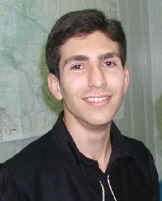
| Ahoura Afshar, International Relations, third year | Name and Position: |
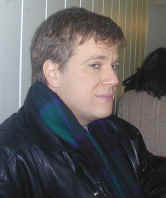
Louis Petrich, Co-Chair of American Studies |
| Aquarius | Horoscope Sign: | Aquarius |
| One elf, two monsters and three dinosaurs | Home Pet: | Please - we are supposed to call them “animal companions.” |
| “i believe in karma what you give is what you get returned” | Do people get what they deserve: | I hope not, unless they are my enemies. |
|
Pain, loneliness, hunger, death... |
What do you love to destroy: | Lefty arguments and illusions (Hydra-headed though they may be) |
| Seeing Gizma (a gremlin) tomorrow morning when i open my eyes. | What excites you: | www.excite.com (but do not use AUK computers!) |
| A burnt IR office! | What is the most exotic place you have ever been: | I went looking for a belly dancing show in Istanbul one evening, and found myself someplace I never intended to be.... |
|
1. Don’t happy be worry! 2. What is lost doesn’t come back. |
Life Motto(s): | “This ain’t no picnic” |
| not be a feminist anyway! | If I were the opposite sex I would: | I would not be me if I were the opposite sex- so how should I know what I’d do? |
| Dig a fourth floor under the ground and then promote each existing floor one step higher. | If you were AUK’s president what would be the first thing you would do: | Re-read Machiavelli |
| Size can be a guise for guys who want to rise. | Does size matter: | Yes. But despair not. There is a lid for every pot. |
| i would choose another body! | If you could change something in yourself what would you change: | Ask my wife (when you have a few hours) |
| A washing machine (to clean ‘soponabrush’ aspects of life), a scale (to measure which animals are ‘more equal’ than others), a magnifying glass (to find all the splinters of liberty), a lot of ‘shining toys’ (to keep ‘civilization’ out), and a subscription of the Star! | What five things would you bring with you if you were stranded on an island: | If I were stranded? What do you call this? |
| i’d rather say ‘the Stars are’ those who make it. | The Star is: | in big, big trouble if it misquotes me |
| What
do you take to get rid of a headache?
Get out of AUK as soon as I can. |
Q from the last interviewee: | Who
is the founder of Rock and Roll?
Bill Hansen and the Comets |
| Why is the tendency to torture students SO common among AUK teachers? | Q for the next interviewee: | What really goes on in the Critical Thinking Laboratory? |
Co-editors - John Atwood, and Konstantin V. Sudakov
Photographer – Anisa Afshar
Adviser - Evangelia Papoutsaki, Deborah Eisenberg
University Editor- Anisa Afshar
Political Editor- Anna Kirey
Russian Editor- Almas Rysaliev
Staff Reporters- Sergey Bogdanov, Julia Balybina, Tatiana Pesina, Alexandra Shpakova, Anton Klyuchin & Effim “Zima” Filippov
Contact and Comments: The Star, Room #105, American University in Kyrgyzstan, 205 Abdumamunova Str. Bishkek, 720000. Tel. (312) 663526
E-mail: [email protected],
Web Manager: Anisa Afshar
For any suggestions, or feedback, feel free to write to me: [email protected]