The World Wide Web
|
In 1945, Vannevar Bush wrote an article about a future mechanical device, which he called the Memex, with many similarities to the WWW of today. It was over 40 years later, in 1989, that Tim Berners-Lee wrote his proposal for Information Management and invented the WWW , realising Bush's vision. Technically speaking, the WWW is all the resources and users on the Internet that are using the Hypertext Transfer Protocol (HTTP) but is more broadly described by the World Wide Web Consortium (W3C), which was founded by Berners-Lee:
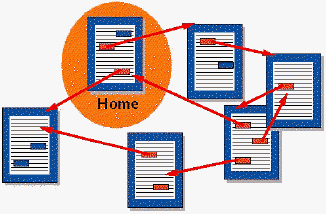
The WWW is accessed through a web browser. The original browser had a text based interface and required specialised knowledge for its operation, in a similar way to the early PCs. It wasn't until Marc Andreessen invented Mosiac, a web browser with a graphical user interface (GUI), that use of the WWW became widespread. A web browser is a software program, or client application, that retrieves documents from Web servers, connected to the Internet using HTTP, and displays them on the user's screen. Each file on the Internet has a unique address known as a Uniform Resource Locator (URL) and can be accessed, through the browser, using this. The key to the functionality of browsers is hypertext. Words, phrases and images, may be highlighted and clicking on these hypertext links instructs the browser to jump to the location to which it is linked. This may be on the same page or to a file located on a computer or server anywhere in the world.
How hyperlinks work. Image source CERN 28/09/00
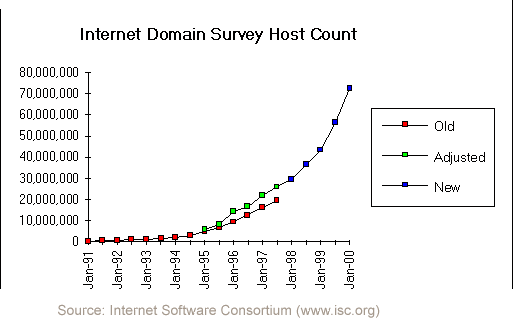
When TCP/IP was widely adopted as the Internet's standard protocol, in 1983, there were only 562 computer hosts on the Internet. It was not until the WWW was invented that the Internet began to show signs of the exponential growth that became the phenomenon of the late 1990's. The development of Mosiac further accelerated this growth to the extent that the Internet now has over 85 million computer hosts.
In the computer industry, it is often thought that the success of hardware is linked to whether the software it is running is seen as useful enough to justify buying the machine. This can be demonstrated by Apple's success with Dan Bricklin's Visicalc, the World's first spreadsheet program. The WWW might be thought of as the 'Killer Application' for the Internet. The 'useful' application that made people want to use the Internet enough for it to become a mass medium. There are millions of web pages available on the WWW today covering a diverse range of topics and a wide range of purposes. Today the WWW is not just a source of information, it is a whole world where one can shop, bank, read the news, explore virtual reality museums and many other things. Anyone, with the appropriate equipment, can access the services available and publish their own work on webspace freely available. The WWW has become one of the most significant inventions of our time and appears to embody almost unlimited power and potential. Further Resources:
back to top |

 |
|