As
we all know Angel was sired by Darla in Galway in Ireland so I
though I would give a brief history of the place to give us a
description of his home town. This is from a website about Ireland
at oak.cats.ohiou.edu/~lb303995/ireland/
Galway is both the center for the Irish-speaking regions in the
West and a lively university city.
Under the Anglo-Normans, it flourished as a trading post. In 1396
it gained a Royal Charter and for the next two centuries was controlled
by 14 merchant families, or "tribes". The city prospered
under English influence, but this allegiance to the Crown cost
Galway dear when, in 1652, Cromwell's forces wreaked havoc. After
the Battle of Boyne, Galway fell into decline, unable to compete
with east-coast trade.
In recent years, as a developing center for high-tech industry,
the city's profile has been revived. The center of the city lies
on the banks of the River Corrib, which flows down from Lough
Corrib widening out as it reaches Galway Bay. Urban renewal since
the 1970's has led to extensive restoration of the narrow, winding
streets of this once-walled city.
Due to its compact size, Galway is easy to explore on foot, and
a leisurely pace provides plenty of opportunity to stop off at
its shops, pubs, historic sights, and the best fish and chips
in ireland, McDonough's.
The Spanish Arch, where the river opens out, was built in 1584
to protect the harbor, which was then outside the city walls.
Here, Spanish traders unloaded their ships.
The old quays are a tranquil spot for a stroll down the Long Walk
to the docks. These walls around Galway were erected by the Normans,
and all irish natives were forced to live outside of these walls.
Beyond the Spanish Arch, on the west bank of the Corrib, lies
the Claddaugh, where many of these irish natives settled. The
name comes from An Claddaugh meaning "flat, stony shore."
From medieval times on, this fiercely independent fishing community
beyond the city walls was governed by a "king" or "mayor,"
the last of whom died in 1954. The only remnants of this once
close-knit, Gaelic speaking community are friendly pubs and Claddaugh
rings, betrothal rings traditionally handed down from mother to
daughter.
Whatever its history, the Claddaugh ring has become an endearing
symbol of affection. The heart in the centre of the design represents
love, the hands that surround it represent friendship, and the
crown at the top (if present) is symbolic of fidelity. Claddaughs
are worn on the left hand, facing inward, if your heart is spoken
for. If you are unattached, it is worn on your right hand, facing
outward.
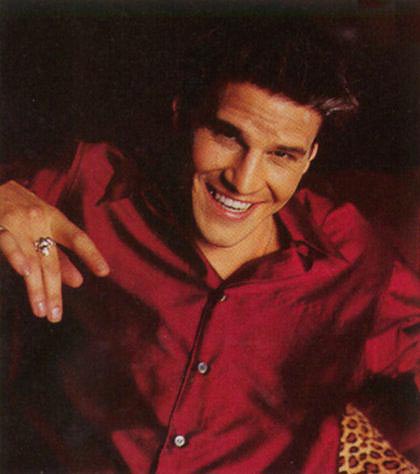
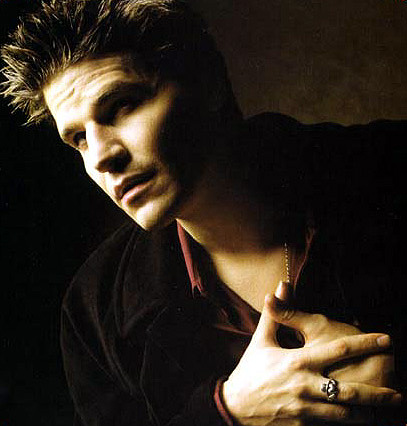
Angel broke tradition with this though as he had it with the heart
pointing towards him on his right hand!
|