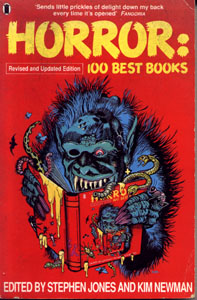
 The following essay by William F. Nolan is from "Horror : The 100 Best Books" edited by
Stephen Jones and Kim Newman.
The following essay by William F. Nolan is from "Horror : The 100 Best Books" edited by
Stephen Jones and Kim Newman.In 1978 I was browsing a Los Angeles bookstore when a particular title caught my eye, a Harcourt Brace Jovanovich hardcover. The dust jacket was arresting: a winged angel, fun in hand, prowling above the multiple towers of Manhatten, pursued by an evil-smiling, horned Satan, knife in hand, cloven-hoof extending between skyscrapers. All this under a gold-foil sky.
I read the inside flap copy. Here were the likes of Stephen King, Robin Moore and Thomas McGuane showering the novel with all-out raves: 'brilliant ...', 'compelling ...', 'terrific ...', 'breathless ...', spellbinding ...'. And when I found out that the plot involved a tough private detective named Harry Angel versus the occult world of voodoo and witchcraft in New York I was hooked. I paid $8.95, plus tax, and Falling Angel was mine.
I read the book that same evening - with the hair standing up on the back of my neck. This week, a full decade later, I read it again. My opinion had not changed: it's one of the century's finest examples of hard-boiled detective fiction, a novel fully deserving to be shelved next to Philip Marlowe and Sam Spade. What Raymond Chandler did for Los Angeles in the 1940s, William Hjortsberg does for New York in the late 1950s. He paints a grim and poetic portrait of New York's mean streets in 1959, bringing the Big Apple to raw life. There's a haunting sense of desolation in his sequence at Coney Island in the off-season, and his portrayal of life inside the plush, high finance office suites of Manhattan is equally convincing.
Harry Angel, in dangerous and desperate pursuit of an elusive shadow-self, is a man fated to lose - the ultimate, cynical, hard-headed private eye forced into a nightmarish descent into the netherworld of evil. As he tells his story in classic, first-person style, we are with Angel in his doomed quest, graphically experiencing a voodoo ceremony in late night Central Park, then a murder in which the victim's heart had been ripped from her body, and finally a truly chilling Black Mass conducted in an abandoned subway station during which a squalling baby is sacraficed to Satan.
A brutal fight to the death on the underground subway tracks between Angel and a member of the cult is Hammett-tough:
The book's prime figure of evil, Louis Cyphre, is drawn in brimstone and Black Magic, a character who bedevils the dreams of Harry Angel and whose power is absolute.I left the shipping millionaire lying on the tracks to be dismembered by the next train train through. The rats would feast tonight.
Hjortsberg's heroine bears a name worthy of a James Bond thriller, Epiphany Proudfoot, and expert practitioner of voodoo and erotic sex. But even this strong woman cannot save Harry Angel from hsi self-created fall.
A suberb tour de force, Falling Angel achieves the impact of a .45 slug to the chest. you'll keep your lights on at night after reading this one.