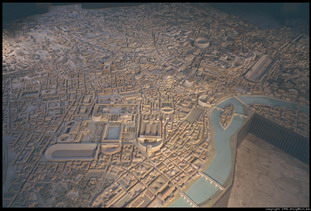

Ancient Rome was a thriving civilization that began growing on the Italian Peninsula as early as the 8th century BC. Located along the Mediterranean Sea and centered on the city of Rome, it expanded to become one of the largest empires in the ancient world[1] with an estimated 50 to 90 million inhabitants (roughly 20% of the world's population[2][3][4]) and covering 6.5 million square kilometers (2.5 million sq mi) during its height between the first and second centuries AD.[5][6][7]
In its approximately twelve centuries of existence, Roman civilization shifted from a monarchy to an aristocratic republic to an increasingly autocratic empire. Through conquest and assimilation, it came to dominate Southern Europe, Western Europe, Asia Minor, North Africa, parts of Northern Europe, and parts of Eastern Europe. Rome was preponderant throughout the Mediterranean region and was one of the most powerful entities of the ancient world. It is often grouped into "Classical Antiquity" together with ancient Greece, and their similar cultures and societies are known as the Greco-Roman world.
The Romans are still remembered today, including names such as Julius Caesar, Cicero, Augustus, etc. Ancient Roman society contributed greatly to government, law, politics, engineering, art, literature, architecture, technology, warfare, religion, language, society and more in the Western world. A civilization highly developed for its time, Rome professionalized and greatly expanded its military and created a system of government called res publica, the inspiration for modern republics[8][9][10] such as the United States and France. It achieved impressive technological and architectural feats, such as the construction of an extensive system of aqueducts and roads, as well as large monuments, palaces, and public facilities.
By the end of the Republic, Rome had conquered the lands around the Mediterranean and beyond: its domain extended from the Atlantic to Judaea and from the mouth of the Rhine to North Africa. The Roman Empire emerged under the leadership of Augustus Caesar. Under Trajan, the Empire reached its territorial peak. Republican mores and traditions started to decline during the imperial period, with civil wars becoming a common ritual for a new emperor's rise.[11][12][13]
Plagued by internal instability and attacked by various migrating peoples, the western part of the empire broke up into independent kingdoms in the 5th century. This splintering is a landmark historians use to divide the ancient period of universal history from the pre-mediaeval "Dark Ages" of Europe.
The Eastern Roman Empire survived this crisis and was governed from Constantinople after the division of the Empire. It comprised Greece, the Balkans, Asia Minor, Syria and Egypt. Despite the later loss of Syria and Egypt to the Arab-Islamic Empire, the Eastern Roman Empire continued for another millennium, until its remnants were finally annexed by the emerging Turkish Ottoman Empire. This eastern, Christian, medieval stage of the Empire is usually called the Byzantine Empire by historians.
Founding myth
According to the founding myth of Rome, the city was founded on 21 April 753 BC by twin brothers Romulus and Remus, who descended from the Trojan prince Aeneas[14] and who were grandsons of the Latin King, Numitor of Alba Longa. King Numitor was deposed from his throne by his brother, Amulius, while Numitor's daughter, Rhea Silvia, gave birth to the twins.[15][16] Because Rhea Silvia was raped and impregnated by Mars, the Roman god of war, the twins were considered half-divine.
The new king feared Romulus and Remus would take back the throne, so he ordered them to be drowned.[16] A she-wolf (or a shepherd's wife in some accounts) saved and raised them, and when they were old enough, they returned the throne of Alba Longa to Numitor.[17][18]
The twins then founded their own city, but Romulus killed Remus in a quarrel over the location of the Roman Kingdom, though some sources state the quarrel was about who was going to rule or give his name to the city.[19] Romulus became the source of the city's name.[20] In order to attract people to the city, Rome became a sanctuary for the indigent, exiled, and unwanted. This caused a problem for Rome, which had a large workforce but was bereft of women. Romulus traveled to the neighboring towns and tribes and attempted to secure marriage rights but as Rome was so full of undesirables they all refused. Legend says that the Latins invited the Sabines to a festival and stole their unmarried maidens, leading to the integration of the Latins and the Sabines.[21]
Another legend, recorded by Greek historian Dionysius of Halicarnassus, says that Prince Aeneas led a group of Trojans on a sea voyage to found a new Troy, since the original was destroyed in the outcome of the Trojan War. After a long time in rough seas, they landed at the banks of the Tiber River. Not long after they landed, the men wanted to take to the sea again, but the women who were traveling with them did not want to leave. One woman, named Roma, suggested that the women burn the ships out at sea to prevent them from leaving. At first, the men were angry with Roma, but they soon realized that they were in the ideal place to settle. They named the settlement after the woman who torched their ships.[22]
The Roman poet Vergil recounted this legend on his classical epic poem Aeneid. In the Aeneid, the Trojan prince Aeneas is destined by the gods in his enterprise of founding a new Troy. In the epic, the women also refused to go back to the sea, but they were not left on the Tiber. After reaching Italy, Aeneas, who wanted to marry Lavinia, was forced to wage war with her former suitor, Turnus. According to the poem, the Alban kings were descended from Aeneas, and thus, Romulus, the founder of Rome, was his descendant.
Kingdom
The city of Rome grew from settlements around a ford on the river Tiber, a crossroads of traffic and trade.[23] According to archaeological evidence, the village of Rome was probably founded sometime in the 8th century BC, though it may go back as far as the 10th century BC, by members of the Latin tribe of Italy, on the top of the Palatine Hill.[24][25]
The Etruscans, who had previously settled to the north in Etruria, seem to have established political control in the region by the late 7th century BC, forming the aristocratic and monarchical elite. The Etruscans apparently lost power in the area by the late 6th century BC, and at this point, the original Latin and Sabine tribes reinvented their government by creating a republic, with much greater restraints on the ability of rulers to exercise power.[26]
Roman tradition and archaeological evidence point to a complex within the Forum Romanum as the seat of power for the king and the beginnings of the religious center there as well. Numa Pompilius was the second king of Rome, succeeding Romulus. He began Rome's great building projects with his royal palace the Regia and the complex of the Vestal virgins.
Republic
According to tradition and later writers such as Livy, the Roman Republic was established around 509 BC,[27] when the last of the seven kings of Rome, Tarquin the Proud, was deposed by Lucius Junius Brutus, and a system based on annually elected magistrates and various representative assemblies was established.[28] A constitution set a series of checks and balances, and a separation of powers. The most important magistrates were the two consuls, who together exercised executive authority as imperium, or military command.[29] The consuls had to work with the senate, which was initially an advisory council of the ranking nobility, or patricians, but grew in size and power.[30]
Other magistracies in the Republic include tribunes, quaestors, aediles, praetors and censors.[31] The magistracies were originally restricted to patricians, but were later opened to common people, or plebeians.[32] Republican voting assemblies included the comitia centuriata (centuriate assembly), which voted on matters of war and peace and elected men to the most important offices, and the comitia tributa (tribal assembly), which elected less important offices.[33]

In the 4th century BC Rome had come under attack by the Gauls. The Gauls until that time had only extended to the Po Valley in the Italian peninsula. The Gauls had been penetrating deep into Etruria, so the Romans decided to join in on the melee. With Etruria completely gone, the Gauls continued their advance south which led them into a fight with the Romans. On 16 July 390 BC, a Gallic army under the leadership of a tribal chieftain named Brennus, met the Romans on the Banks of the small Allia River just ten miles north of Rome. Brennus defeated the Romans, afterwards the Gauls marched directly to Rome. Most Romans had fled the city, those who were capable of fighting barricaded themselves upon the Capitoline Hill for a last stand. The Gauls looted and burned the city, then laid siege to the Capitoline Hill. The siege lasted seven months, the Gauls then agreed to a compromise peace. The Romans were forced to pay the Gauls 1,000 pounds of gold. According to legend, the Roman General supervising the weighing noticed that the Gauls were using false scales. The Romans then took up arms and drove the Gauls back, and then an army led by Camillus defeated the Gauls and he said, "With iron, not with gold, Rome buys her freedom."[34]
The Romans gradually subdued the other peoples on the Italian peninsula, including the Etruscans.[35] The last threat to Roman hegemony in Italy came when Tarentum, a major Greek colony, enlisted the aid of Pyrrhus of Epirus in 281 BC, but this effort failed as well.[36][37] The Romans secured their conquests by founding Roman colonies in strategic areas, thereby establishing stable control over the region of Italy.[