When it comes to protecting yourself from the elements, there are basically 6 options:
- No Shelter
- Bug Screen
- Bivy Sack
- Tarp
- Tent
- Hammock - We're talking hammocks with optional enclosures... the Gilligan's Island models are considered "No Shelter"
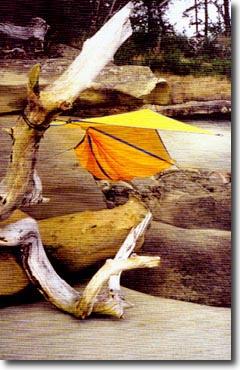
Here's a quick comparison between these options -
Type* Cost Ease of
SetupPersonal
SpaceWeight Rain Bugs/
CrittersNo Shelter 4 4 4 4 0 0 Bug Screen 4 3 1-2 3 0 2 Bivy Sack 1 3 1 3 4 4 Tarp 3-4 2 3 3 3-4 0 Tent 1-2 2 2-3 1-2 4 4 Hammock 1-2 2 2 2-3 4 4
* You can combine shelter options to suit you individual needs (e.g. Tarp with Bug Screen for a bug protected tarp).0=none 1=poor 2=fair 3=good 4=excellent/free So, how do you choose which shelter to go with?
The answer is the same as with everything in "lightweight" backpacking - First choose the option that caters to the amount of comfort that you are looking for, then go comparison shopping and find the lightest alternative in the price range which you can afford.
In my case, I'm taking looking for a shelter for mainly two functions: sleep without intrusion from mosquitos and as a refuge from storms.
In short, I'm looking for something that has high marks in the catagories of "Rain" and "Bugs" (Bivy Sack, Tent, or Hammock). If I choose, I can also combine a Bug Screen or Bivy with a Tarp and meet my criteria.
All other things being equal, I'd prefer to have more personal space - Let's ditch the standalone bivy!
If I'm solo hiking, I want to carry as little weight as possible and thus leave the tent at home. If I'm teaming up with someone, the tent is still a good option as one individual can carry the "fly/poles/stakes" combo and the other can carry the "tent" itself.
Let's assume that I'm planning on going solo... or just value my personal space at night. My options are now down to Tarp/Bug Screen, Tarp/Bivy, or Hammock.
First, let's look at the Hammock.
There are many advantages to sleeping in a hammock. All you need is to find for a comfortable night's sleep is two trees about 9-feet apart. When's the last time you've been hiking in a non-alpine area where this wasn't the case? OK, a non-alpine, non-desert environment where this wasn't the case?
In most backcountry, 3-season, applications, a hammock is a dream. No mattress to lug around, no fairly-flat section of ground to look for, no guilty feelings of matting down the ground, no worry about finding that rock under your shelter in the middle of the night.
No matter what the slope of the ground, no matter how big the puddle below, all you need is two trees with some distance between them and you're styling. Best of all, with the engineering updates that have been made in today's camping hammocks, the days of falling out are over.
Hammocks are lightweight - Under 4-pounds for the deluxe models, under 3-pounds for the "average" models, and less than 2 pounds for the "Ultralight" models. As for cost, you can get into a hammock that weighs less than 3-pounds for around $100.
While the hammock gives you, arguably, the most comfortable night of sleep one can get in the backcountry, the lack of interior room still has it's occupant feeling like a contortionist when getting in/out of the sleeping bag.
On top of this, there's no vestibule and little room for gear storage inside. This means you have to either strap your pack to a tree or lay it on the ground outside the hammmock.
As for exposure to the elements, while you might remain warm and dry inside the hammock, you still have to exit the hammock to, for example, use your stove. Depending on how harsh the weather is, this entry/exit process can end up being pretty miserable. What you end up having to do is carry two shelters, one for you and one for your gear/cooking area.
Keep in mind that the hammock is, for the most part, a one person shelter. If you're not solo hiking, and find yourself pinned down for a few hours waiting out a storm, there's no way to invite someone into your shelter for company.
Links to Enclosed Hammocks: Hennessy Hammock | Clark Jungle Hammock
The tarp is definitely the most economical option available. Even if I get one of those fancy "Sil-Tarp" knock-offs that Campmor sells (basically a tarp made of parachute fabric - extremely strong and lightweight), I'll still be at under $100 for my shelter. If I really want to decease the cost, I can just buy a roll of 2-mil landscaping plastic and trim to suit, or go with one of those "blue-poly" hardware store tarps. Yes, it will weigh much more than the "Sil-Tarp" but my shelter solution will end up costing less than $20.
A tarp also gives you the most vetilation of any of the shelter options which give you protection from the elements. This is a big plus for those hiking in humid areas where condensation has you waking up with a sleeping bag that's damp in the footbox area and elsewhere (hello Michigan hikers).
There are no easy setup instuctions that come with a tarp so using it can take practice and patience. It takes time to develop truely storm-proof pitching techniques, and, if the wind should shift, you could be exposed to blowing sand/dirt.
If you've never used a tarp before, practice in your backyard or go hiking with someone who has tarp-camping experience. If you practice in your backyard, make sure to leave the tarp standing during at least a couple of heavy storms. I'll bet that, for at least the first few times, you'll feel lucky that you weren't spending the night in that sorry thing. After adjusting your technique a few times, your layout should prove to be more stormworthy. Also, remember that, in order for a tarp to stand, staking it down is essential. This means you'll have to spend extra time looking for a spot in the backcountry that's fairly level and that has ground that's suited for driving in stakes - Or, you could just guy the tarp out to surrounding rocks and trees.
In the long run, you should find that the versatility in setup that a tarp provides is actually a benefit. Since there's no "set way" to erect a tarp, styles of pitching can adjust to the given situation - sun, wind, or rain. You can set up a tarp in a number of ways - Borrito, lean-to, flying diamond, A-frame, modified A-frame, pyramid, trapezoid, custom... it's all good.
For some, the thought of waking up with a field mouse, spider, or whatever your worst fear may be on your nose can mean that using a tarp will simply keep you from falling asleep at all. In the true "backcountry", where you choose the camping spot, such situations are simply more paranoia than anything else. In "family campground" type environments, however, such worrys may be valid - With all the racoons and other critters fighting over the trash uneducated and undisciplined campers leave lying about, the odds of one of these animal scurrying into or through your personal space is dramatically increased.
If you find yourself with such concerns, I recommend using an dryloft overbag with integrated no-see-um netting over your head area for protection. This option will also protect against mosquitos and other biting insects, and provide your bag with added protection should some spray from a rainstorm make it into your tarp.
Bug Bivy/Tarp Photo Credits: Rick Halbert ~ Great Lakes Lightweight Backpacking
Base Kamp