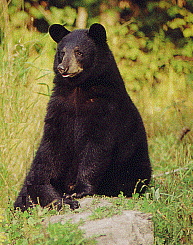
Black Bears in Michigan
Fossil remain indicate that the black bear has been a resident of Michigan since the retreat of the Wisconsin Glacier some 8,000 years ago. It wasn't until European man's settlement of southern Lower Michigan that the bear population began to decline. Black bears were treated like vermin in Michigan and could be shot or killed at any time, in any number, anywhere in the state. The bear, losing ground at a steady pace, disappeared from Monroe, Washtenaw, Jackson, and Kalamazoo counties by the mid 1800's.
In 1946, the Michigan Bear Hunters Association, the Michigan United Conservation Clubs, and a group of hound hunters banned together to seek protection for Michigan's dwindling bear population. Since that time, Michigan has developed one of the most tightly regulated bear hunting programs in the Nation.
Today, the American Black Bear (Ursus Americanus), the only species of bear found in Michigan, can be found throughout all of Michigan's Upper Peninsula (U.P.), and much of the Northern Lower Peninsula. There are approximately 14,000 black bears living in the forested areas of the state, including about 1,600 in the northern lower half of the state. That's a 50% increase over 1996, when an anti-hunting group failed to convince voters that bear numbers would decline unless they ended bait and hound hunting. Michigan bear numbers have been increasing at about 10 percent a year for a decade. The fastest growth has been in the Lower Peninsula, where empty habitat and a rich food supply result in high production of cubs.
Adult black bears are the largest predators in the state, weighing from 200 to 500 pounds. Occasionally, large males weighing more than 700 pounds are reported. Black bears stand 27 to 36 inches high at the shoulder and are 4 1/2 to 6 feet long. Although black bears come in a range of colors, bears in Michigan are known for their jet-black coat. Black bears have a life span of about 15 years, although they have lived longer in captivity.
An excellent sense of smell and a keen sense of hearing alert the bear to potential food sources and danger. The bear is somewhat nearsighted, but sight is not an important sense for the bear. The bear's sense of smell is his greatest asset. Because 75% of its diet is vegetation, the sense of smell plays an important role. The black bear has the largest ears of any of the four American bears, helping it to hear danger coming from far away and thus enabling it to retreat into the thickets, or leave the area altogether.
When traveling from place to place, the bear moves at about 2 to 3 miles per hour. Its lazy, flat-footed, shuffle can be very deceptive. When moving at an all out run, the black bear has been clocked at 35 mph. This is an animal that can outrun a horse over short distances. The black bear is also extremely agile, and is a very capable climber and swimmer.
Black bears may be seen at any time of day or night but are most active at dusk.
Bears are constantly looking for food. Although they are large and powerful, bears survive by eating almost anything that is edible and can't get away.
Black bears are omnivorous, eating both plants and animals. It has been determined that more than 75% of their diet consists of vegetable matter including greens, berries, flowers, grasses, herbs, roots, and nuts. For the remaining portion of the diet, animal matter such as carrion, fish, insects, and any mammal they can catch are consumed. Black bears are particularly fond of larval grubs, earthworms, and ants found in decaying logs. Bears will take advantage of human foods and garbage, returning to feed on these items regularly if left accessible.
Black bears are not migratory, but males do roam large areas. The size of the home range of an individual black bear will vary with the concentration of high energy food sources - the more concentrated, the smaller range is necessary to maintain an individual bear. Although they spend the majority of their time in this "home range", there are records of radio-collared bears moving nearly 100 miles through the course of a summer, and returning to their home by the fall.
In general, females will have a home range that is 3 to 10 square miles, while males will normally have a range from 10 to 40 square miles. The range of every adult bear is composed of an individual territory, part of which constitutes its exclusive domain while the rest of it co-habits with other bears. The home range of a mature male will often overlap the home range of several female bears.
Characteristically, a home range does not constitute one large area but rather is composed of several smaller food source areas connected by travel lanes. Open areas are usually avoided by black bears, as they prefer wooded cover. Stream and creek beds are often used as travel lanes because of the thick undergrowth and a barrier-free escape route. This is particularly true in areas were there is heavy urban build-up.
Female black bears normally mature at 3 to 5 years of age with some waiting even later for their first mating. Females will normally mate with several males over the two to three weeks of the breeding season. Females will normally breed every other year.
Through a remarkable process referred to as delayed implantation, the fertilized ovum divides a few times and then floats free within the uterus for about six months with its development arrested. Sometime around the denning period, the embryo will attach itself to the uterine wall and, after a period of eight weeks (January/February), the cubs will be born while the mother is still in winter dormancy.
Delayed implantation clearly serves an important survival need for the mother. Should she not have enough fat reserves to carry her through the winter, the embryo will not implant and it is simply reabsorbed by her body.
As many as five cubs may be born to an exceptionally healthy, adult, female. Although females with five cubs are rare, the birth of four cubs in Michigan females is not unusual.
At birth, the cubs are blind, hairless, and very tiny. They weigh from 8 1/2 to 12 ounces. Virtually helpless, they are, however, able to move sufficiently to suckle on their mother who remains asleep. In spite of the harsh weather common during Michigan winters, most cubs manage to stay warm. While the temperature inside maternal bear dens is only slightly warmer than outside, the cubs are more than comfortable clinging to their mother's. As the cub's hair grows, insulation becomes less of an issue. About six weeks after birth, the cub's eyes open.
Within the next five weeks, the cubs will develop rapidly on this rich diet such that they will be able to follow their mother when she leaves the den.
The cubs will stay with their mother for the entire first year. They are generally weaned between July and September of their first year and stay with their mother through the first full winter. Their survival is totally dependent on the skill of the mother in both protecting them and teaching them the basics of what to eat, where and how to get it, where to den, and how to cope with danger.
As adolescents, the young bears are still in extreme danger. As the mother prepares to breed again, they are driven off. They must now become rapidly self sufficient if they are to stay alive and find sufficient food to build up their fat reserves to last over the long winter. Occasionally, young bears will spend a period of time together after their mothers have driven them off.
During late summer and early fall, all bears have, as a survival imperative, the need to gain as much weight as possible. Through the harvesting of locally available nut crops, berries, etc., black bears normally make very large weight gains. Such gains may be as much as 30 pounds per week. At such times, foraging may occur around the clock with only short rest periods.
Although the bear's wintertime slumber is often considered hibernation, it is not. Termed "carnavorean lethargy", the life processes (heart rate, breath rate, body temperature) do not drop as drastically as do those true-hibernators like the woodchuck and ground squirrel. Black bears usually den in excavated cavities under stumps or in knolls or hillsides. Brush piles, hollow logs, or other situations have also been frequently reported.
While "hibernating", a bear's heart rate drops from between forty to seventy beats per minute to only eight to twelve beats per minute and its metabolism slows down by half. Unlike many other animals that hibernate, its body temperature only undergoes a minor reduction of 5 to 9 degrees.
During the entire period of "hibernation", the black bear will neither pass urea or solid fecal waste. While urea poisoning causing death would occur in all other animals, bears have developed a unique process of recycling the urea into usable proteins.
Although black bears are large and powerful animals, they are not normally aggressive toward man. Black bear attacks are responsible for only three deaths in Michigan, the most storied attack occurring in the Eastern U.P. on July 7th, 1948 - A three year old girl was playing on the porch of the family cabin when she was snatched by a black bear, carried into the bush, and partly eaten.
To put the safety issue in perspective, national statistics show for every person killed by a bear, 17 are killed by spiders, 67 by dogs and 180 by bees and wasps.
Black bear sightings have become more common in recent years. In the past few years, there have been confirmed bear sightings in Bay City, Grand Rapids, Lansing, Midland, and Clarkston.
To many a hikers distress, the location of bear sightings is increasingly becoming the campground. Fortunately, the bears do not want the campers, merely the coolers, picnic baskets, and other food related items that they can drag off for a quick snack.
When you see a bear, remain calm. The black bear has a natural fear of humans and usually, the bear will just turn and run from an encounter. Most bears are timid enough to be scared away by yelling, waving, and banging pots or cans. If this does not work, chase the bear out of your campsite. Be sure the bear has a clear escape route, and then yell, wave, and rush toward the bear, but no closer than 15 feet. This tactic is most effective when several people cooperate.
Capsaicin, a derivative of cayenne peppers used by mailmen to repel aggressive dogs, has been used to effectively repel bears that are reluctant to leave or approach too closely. In more than 200 trials, no bear indicated any sign of aggression after being sprayed, sometimes repeatedly. Most immediately turned and ran, stopping eventually to rub the sting out of their eyes. Capsaicin causes no lasting injury to the bear.
If you see a bear cub on the trail, keep calm and retreat slowly - Do not run. Although these little fur-balls may look harmless, a mother bear who has been separated from her cubs poses a great threat. If she senses that her cubs are in danger, she may turn violent. Simply put, avoid bear cubs.
There is no guarantee that a bear will not visit your campsite, no matter how careful you are. The following tips are designed to minimize the possibility of negative encounters with bears. Please note that the tips regarding storing food in your vehicle apply to bears in Michigan - try these tactics in Yosemite, for example, and your car will be little more than a statistic.
- Do not feed wild bears - Once people have fed a bear, its natural instinct to fear humans begins to gradually lessen and may cause the bear to become dangerous and destructive. A bear that is breaking into camps and vehicles to obtain food, and no longer has any fear of humans, must be destroyed.
- Keep a clean camp - bears have an excellent sense of smell and are attracted by food odors, particularly greasy smelling garbage. Dirty dishes and garbage may lure bears to your camp. If you arrive at a campsite with bear tracks, droppings, or scattered garbage, try to find another place to set up camp as these are sure signs that bears in the area have made the connection between campers and food.
Wash dishes immediately. Dispose of the water away from your camp, at least 150 fet away from any lakes or wetlands, or use a sump hole to filter the water. Burn the food scraps, all leftover food, wrappers, and grease. Items which cannot be disposed of by burning should be "bear bagged", and packed out for proper disposal.
- Store food in a safe place - Do not store food in your tent. If your clothes have food or grease on them, do not bring them into the tent with you. This just invites bears to your tent. When camping in the wilderness, food and other items with an odor, including toothpaste, perfume, deodorant, soap, and suntan lotion, should be properly "bear bagged". When possible, burn all food scraps, left over grease, and garbage. Non-burnable garbage should be hung up with the rest of your food an packed out when you leave. Don't dispose of food in wilderness latrines - bears can still find it and destroy the latrine in the process.
If you are camping near your vehicle, store food in containers inside, preferably in the truck of you car in a cooler, out of site, until you are ready to use them.
- Leave your tent open when you leave your campsite - Bears are naturally curious and may want to look inside your tent. It's no problem for bears if the tent is closed tight - they'll just make their own opening.
- Report problem bears - If a bear continues to visit your campsite, notify a local park ranger or the National Forest Service so they can keep track of the bear and have it moved if it continues to cause problems.
Strictly Michigan
Base Kamp