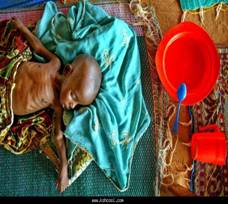
Famine is the
endpoint of a lengthy process in which people in increasing numbers lose their
access to food. Most famines have long gestation periods, typically covering
two or more crop seasons. Because the descent into famine is slow, early detection
is possible. Because it is also typically shrouded in ambiguity, early
detection is rarely definitive and seldom produces early response. Herein lies a dilemma that continues to plague famine early warning
systems.
Famine is induced by a
human population beyond the regional carrying capacity to provide food
resources. In Africa, if current trends of population growth and soil
degradation continue, the continent might be able to feed just 25% of its
population by 2025, according to UNU's Ghana-based Institute for Natural
Resources in Africa.[1] An
alternate view of famine is a failure of the poor to command sufficient
resources to acquire essential food (the "entitlement theory" of
Amartya Sen), analyses of famine that focused on the political-economic
processes driving the creation of famine, an understanding of the complex
reasons for mortality in famines, an appreciation of the extent to which
famine-vulnerable communities have well-developed strategies for coping with
the threat of famine, and the role of warfare and terrorism in creating famine.
Modern relief agencies categorize various gradations of famine according to a
famine scale.