With a
throw of a switch, Pune entered the history books. Radio Mirchi,
the city's first private FM radio station was sizzling the
airwaves on 93.9 FM.
''Pune will never be the same again,'' promised Times Group
managing director Vineet Jain. ''Radio Mirchi will entertain you
like never before.''
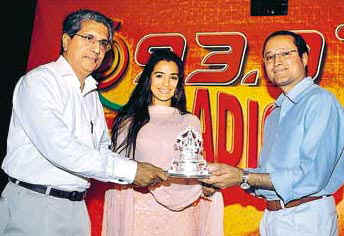
Launched by Bollywood hearthrob Amisha Patel in the presence of Mr
Jain and Entertainment Network (India) Limited (ENIL) managing
director AP Parigi, Radio Mirchi is set to rewrite the
entertainment scene in the city.
The primarily music-driven channel with a bouquet of programming
in English, Hindi and Marathi is aimed at reaching every Puneri
who is young, or, as Mr Parigi put it, ''anybody who is young at
heart''.
Radio Mirchi Pune marks a significant milestone in the the FM
business of ENIL, a wholly-owned subsidiary of The Times Group.
With stations in Indore, Ahmedabad, Mumbai and now Pune, the
crucial western grid has been completed for the company, Mr Jain
pointed out, covering an addressable population of 60 million in
the country's most developed socio-economic zone.
By the end of August, Radio Mirchi stations will be launched in
Delhi, Kolkata and Chennai giving it a national footprint.
By year-end, the eastern grid will also be completed, giving an
addressable population of a staggering 150 million people, Mr Jain
informed a crowded press conference, which was preceded by a
spectacular laser show organised by event management specialists
360 degrees.
''We believe in the medium. We are here for the long haul,'' Mr
Jain said, adding that Radio Mirchi will provide the best in
entertainment through music and humour.
In response to a question, he said that the Times Group, which has
diversified rapidly over the past few years, including music and
retail, will primarily remain a media group, with presence in all
areas of media.
Research has shown that after the launch of Radio Mirchi in Indore
and Ahmedabad, radio's reach jumped. Over 90 per cent of the
population in the age group of 15-35 in the prime A and B
socio-economic classifications listen to radio, even amidst the
existing media clutter.
But Ms Patel, an economics major from Boston, summed it up best.
''We had 50 channels of TV to surf. Now we have one channel for
radio. And we don't need to surf
 Radio
Mirchi scorches the west
Radio
Mirchi scorches the west