
Added to the Noise Blanker Project

There are two Noise Blankers. No. 1 is active/passive with adjustable setup parameters, as shown. No. 2 is a dynamic version where the clipping diodes are biased so that the threshold can be adjusted for when the "hole puncher" circuitry kicks in.
The head end is a very simple protection circuit allowing for a variable amount of bleed and flash-over (see below). These functions are really not (absolutely) necessary as "user adjustable" controls, but for maximizing the system for use with various receivers and antennas, I elected to make then front panel controls rather than internal adjustments, because I have had issues with front end protection in the past.,
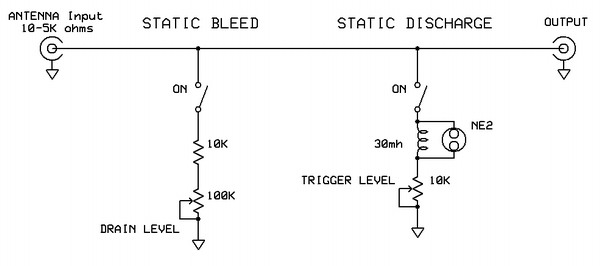
A basic "bleed" system in the time-honored tradition (long before transistors) was to shunt the antenna terminals with a 500K or 1 meg resistor. Here, we are just utilizing the basic functions to their minimum and maximum functional applications. A quick study or the circuits will reveal their utility.
Even with my latest end fed (quasi-Marconi) antenna, which I use almost exclusively for SWLing (and some 160 transmitting), there are significant "bursts' of unwanted junk getting through to the shack. The antenna is matched (and protected) with a very heavy duty 9:1 balun (wired as an unun). This configuration provides a nice low impedance path to ground for static buildup on the wire. However, nearby bursts, which are rich in RF component and harmonics do pass through the balun, as RF energy, and on down the line to the radio. At one point, before the balun was in place, I measured the number of times an NE2 neon tube flashed during a gentle, dry, quiet, winter snowfall. I coupled the NE2 to a photocell, which triggered a transistor switch attached to a digital counter. The counter registered 387 counts over the course of 4-5 hours. It should be noted that the NE2 would flash over at about 85 volts. One night, just prior to a summer thunder storm, we disconnected the long wire antenna down at the club. It is a 265 foot-long beauty. The PL-259 was removed from the switch box and brought over to our ground bus which has a series of SO-239s all tied to the shack's common, bonded ground system. As the connector approached the ground panel there was a brilliant flash of blue/white light which arced more than 1 inch - there was also a very loud, sharp snap ... somewhere in the 130 dB SPL area!!! The club members present that evening are now all believers in the power and speed-of-buildup of static electricity on and antenna ... especially a hi Z end fed!

8-23-06