Plants
in the rainforest
The following plant adaptations enable
tropical plants to live in the hot, humid and wet conditions of the tropical rainforest.
Bromeliads
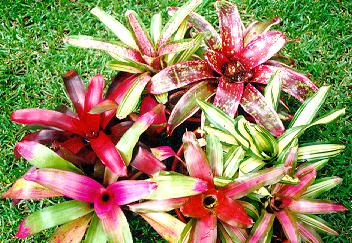 Bromeliads are related to the
pineapple family. They are found almost exclusively in the Americas. Some grow in the
ground but most species grow on the branches of trees. Small roots anchor plants to
supporting branches. Their thick, waxy leaves form a bowl shape in the
centre for catching rainwater. Some bromeliads can hold several
gallons of water and are miniature ecosystems in themselves providing
homes for several creatures including frogs and their tadpoles,
salamanders, snails, beetles and mosquito larvae. Those that die
decompose and furnish the plant with nutrients. One bromeliad was
found to contain several small beetles, crane flies, earwigs, a frog,
a cockroach, spiders, fly larvae, a millipede, a scorpion, woodlice
and an earthworm! Most bromeliads produce conspicuous flowers that are
pollinated by nectar-gathering birds.
Bromeliads are related to the
pineapple family. They are found almost exclusively in the Americas. Some grow in the
ground but most species grow on the branches of trees. Small roots anchor plants to
supporting branches. Their thick, waxy leaves form a bowl shape in the
centre for catching rainwater. Some bromeliads can hold several
gallons of water and are miniature ecosystems in themselves providing
homes for several creatures including frogs and their tadpoles,
salamanders, snails, beetles and mosquito larvae. Those that die
decompose and furnish the plant with nutrients. One bromeliad was
found to contain several small beetles, crane flies, earwigs, a frog,
a cockroach, spiders, fly larvae, a millipede, a scorpion, woodlice
and an earthworm! Most bromeliads produce conspicuous flowers that are
pollinated by nectar-gathering birds.
Orchids
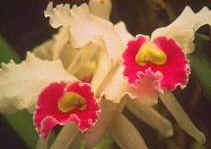 Orchids comprise one
of the most abundant and varied of flowering plant families. There
are over 20,000 known species and orchids are especially common in
moist tropical regions. Although temperate orchids usually grow in
the soil, tropical orchids are more often epiphytes which grow
non-parasitically on trees. Orchid flowers vary
considerably in shape color and size, although they share a common
pattern of three petals and three petal-like sepals. The lower petal
has a very distinctive appearance.
Orchids comprise one
of the most abundant and varied of flowering plant families. There
are over 20,000 known species and orchids are especially common in
moist tropical regions. Although temperate orchids usually grow in
the soil, tropical orchids are more often epiphytes which grow
non-parasitically on trees. Orchid flowers vary
considerably in shape color and size, although they share a common
pattern of three petals and three petal-like sepals. The lower petal
has a very distinctive appearance.
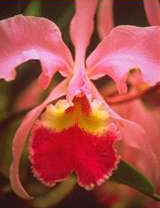 Gongora
Orchid: Like other orchids, the gongora grows on the trunks and branches of forest
trees. This orchid has brightly colored flowers that
produce a powerful fragrance attractive to bees. The gongora flower is shaped in
a way that attracts and allows only certain kinds of nectar-seeking bees to pick
up or to deposit pollen that they have carried in from other orchids. Without the trees the orchid would have no support on
which to grow. Without the bees the orchid would not be able to successfully
reproduce.
Gongora
Orchid: Like other orchids, the gongora grows on the trunks and branches of forest
trees. This orchid has brightly colored flowers that
produce a powerful fragrance attractive to bees. The gongora flower is shaped in
a way that attracts and allows only certain kinds of nectar-seeking bees to pick
up or to deposit pollen that they have carried in from other orchids. Without the trees the orchid would have no support on
which to grow. Without the bees the orchid would not be able to successfully
reproduce.
Crecropia
Tree
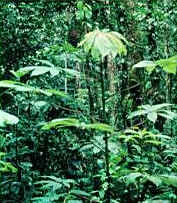
A tropical relative of the mulberry tree that is found in the understory and
lower canopy layers of the forest, cecropia are relatively small,
umbrella-shaped, quick-growing trees that can increase six feet in height each
year. They are relatively short-lived (rarely exceeding 80 years), and are
eventually replaced by other tree species that grow up beneath them and
ultimately reach the canopy. Cecropias are “pioneer” species that quickly invade
and colonize forest clearings, riverbanks, roadsides, abandoned farmland, or
other disturbed areas.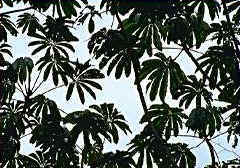 Cecropia trees have a hollow trunk and branches, which
are divided into a series of chambers by partitions. The tree produces special
structures in velvety-brown glandular patches under the leaf stems, providing
nourishment for Azteca ants, which defend the leaves.
Their leaves are eaten by some animals (e.g. three-toed sloths), and their seeds
are eaten by birds, bats, rodents like the agouti, and other animals. One study
of cecropia showed 8 species of monkey, 12 species of bat, and 76 different bird
species eating its dangling spike-like fruits.
Cecropia trees have a hollow trunk and branches, which
are divided into a series of chambers by partitions. The tree produces special
structures in velvety-brown glandular patches under the leaf stems, providing
nourishment for Azteca ants, which defend the leaves.
Their leaves are eaten by some animals (e.g. three-toed sloths), and their seeds
are eaten by birds, bats, rodents like the agouti, and other animals. One study
of cecropia showed 8 species of monkey, 12 species of bat, and 76 different bird
species eating its dangling spike-like fruits.
Nepenthes
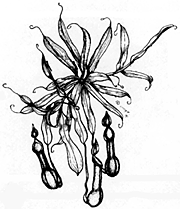
Pitcher plant vines in the family Nepenthaceae have leaves that form a
pitcher, complete with a lid. Sweet or foul-smelling nectar in the pitcher
attracts insects, especially ants and flies, that lose their grip on the slick
sides and fall into the liquid. Downward-pointing hairs inside the pitcher
prevent the insects' escape. Pitcher plants are not epiphytes but climbers
rooted in the soil.
Bamboo
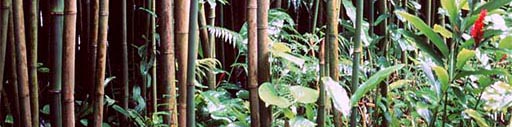
Bamboo is the world's largest grass and is native to many parts of the world.
It can grow
up to 120 feet high and have stems 12 inches in diameter. One Bamboo
plant was recorded growing at a rate of 36 inches in 24 hours. It is grown throughout the tropics and is used as a source of food as well as
for construction and weaving. It has great strength and is used in Japan as
scaffolding for building skyscrapers.
 Rafflesia
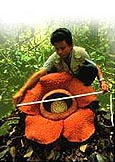
Rafflesia is a parasite that has the world's largest flower. It's over 3 feet
across and can hold several gallons of water. When it opens, the
rafflesia makes a hissing sound like a cobra. It also has the strong
odor and color of rotting meat, which attracts flies that pollinate it.
Giant
water lily
The giant water lily (Victoria
Amazonia) has leaves that can grow
over 5 feet across. It is actually strong enough for a kid to stand on
… although your feet will still get wet.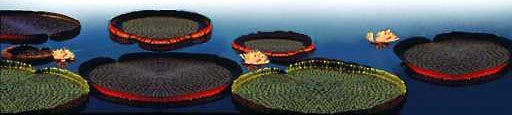
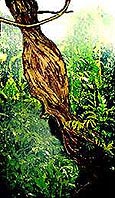 Monkey ladders
Monkey ladders are these very cool vines that grow in a zig-zag
fashion and look like ladders. They're filled with pure water, so
travelers only need their machete to get a quick drink if they want one.
When it comes to having everything, the rain forest doesn't "monkey
around."
Walking palm
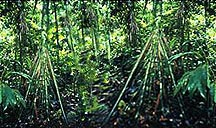 The
walking palm (Socratea Exouhiza) is one of those things that's
simply hard to believe. Here's a tree that forms stilt-like roots and,
over a period of time, picks itself up on them "walking" out
from under fallen trees or toward light. This is the only plant that
plants itself … wherever it wants to!
The
walking palm (Socratea Exouhiza) is one of those things that's
simply hard to believe. Here's a tree that forms stilt-like roots and,
over a period of time, picks itself up on them "walking" out
from under fallen trees or toward light. This is the only plant that
plants itself … wherever it wants to!
Heliconia
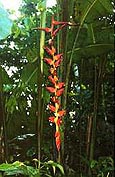
 The
heliconia is a gorgeous red hanging flower that
is pollinated only by the tropical hummingbird. The hummingbird's
predator, the eyelash snake, knows this and often curls up and waits
inside the flower. So don't stick your fingers in one without looking
first.
The
heliconia is a gorgeous red hanging flower that
is pollinated only by the tropical hummingbird. The hummingbird's
predator, the eyelash snake, knows this and often curls up and waits
inside the flower. So don't stick your fingers in one without looking
first.
 Acrum Lily
Curious observers have been known to faint from the overpowering stench
of the giant acrum lily. It's pollinated by carrion flies. You
won't have to follow my nose to find this one!