The matter prevails it is taken out in the barriers, making wells or holes, with a depth that varies between the meter and half and the two meters, and at once they are practiced small galleries to take advantage of the reef well, unless the mouth is very wide and in this case one generally works to discovered sky.
Two are the qualities but appreciable for the production of the pots: one more " ligoso " or strong conopcido like mud correvado that it was taken out of the barriers of S. Xinzo of Lobios and other but sandy, referred as mud farangullan", coming from Veiga of Liñares, of the parish areoso, referred as mud farangullán", coming from Veiga of Liñares, of the parish of S. Salvador of Figueiroá. As it is two white acnes, to give them something of color he/she mixes with referred mud. For the " spits " you úsan without mixing the mud farangullán that supports very high temperatures. In other times mud of other many places was taken out
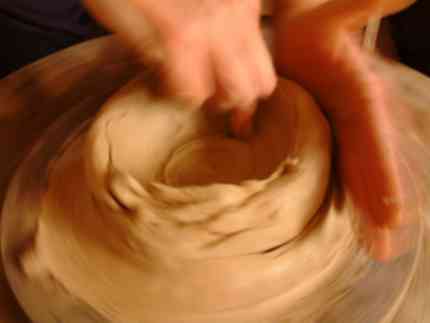
Once the mud is taken to the work place, annex to the potter's house, allows to dry off in a " barreiro ", a floor of stone flagstones. There it is hit with the " bar ", taken out iron piece of a sheet of wheels of car of the country. The operation with the mud is denominated to itch in turn he/she goes becoming moist with water with the purpose of that relents, " molentar "
When the mud this perfectly bothered one, they mix the different class of mud in the quantity to use for the task of every day and it is deposited on a plane stone that one knows as stone of hardening mud". to harden it it is hit with a wooden mallet of oak that has a mango of almost a meter long. Then kneading well, at the same time that becomes moist, with the feet and hands, to eliminate the sludges and to avoid that it takes clots. Of this treatment it is a base of mud denominated " piadela ". it is prepared this way, being formed two buns or " borillons ", for the task of the day that is left next to the wheel.
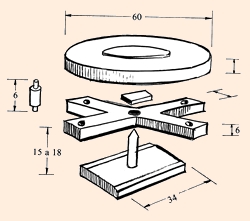
In Gundivos the Cacharreros works with wooden low " rodas " of oak, very thick so that their weight lengthens the turn of the same one that moves on a cherry tree axis, and that he/she has an approximate diameter of 60 cm. This wheel it takes a central piece, acquaintance as " fondeira " that is renewed for the waste that suffers with the use. For below the axis this fixed one in a " shaft ", a rectangular piece, also of oak, on which settles the group of the wheel. Under the wheel, immediately for under, two oak charts, crusades are the support point to rotate the wheel. At the present time the center of the cross usually takes a box of steel balls to facilitate the turn of the same one
For their handling, the wheel is placed in to the balcony of the house or in the kitchen if it rains or it is cold, and in the days of sun and of heat he/she puts on he/she went to the cool air. The cacharreros works the whole year, because the strongest sales are carried out in winter, for the time of the slaughter, or in the summer with the vintage. The handling of the lathe is thing of each cacharreiro or cacharreira. Only for the big pieces they specify help to move the wheel.
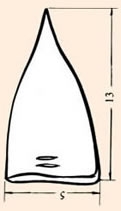
Several instruments are employees for the making of the pots in the lathe. A
simple wooden triangular sheet, of cherry, well-known as to whistles her",
of thirteen to twenty cm. In the base and sharpened in an end, it is used to
finish the external surface of the pots and for the tip for the decorations
incise. The linen " cloths " or wool, wet, they are to finish the walls and
the border, and the piece gives auga to clean the hands and the work
material