ISLAM: A REFORMED RESPONSE
When the violence of Islam is criticised, the usual responses by Muslims and others are: What about the Crusades? Isn't Christian history as bloody as Islamic history? What about Northern Ireland? However, such a simplistic comparison ignores a fundamental difference between the two religions, and evades pertinent truth. While the crusades were a failure on the part of medieval Roman Catholicism to obey the New Testament (see Matthew 5: 43-5; 26: 52; Luke 9: 56; Romans 13: 10; 2 Corinthians 10: 4-5; Ephesians 6: 12), Islamic violence is in perfect harmony with the dictates of the Qur'an (see Suras 2: 178, 244; 4: 84, 96; 9: 5, 12, 41, 73, 122).
So, a 'Christian response' to Islam demands careful definition. In short, by the standard of the Bible, both Islam and the Roman Catholic Church are guilty. Furthermore, Muslims were not the only targets of Vatican violence. Jews and Protestants have also been victims. While some early Protestants had difficulty in shaking off the violent and unbiblical legacy of Rome, the Reformed Churches appealed to the Bible against both Islamic and Roman persecution. Of all Rome's protestant victims, the Reformed Churches of France suffered the most. From (and even before) the St Bartholomew Massacre (1572) to the Revocation of the Edict of Nantes (1685), the catalogue of crimes against French Reformed believers defies the imagination. Indeed, Rome's methods were hardly different from those of Islam.
The root cause of Rome's policy against the Huguenots was the latter's rejection of papal tyranny and tradition in favour of a pure attachment to biblical doctrine and practice. Thus, the authentic 'Christian response' to both Rome and Islam is the 'Reformed response'. This is clearly reflected in a document entitled The Form and Manner of Baptising Pagans, Jews, Muslims and Anabaptists converted to the Christian Faith; composed by the National Synod of the Reformed Churches of France, assembled at Charenton [near Paris], in the year 1645. The form relating to Muslims is worthy of our consideration. It reminds us that the basic issues are those of Scripture, the person and work of Christ and the character of the Qur'an:
Q. 1 Do you ... believe that the Scriptures of the Old and New Testaments be inspired of God, and contain His whole counsel for the salvation of men, and are the only perfect rule of faith and life?
A. Yes.
Q. 2 Do you ... believe that Jesus the son of the blessed virgin Mary, who was conceived in her by the virtue of the Holy Ghost, and formed as to the flesh out of her own substance, is God and man, blessed for evermore, perfect God, and perfect man; man born of a woman in due fullness of time, and God begotten of the Father from everlasting?
A. Yes.
Q. 3 Do you ... believe that the Lord Jesus, from his first conception after the flesh, was holy, innocent, without blemish, and separate from sinners; and that he did not suffer death for his own sins, but for ours only?
A. Yes.
Q. 4 Do you ... believe that his death is the propitiation for our sins, yea, and for the sins of the whole world; and that this propitiation is infinitely meritorious, through which everlasting glory and salvation were purchased for us?
A. Yes.
Q. 5 Do you ... believe that Muhammad was an impostor, and that his Qur'an is a sacrilegious heap of idle fancies, full of absurdities, broached on design to set up a false and abominable religion?
A. Yes.
Q. 6 Do you ... believe that the Gospel of our Lord Jesus Christ is the power of God unto salvation, to everyone that believeth; and that in the Christian religion, only God the Father has revealed his good will and pleasure for the salvation of men, until the end of the world; and that since its revelation, there is not any new religion to be expected, for that the Lord Jesus Christ is the only great Prophet promised unto the faithful of the Old Testament; and that God having formerly spoken at sundry times, and in divers manners unto men, before the Law, and under the Law, has spoken to the Church of the New Testament, by the mouth of his only Son the Lord Jesus?
A. Yes.
Q. 7 Give an account of your creed.
A. I believe in God, the Father Almighty, creator of, &c.
Source: John Quick,
Synodicon in Gallia Reformata (London, 1692), ii. 449.
So may the Huguenots enable us to assess correctly the religious dimension of
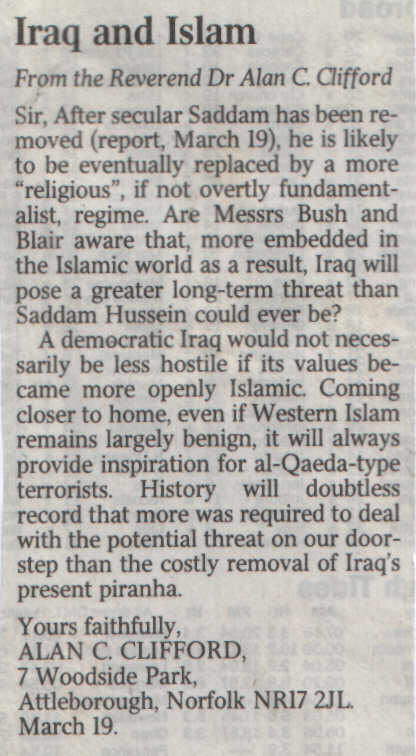
the current world crisis. While guilty terrorists must be brought to justice,
may we avoid a coalition crusade against innocent Muslims. May they only be
targeted with truth and lured by love. May God in His infinite grace and mercy
bring Muslims and inconsistent Christians to a true confession and expression of
the Gospel of His dearly-beloved and only-begotten Son, our Lord Jesus Christ.
Only then will the world know peace and harmony.
Pastor, Norwich Reformed Church
ISLAM DEBATE EPILOGUE
Dear Friends,
As the third anniversary of '9/11' approaches, I re-issue my 'Path to Paradise: Christ or Muhammad?' as an epilogue to our recent Islam debate.
We dare not lose
sight of the fact that our controversy with Islam is not only about free speech,
civilised values and democracy. Since authentic Christianity gave birth to these
things, their survival cannot be guaranteed without it. Thus the chief crisis we
face is the widespread collapse of Christian conviction in the West. Divorced
from its Protestant Christian roots, liberal democracy has exceeded the boundary
of all that is true, pure and wholesome.
The political and religious 'left' have corrupted our fountains. With biblical
spiritual and moral absolutes widely despised, we are being ruined by relativism
in every area of life. Much evil therefore exists at the very heart of the free
world. The resultant secularism is the mark of a civilisation in decay. As such,
it has no defence against militant Islam. The only antidote to this evil
religion and its barbaric ethos is the pure Gospel of Jesus Christ. Thus the
remedy for our crisis is not simply a matter of maintaining traditional
religious, political and social institutions. Now largely compromised, these
have no authority and integrity without personal faith and character at the
grass-roots.
An effective virtuous society demands the concensus of personal Christian
character. To enable us to focus on this fundamental requirement, the following
statement is presented for your consideration. It endeavours to deal with the
most urgent question of our times: will we have Christ or Muhammad?
Yours faithfully in Christ,
Dr Alan C. Clifford
Click Here for the Christ or Muhammad? Tract in Adobe PDF format.