 Farming and forestry have played an
important role for many years, because about 57% of the land is used for
farming and 32% for forestry.
Farming and forestry have played an
important role for many years, because about 57% of the land is used for
farming and 32% for forestry.| |Bavaria Home Page|OF Home Page| |
More about Bavaria
Farming and forestry have played an
important role for many years, because about 57% of the land is used for
farming and 32% for forestry.
Main products are rye, wheat, oat, potatoes, hops( Hallertau ), vegetables, fruit and dairy products in the Alps.
Bavaria has nearly no mineral resources except some ore, coal , granite, kaolin (china clay) and salt.
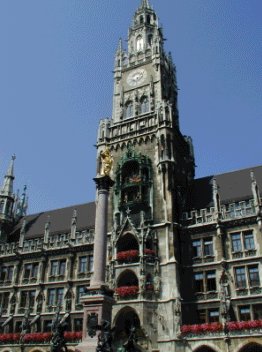
Tourism is very important for Bavaria. There are a lot of interesting cities like Munich, the capital of Bavaria, Regensburg, Nürnberg or Bamberg. But also the Alps and are worth being visited.
Upper Palatinate
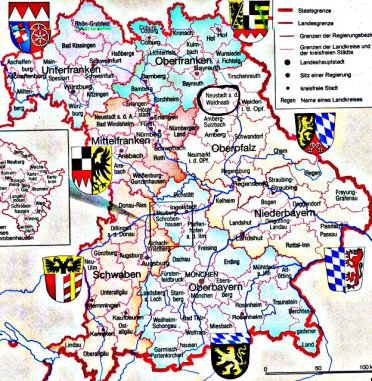 The Upper Palatinate is one of the seven districts
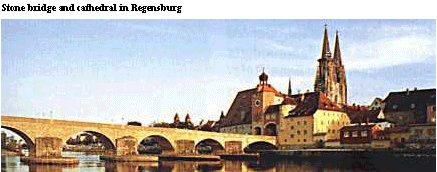
in Bavaria. Its seat of government is in Regensburg, one of the oldest cities
in Germany, thanks to its strategic location on the Danube. Historians have not
been able to precisely determine when Regensburg was founded, but traces of
human habitation dating back to the sixth millennium B.C. have been discovered
in the are. The town was already powerful back in Roman times. Weiden, dating
back to 1241, can give a visitor a glimpse into a hectic central European past.
First a flourishing trade centre thanks to its location on the "Golden
Road", the trading route to Bohemia, the town suffered terribly during the
Thirty-Years War. Fires and then the plague sped its economic decline and up to
the 19th century, Weiden was just a small, quiet, country town.
However when it was linked to the railroad network in 1863, Weiden’s
economy began to revive; a new glass and china industry developed. It now
prides itself as the city with the fastest expanding economy in the whole of
Bavaria during this century
The Upper Palatinate is one of the seven districts
in Bavaria. Its seat of government is in Regensburg, one of the oldest cities
in Germany, thanks to its strategic location on the Danube. Historians have not
been able to precisely determine when Regensburg was founded, but traces of
human habitation dating back to the sixth millennium B.C. have been discovered
in the are. The town was already powerful back in Roman times. Weiden, dating
back to 1241, can give a visitor a glimpse into a hectic central European past.
First a flourishing trade centre thanks to its location on the "Golden
Road", the trading route to Bohemia, the town suffered terribly during the
Thirty-Years War. Fires and then the plague sped its economic decline and up to
the 19th century, Weiden was just a small, quiet, country town.
However when it was linked to the railroad network in 1863, Weiden’s
economy began to revive; a new glass and china industry developed. It now
prides itself as the city with the fastest expanding economy in the whole of
Bavaria during this century