History of The Mayas
Formative (1500 b.C., to 212 a.C.)
During that long period of seventeen centuries, the Mayas were dedicated
to agriculture, activity that allowed them to establish permanent
population centers, and as a natural consequence, becoming sedentary.
That meant an important development and the base of the later culture.
They constructed platforms and wooden pyramids to raise their temples
and oratories, shortly after starting stone working, as well as
monochrome ceramics; modeling, very rudimentarily, small mud statuettes.
They learned to make metates so necessary to grind maize, the divine
grain, and managed to perfect some stone instruments: axes, hammers,
bars, et cetera. The culture advanced fast and, the most outstanding
settlements were the today called La Victoria, Izapa, Baúl and
Kaminaljuyu. In the meantime, in the central area Uaxactún and Tikal
arise in splendor, that would arrive at their maximum flourishing during
the next period. On the northern part, they founded Dzibilchaltún.
Pre-classic period (202 to 900 a. C.)
The wonderful wake number 29 of Tikal provided the investigators the
exact date in which it was carved, according to the very simple Mayan
numeral system:
The zero was represented with the symbol of a grain, a seed, meaning the
germ of all creation, because according to their mathematics, zero does
not mean nothing, it means the beginning. Number one was represented
with one point; number two, with two points; three, with three points;
four, with four points; five, on one line; six, one point and one line;
and thus until nine; ten, with two parallel lines; fifteen, with three
lines; sixteen, with a point over three lines. The numeration of larger
amounts followed an arithmetic system of positions that is out of this
section’s scope.
This period is, so to speak, the first step towards the high Mayan
civilization, because during it temples were constructed using the false
arc. The gorgeous wakes that now astonish us were carved (many of them
have been stolen) and which show complicated hieroglyphics; samples of
an art that other cultures of the same origin did not know, except for
the use of the vault in the tombs.
In the central area agriculture is perfected to optimal production. The
construction of ceremonial centers surrounded by innumerable human
nuclei begins. A very special theocracy is established, with diverse
degrees and hierarchies. Religious and civilian dignities were created.
Hieroglyphic writing reached unusual height and the Mayas wrote their
history in wakes not yet deciphered completely. They were skilled in
medicine and, mainly, in astronomy, mathematics and chronology. They
perfected the religious cult into a sophisticated art; and they excelled
in mural painting, sculpture, architecture, dance and music. The height
of such an extraordinary culture in the central area, occurred in the
Late Classic period, whereas in the north the development of its
peculiar culture does not begin until the central reaches its apogee.
Classic (292 to 650 a.C.)
In the southern area are noteworthy, by their perennial beauty the
cities of Kaminaljuyu, in Guatemala; in the central region, Tikal and
Uaxactún, in the Petén; Copán and Quiriguá in the valley of the Motagua;
Piedrasnegras, Yaxchilán and Bonampak, in the valley of the Usumacinta;
Tabasco and Palenque, in Chiapas. In the northern area, rise in the
region of the River: Bek or Bec, Xpuil, Hochob in the region of chenes;
Uxmal, Labná and Sayil in the region of Puuc, and Chichén Itzá in
Yucatan.
After the extraordinary flourishing of this culture in all the regions
of what we have called the Mayan Empire, decadence came, a phenomenon
that registers in the history of every civilization. The central area
fell in a secular sopor, according to the data obtained in the
hieroglyphs, and in the vestiges that still survive of wars or invasion
of strange people who, like in all Central America, happened with the
predominance of the military class that devastated those classic
cultures. To the Mayas misfortune, during the Late Classic period the
splendor of that fabulous culture disappeared forever. In the meantime,
in the southern and northern zones, the Mayas were not conquered
militarily, but amalgamated with the toltecs, who according to various
and diverse versions exerted on them a complete political and religious
dominion. So powerful it was, it forced then through time and
persuasion, to adopt the new rites and customs of those called pyramid
builders.
Numerous late chronicles talk about this period, some dated after the
Spanish conquest, one example of them is the Popol Buj, which mentions
the doubtless Toltec origin of the southern groups. From them the cult
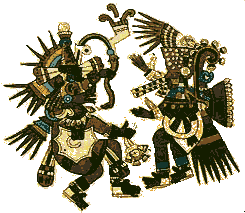
to Quetzalcoatl arises, the same God that they had adored for centuries
under the name of Kukulkán. These chronicles do not allow any doubt
about the influence exerted by the Toltecs in the already very cultured
Mayas, especially among the Mayas of Yucatan.
Around the year 987 a.C., commanded by Kukulkán (Quetzalcóatl) and
including as allies the Itzaes, nahuatlized Mayas and the Xiúes, they
founded the empire of Mayapán, governed by the Cocomes. Through a
political alliance between that city and the settlers of Yucatan, they
founded, in different periods, the great cities of Chichén Itzá and
Uxmal, two examples of the grandiosity that the Mayas achieved.
From cultural interchange the city of Uxmal flourished, almost
inexplicable in its beauty and astronomical perfection, and the
incomparable architecture of the numerous temples of Chichén Itzá.
Mayapan fills itself of pride, assumes itself owner and ruler of all the
empire and begins to watch over the Itzaes, then subjugates them and
finally starts a war whose end nobody could anticipate: Mayapán was
devastated around the year 1200. Almost all the small towns, their
houses, their ceremonial centers, their temples, altars and crops were
destroyed. Of the old and proud empire hardly a few traces were left.
Militarism delays the cultural advance of that privileged race, erase
all sign of its prodigious culture and they join the apocalyptic
destruction of the empire with several Mayan groups, until the
predominance from the Maya-quiches; though later, its hegemony ends,
almost at the same time as that of the Cocomes. The destruction is
complete, definitive, and from those ruins it will never again rise the
amazing Mayan culture.
That culture was able to create a really surprising mathematical system,
to such degree, that no other system reached its perfection and
philosophical sophistication. The Mayas were the creators of the concept
of zero, not the nothing, but the origin. And with the positional value
of their signs, managed to develop a chronology as perfect as the one
that centuries later we had to use and, not only that, but mathematics
that allowed them to reach really astronomical numbers since its
calendar, almost perfect in comparison with the one we use, covered many
centuries.
They knew, and this is really amazing, how to foretell Sun and Moon
eclipses. The Mayas, through a thousand years of constant advance in
their own culture, perfecting their very ample theology, come to believe
in the existence of a being created by the Heart of the sky (Hunab Ku).
This means, they believed in a unique God, although they continued
adoring, almost always in ocultis their old idols:
Itzamná, God of the sky and propagator of the culture;
Kinich Ahau or God of the Sun, hunter and patron of music and poetry;
Chaac, God of rain, perhaps the most ingrained God in the core of the
Mayan, inhabitant of a porous, almost desert land, fed exclusively by
the water in underground rivers, extracted of the natural wells
(cenotes);
Ixchel, goddess of the floods, fabric weaving and pregnancy;
Yum Xax, God of vegetation and perhaps of the maize, according to some
well-known hieroglyphic signs in its representations;
Ah Puch, God of death to which the souls of soldiers died in combat,
women died during the childbirth and of children were entrusted;
Kukulkán, God of the wind and cultural hero;
Xaman Ek, God of the afternoon star (Venus) and patron of the merchants.
But above all of them, like an insurmountable symbol of the divinity,
Hunab Ku, the unique God to which the other Gods served as contacts so
that the people adored Him and respected His laws.
The Mayas, like many eastern civilizations, strongly believed in the
existence of old lands inhabited by very advanced cultures, which had
disappeared because of a cosmic deluge.
The Mayas had a polisynthetic language of incorporation in which many,
many words, serve to express the highest concepts since it’s integrated
words that constitute a proposition. For example, Yacunah is constituted
by ya, pain and cunah, love; emotional binomial since it indicates for
the Mayan, that the one that loves suffers and the one that suffers
loves.
The mathematicity of the Mayan cosmic vision in which everything is
subject to measure and movement, conceptualized number 13 as the perfect
number, symbolized by the Oxlahuntiku or 13 Lords of the Superior
World. Once conquered, forced to believe in a new religion in no way
similar to theirs, they thought that the treason of Judas Iscariote was
breaking the numerical harmony of 13, when Jesus was crucified that left
only 12 apostles. The Mayas thought that they were created there, in
the territories of the Mayab, because they had not come from anywhere
else, from none of the four cardinal points. There they were because
there they were made by That whose name is said in a sigh (Hunab Ku).
In spite of their high religiosity, the Mayas knew how to evolve and
reach a cultural degree that, at the time, was unknown even in the most
advanced countries of Europe. So much so that without any known
technology, instruments or with some really primary ones, they
discovered and created, to believe in HIM, a unique God (Hunab Ku), and
they constructed in Uxmal astronomical observatories that allowed them
to know the march the Sun, the Moon, Mars, Jupiter, Saturn, the Pleiades
to the Constellation of the south, the Milky Way and the Afternoon Star
(Venus).
They made very diverse and precise calendars and knew (before many of
their contemporaries in other countries) of the roundness of our planet,
the precision of the equinoxes, the sidereal year and the tropical
year, the skies of the eclipses of the Sun and the Moon and, which is
really amazing in case all of the above isn’t, the effects of the
sunspots and sun storms in the life of our planet. This allowed them to
predict cataclysms, deluges, hurricanes, storms, sea currents and, some
say, even the movement of land masses. This may be a reason why, perhaps
opportunely and effectively, they left their possessions, temples,
crops, teir homes and their Gods, towards high lands in Guatemala.
Before starting off, without imagining that it would be forever, they
covered with earth and weeds all their majestic constructions that
slept, for centuries, under the earth that they loved so much.
Any questions, comments or suggestions, please send to Email: [email protected]
