
home page | parable menu | main menu
home
page | parable menu | main
menu
 |
Matthew
19:16-30And someone came to Him and said, "Teacher, what good thing shall I do that I may obtain eternal life?" 17 And He said to him, "Why are you asking Me about what is good? There is only One who is good; but if you wish to enter into life, keep the commandments." 18 Then he said to Him, "Which ones?" And Jesus said, "YOU SHALL NOT COMMIT MURDER; YOU SHALL NOT COMMIT ADULTERY; YOU SHALL NOT STEAL; YOU SHALL NOT BEAR FALSE WITNESS; 19 HONOR YOUR FATHER AND MOTHER; and YOU SHALL LOVE YOUR NEIGHBOR AS YOURSELF." 20 The young man said to Him, "All these things I have kept; what am I still lacking?" 21 Jesus said to him, "If you wish to be complete, go and sell your possessions and give to the poor, and you will have treasure in heaven; and come, follow Me." 22 But when the young man heard this statement, he went away grieving; for he was one who owned much property. 23 And Jesus said to His disciples, "Truly I say to you, it is hard for a rich man to enter the kingdom of heaven. 24 "Again I say to you, it is easier for a camel to go through the eye of a needle, than for a rich man to enter the kingdom of God." 25 When the disciples heard this, they were very astonished and said, "Then who can be saved?" 26 And looking at them Jesus said to them, "With people this is impossible, but with God all things are possible."
|
| What Did
Jesus Mean
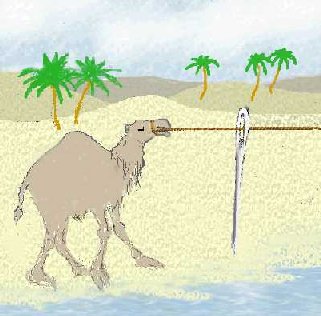
This parable poses many questions: Is it possible for a
camel to be threaded through the eye of a needle? It has been said that the eye of the needle was in fact a small entrance on the city wall, an opening intended only for people. Perhaps with some help a camel may get through that gate. If he fasts a little and loses his surplus hump - relying on God in day to day living. The camel could unburden himself of his heavy load of riches - you get the idea now, he is getting smaller. The camel could stretch out his long lofty neck - prostrate himself. He could also try to get on his knees in prayer. At last it is looking like a possibility. But at the end of the day, the camel still requires assistance, he needs someone to push and shove him through that entrance. It's a tight fit but he may make it through the doorway. Many scholars have discounted the narrow doorway idea - there is no definite proof that this gateway existed. They say the story became popular in the middle ages, encouraged by the rich who liked this version, preferring to think that there may be a way for them to enter heaven. Another idea put across by
scholars, is
that the original Greek tells not of a camel, but a rope (kamilos
These alternative views are interesting but they do not shed light on what Jesus was saying. The rich young man had many concerns in life, the more we possess materially the more the world weighs our spirits down. Our focus becomes on our possessions instead of on heaven. The crux of the parable lies in the words of Christ "With people this is impossible, but with God all things are possible." All of us find it impossible to enter heaven except by way of a miracle. That miracle is the free gift of God, the gift of forgiveness. |
7 October 2002 - Nancy Rosie - Seeds of Love
 ).
When it was translated into Latin, kamilos was confused with
kamelos
).
When it was translated into Latin, kamilos was confused with
kamelos  camel).