Version 4.0 from 3/1/01
Introduction
"Niewodowski Families of Modzele and Suchekomnaty Homes" is the second part of the work dedicated to reproducing genealogy and description of Gulinski, Niewodowski and G�recki families, and to present Janina Home. The work presented below is being updated, as new information becomes available.
Niewodowski Families of Modzele and Suchekomnaty coat of arms
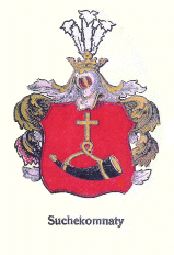
At the end of XIV century (1), Janusz, the Mazovian Prince, become planned settlement of Mazovia. A part of his action was buying back in 1402 part of the region called "Ziemia Wiznenska" from Teutonic Order. As a result of prince donatons, many new villages were established. After receiving fourty lans of woods called Sokolalaka from Prince Janusz, Mikolaj established Modzele village and property. His brother or son, Scibor of Modzele in 1404 received next ten lans of the same area (2). Szymon of Modzele was Mikolajs or Scibors brother or son.
Szymon of Modzele (3), of Modzele Clan, may be considered a progenitor of the Niewodowski family. He and his nephew Sunislaw, from Zakliczewo (4) in 1417 for their merits received sixty wl�k (5) of land in Niewodowo and Drozdowo area of the Wizna region (6,7) from Janusz, the Mazovian Prince of Czersk and Warsaw. It is unknown if this donation was a part of Janusz settlement plans, or it was a reward for a taking part in the Great Battle of Tannenberg in 1410 against Teutonic Knights Order. That privilege was approved in 1420 by Ziemowit IV, Prince of Plock to Sunislaw and to Szymon's sons: Adam, Mikolaj, and Jan. In 1420 Sunislaw of Zakliczewofounded a parochial church in Drozdowo. This church was erected in 1436 by bishop Stanislaw (1), and was burnt in 1737. Adam, Mikolaj and Jan divided Drozdowo propery, and they began to call themselves Drozdowski. Sunislaw, on other hand, who received the Niewodowo part of the land, began to use name Niewodowski. Later most of Niewodowskis changed the Home, and moved to the Suchekomnaty Clan (6,8,9). According to Starykon, some of Niewodowskis belonged also to the Pilawa Home. Uruski (6) assigns some other Niewodowskis to the Lubicz Clan, but the authors don't reveal their sources.
As shown above Niewodowskis, Drozdowskis, Modzelewskis and Zakliczewskis have the same ancestral roots.
Jan Niewodowski, probably Sunislaws son, of the Suchekomnaty Home, is mentioned in Akta Lomzynskie (10) in 1427. He and Piotr in 1496-1497 participated in the Woloska Expedition (11). Bernard, son of Andrzej proved his nobility status in 1510 (12) in the City of Lomza. The same year Malgorzata, a daughter of Andrzej married Stanislaw Kozak, a prosecutor from Siemien (13). Dorota Niewodowska, in 1590 was Jakub Budziszowski wife.
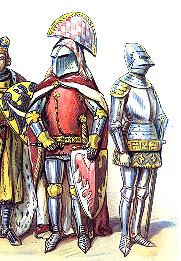
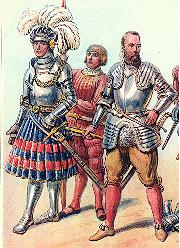
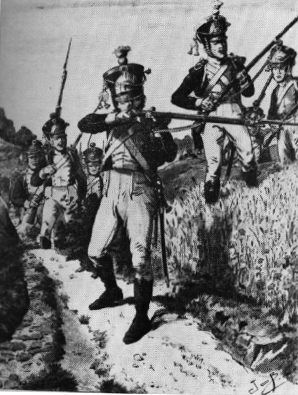
The knights of XIV, XV and XVI century present illustrations A and B.
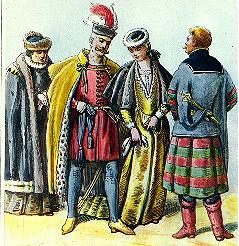
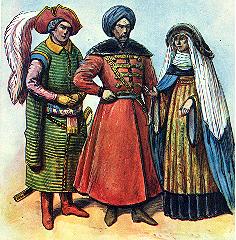
Typical dresses of nobilty from XVI century present illustrations C and D.
Jakub and Stanislaw signed the election of King Michal Wisniowiecki in 1669. Agnieszka Niewodowska and her husband, Jan Jeziorkowski, a Rozansk standard - bearer (14) proved their nobility status in 1700. Tomasz, voted in 1697 (6) for King August II.
The above-mentioned Tomasz married Agnieszka Jeziorkowska, and they had a son Antoni, who in 1761 was the county treasurer (15) of Wizna and then a Wizna City official (16). Antoni voted for King Stanislaw August in 1764 . Antoni's son, J�zef, was in 1789 a donation commissary (17,18).
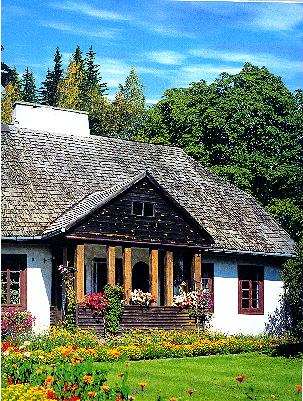
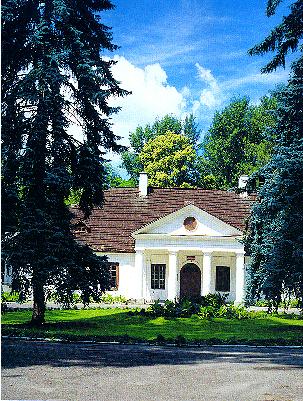
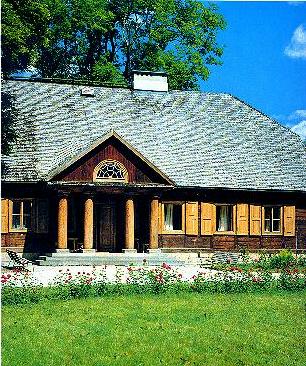
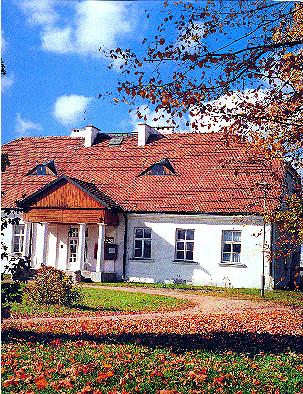
Typical nobilty residences are presented on the following photos: E , F , G and H.
Tadeusz Niewodowski, son of J�zef and Brygida Cywinska, born in 1782 in the village of Bokszyszcze, in August�w region, served in Prussian military between 1799 and 1806, where he received the rank of second lieutenant. He joined Warsaw Duchy military, where he fought against Prussia in 1806 and 1807 (4). St. Kirkor (19), based on the French documents, presents Tadeusz as born in Niewodowo. According to Kirkor, Tadeusz in 1808 joined the Vistula Legions fighting on the Napoleon side in Spain. Tadeusz was a second lieutenant of second regiment. In 1810 he was assigned to an elite unit, and a year later he was promoted to lieutenant rank. He fought in Spain, Russia, Saxonia, and in 1813 during the fights near Leipzig he was wounded, and taken prisoner by Prussians. During the captivity period, Napoleon surrendered, and the Polish forces came back to Warsaw Duchy. Tadeusz was promoted to captain in 1813 and in 1815 rejoined Warsaw Duchy forces. In 1816 he finished military duties, but in 1821 he came back to Ulhan Regiment, and in 1824 was promoted to rank of lieutenant colonel. In 1825-1828 Tadeusz worked for Sejm Court (20).
According to Stanislaw Niewodowski research done in the fifties of this century, during the independence insurrections Niewodowskis fought against Russian forces, they were captured and sent to Siberia. Later they immigrated to Galicia. The Niewodowo property was owned by quite few people: Burskis, Godlewskis, Trzeszkowskis, Chludniewicz and Lutoslawskis (21).
The first birth of the Niewodowskis in Galician city of Brzostek is documented in seventeen eighties. It would mean that Niewodowskis settled down in Galicia at the time of early independence movement, probably during the Bar Confederation of 1768 - 1772. Wojciech, Pawel Antoni and Lukasz probably fought under the command of Casimir Pulaski, the Marshall of Lomza Confederation, whose forces fought also in Galicia. All four Niuewodowskis married in Brzostek. The indication comes from the last names of their wives.These Niewodowskis, who moved to Galicia, lost their land in Mazovia, so they are not listed as nobles (24). In Galicia they must became local townsmen. In late nineteen century due to the regional overpopulation, many people immigrated to USA. That group consisted family of Karol Niewodowski and family of Jan Niewodowski (25).
The Niewodowskis from the side of the author mom, appear in the sources in 1792, when in Brzostek an older brother of the author great-great-grandfather Michal was born. His parents were mentioned above as Lukasz and Helena Jastrzebska. Michal b. 3.IX.1796 married Katarzyna Oszkanda. Their fifth of seven children wasr Jozef Wladyslaw b. 11.IX.1835 in Brzostek. Jozef, later a clerk in the Post Office, married Katarzyna Bieniarz, with whom he also had seven children. His son Jozef Wladyslaw, b. 16.I.1870 in Rzeszow (26), died in Niepolomice 23.II.1921. At the age of twenty four he married 19 year old Katarzyna Sehn, a daughter of a rich and well educated Austrian townsmen from Rzeszow. Katarzyna was madly in love with Jozef, and resigned her rights to the family wealth to marry Jozef. She pledged publicly to raise their future children as Poles. Jozef, educated as a teacher, worked at the Rail as the senior controller. All their children were born in Cracow. Emilia, the youngest of six, who was born 30.IX.1916, was his favorite. After each business trip Jozef brought his children small presents which he would hang on buttons of his uniform. The lowest hanged present was for the youngest daughter.
Tracing Niewodowskis from the Wizna region is difficult as the Drozdowo church, with its three hundred years old documents, had been burnt to the ground in 1737 (27). Fortunately some records survived and recently were microfilmed by the Latter Day Saints Church researchers. The pre-1808 church certificates from Wizna parish still remain missing.
Currently, the known Niewodowskis are 1) Konstanty Niewodowski - Furowicz b.1898, the son of Antoni, a judge and second lieutenant of the reserve forces (28), and 2) general physician, captain Witold Niewodowski, killed during WWII in 1939 (29).
Summarizing, the Niewodowskis come from not wealthy nobility, but till XVIII century they held many senior positions in Lomza - Wizna region. Probably they sold the land early, and these that settled down in Galicia joined the local townsmen class. It is not proven, if Niewodowskis owned the land in XIX century, but they are not listed as nobility according to the 1848 nobility list (30).
Andrzej GulinskiSources
(1) Dzieje Mazowsza - Mazovian History p.350 to 352
(2) Smolenski, Szkice z dziejow szlachty mazowieckiej - Mazovian Nobilty, p.19
(3) Red. F.Sulimowski, B.Chlebowski, W.Walewski Slownik geograficzny kr�lestwa polskiego i innych kraj�w slowianskich - Geographical dictionary of Polish Kingdom and
other Slavic nations Warsaw 1880-1902 ( later: SGKP) v.6 p. 575. Modzele - a village on Narew river coast, Makow county, Sielun parish
(4) SGKP v.14 p.296 Zakliczewo, a village on Orzyc river coast, Makow county, Makow parish
(5) Zygmunt Gloger, Encyklopedia Staropolska (later ES) v.4 p.456. One wl�k was the area that could be plough with a pair of bullocks during one day
(6) Seweryn Uruski, Adama Kosinski, Rodzina, herbarz szlachty polskiej - Polish Armorial Warsaw 1904 - 1917 r. v.9 p.?
(7) Starykon, Kasprzycki, Polska Encyklopedia szlachecka - Polish Armorialv.9 s.?
(8) Ignacy Kapica Milewski, Herbarz - dopelnienie Niesieckiego - Additions to Niesiecki Armorial v.? p.?
(9) Borkowski, Roczniki szlachty polskiej, Spis nazwisk szlachty polskiej, Genealogia zyjacych rod�w polskich - Polish Armorial
(10) Akta Lomzynskie - Lomza City Records
(11) Baranowski, Spis rycerstwa powiatu wiskiego i wasoskiego, kt�re uczestniczylo w wyprawie woloskiej 1497 r. - Knights of Wizna and Wasock county, who took a part in Woloska Expedition in 1497, Warsaw, p.50
(12) Zbigniew Leszczyc, Herby szlachty polskiej - Polish Armorial, p.305
(13)Mazowieckie zapiski herbowe - Mazovian Coat of arms descriptions p.877
(14) ES v.1 p.240, 241. A high rank officer, and county official, who during wars or festivities carried a standard in the front of retinue
(15) ES v.4 p.242. A county clerk responsible for tax and other payment collection and preserve.
(16) Slownik staropolski - Historical Dictionary, PAN, Wroclaw - Warszawa - Krak�w, 1956 - 1959 v.4 p.202 and 203. An official who during celebrities
carried a sword at the front of Wizna burgrave retinue
(17) Metryka Koronna - Polish Kingdom Records,
(18) Verdicts of Piotrkow Tribunal
(19) Stanislaw Kikor, Legia Nadwislanska 1080-1814, - Vistula Legion 1808-1814, London 1981, p.453, 532, 548
(20) Odpisy aktow Delegacji Sadu Sejmowego ( z Katalogow rekopisow Biblioteki PAN w Krakowie, t.2, sygn 2228). Documents of Sejm Court (from Library of PAN in Cracow, v.2, # 2228.
(21) SGKP v.2 p. 162
(22) From birth, marriage and death register from catholic parish in Brzostek
(23) Ks. Bogdan Stanaszek, Brzostek i okolice, Brzostek and sourrourdings, Towarzystwo Milosnik�w Ziemii Brzosteckiej, Brzostek,
1997, p.30,31
(24) Poczet szlachty galicyjskiej i bukowinskiej - A list of Galician and Bukovinian nobility, Lwow, 1857
(25) According to family data from U.S.A.
(26) From birth register from catholic parish in Rzeszow
(27) Antoni Skiwski, Piecsetlecie parafii Drozdowo, 500 years of Drozdowo Parish, Lomza, 1935, p.17
(28) M. Skrzynska-Pawinska, Rozstrzelani w Charkowie - Killed by Soviets in Charkow, Osrodek Karta, 1966 v.2 p.138
(29) Stanislaw Truszkowski, Przeciw nawale, pamietnik dow�dcy 201 pulku piechoty, Against Invading Army. WTK Warszawa-Wroclaw,
Tygodnik katolicki PAX, an article, Nr.18 (920) from 2.V.1971r.
(30) Spis Szlachty Kr�lestwa polskiego z dodaniem kr�tkiej informacji o dowodach szlachectwa - List of nobility in Polish Kingdom, Warsaw 1851
Further reading titles are located here