Sad Saga of Mad and Bad Thai Monks
by Phairath Khampha
31August 1999
The tense stand-off between thousands of supporters of a controversial Thai monk and police was just another embarrassing episode in what has become a very tired soap opera. Young enthusiasts outside the ambitious Dhammakaya Temple on the outskirts of Bangkok said there could be violence if the authorities tried to arrest their hero abbot, Phra Dhammachayo, who was exposed to being a venal sort of religious leader of what in effect is considered to be a Buddhist cult making a mockery and travesty of the Buddhist religion.
|
The Interior Ministry on August 23, 1999 approved his arrest after months of delay. The venal monk was charged with crimes of malfeasance, embezzlement and making false statements. It is a story that has been going on since early 1999 and equally corrupt officials were quite reluctant to make moves against the abbot of a temple whose near-cult following threatened to create mayhem should the corrupt religious operation be shut down. Thailand is obviously rapidly sliding into moral decay when the once revered Buddhist religion is now also being used to extract wealth out of an increasingly impoverished people. |
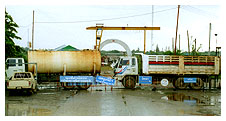
Prime Minister Chuan Leekpai called for calm and urged the abbot to surrender, as 400 police took up positions outside the sprawling compound. A rumour among the 10,000 people gathered in the temple was that the police might try a helicopter assault.
The history of the Thai religious authorities' dealings with mad and bad monks suggests the saga still has many episodes to run. During a period when Thais are going through an extraordinarily stressful time dealing with unemployment, debt and uncertainty as a result of the economic crisis that started in 1997 in Thailand and spread throughout the Orient, their need for spiritual help would seem to be as high as it has ever been.
|
The Dhammakaya temple's chief critic, Satienpong Wanabot,
a columnist on the Kao Sot newspaper, said: "Thais need spiritual
help, not a pyramid-selling scheme dressing up as religion. What cries out
for decisive action by the authorities has just been turned into another
soap opera."
This may be a bit harsh on television.
|
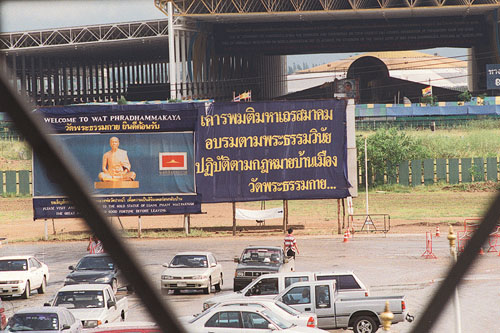
A popular series that had just ended - Khun Daed - featured a strange but sincere temple protector who kills religious thieves. What would Khun Daed think of a temple that offers special meditation techniques for a quick trip to heaven to check on Buddha?
The Dhammakaya movement - founded by engineering students 30 years ago - has pandered to modern, young Thais' demands for more religious bang for their buck.
Donations, not surprisingly, will also yield business success or luck in love-or so the usually gullible Thais are lead to believe. This is all cheeky to say the least for a religion whose central tenant is denial of the self and of materialism.
Buddha himself discussed the problems of bad or deviant monks and strongly recommended that they be - if culpable - defrocked quickly. Of course the temple could simply transform itself into an executive de-stressing centre. But then it would not have the trappings of a real religion that even suckers for the fashionable still crave.
Sect Leader Submits to Police Questioning
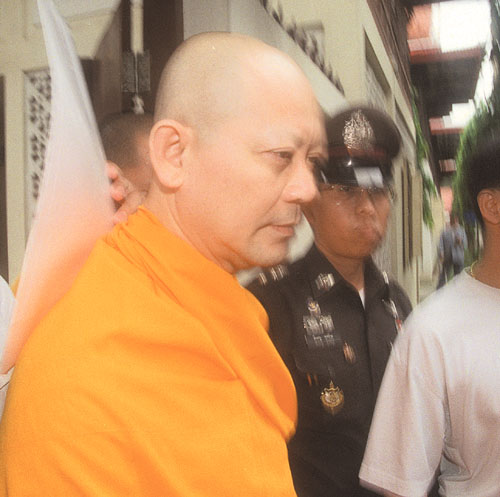
The controversial Thai Buddhist abbot accused of fraud, embezzlement and heresy submitted to police questioning on August 25 after ending a two-day standoff at his sect's headquarters.
|
Live television showed Phra Dhammachayo, head of the Dhammakaya sect,
arriving at the Bovorn Nives temple in Bangkok's old town after agreeing
to leave his sprawling headquarters on the outskirts of the city that supporters
had barricaded since a warrant was issued for his arrest on the night of
August 23.
Some 300 anti-riot police and 100 policemen in plain clothes were deployed around the Bovorn Nives temple, which is also run by Dhammachayo's sect. The abbot's supporters had warned earlier they would resist any attempt to arrest him by force. |
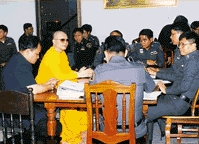
The abbot was released on bail later in the day after questioning, a compromise that would allow him to remain in the monkhood for any trial, making a mockery and travesty of the Buddhist religion.
|
"I understand that he will not be defrocked during the trial and police
will agree to grant him bail," Education Minister Somsak Prisananantakul
told reporters. Dhammachayo had refused to surrender to police unless he
was guaranteed bail, something the government said earlier it was unable
to guarantee.
Disgusted Thais took to the streets and burned effigies of the obviously corrupted abbot. |
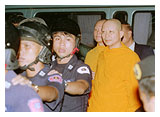
Abbot freed on bail and vows to fight charges
Important evidence has come to light, said investigators as Phra Dhammachayo was charged formally with embezzlement and abuse of authority after he turned himself over to police at Wat Chanasongkram in Bangkok on August 25.
Chronology Events Leading to the Arrest of Dhammachayo |
After three hours of questioning,
investigators said the abbot of Wat Phra Dhammakaya had inadvertently disclosed
information that could be used for additional charges under the new anti-money
laundering act. Thavorn Promthavorn, a close aide, was charged with being
an accessory. They denied the charges and were each released on two-million-baht
bail. In a statement, the abbot said he would defend himself in court and
appealed to all parties to be orderly.
Pol Gen Pornsak Darongkhavibul, the deputy police chief, who questioned the suspects, said he had evidence the abbot had bought himself land with temple money which had also been transferred into the bank accounts of others. The abbot, he said, had also deposited donations with a finance company without the consent of the Religious Affairs Department. A source said police had obtained evidence that Phra Dhammachayo had bought a 900-rai (1 rai=1,600 m2) plot on the border of Phichit and Petchabun provinces under his lay name of Chaiyaboon Sutthiphol from Charnvit Temkamol for about 10 million baht (1 US Dollar = 38.36 Thai Baht). The source said gold had been found on the land and Phra Dhammachayo told the vendor, a geologist, he planned to use it to cast a huge Buddha image. Mr Charnvit told Crime Suppression Division police the abbot paid for the land by instalment. The source said additional evidence had come to light that Phra Dhammachayo had transferred a huge sum of cash into the bank account of a nun. Pol Gen Pornsak said bail was granted because the abbot and his aide were unlikely to flee or intimidate. In addition, the abbot's release would pre-empt possible unrest. Pol Lt-Gen Vassana Poonlarp, leading the investigation, said measures had been taken to prevent the abbot leaving the country. Phra Dhammachayo's conditional surrender at Wat Chanasongkram instead of a police station was agreed late on the night of August 24 in talks between the abbot's followers and Sanan Kachornprasart, the interior minister, at the temple in Pathum Thani. During the talks, Somdej Phra Maha Thiracharn, abbot of Wat Chanasongkram, had recommended Phra Dhammachayo be granted bail. Phra Dhammachayo was given three options for his surrender and chose Wat Chanasongkram over Wat Paknam Phasicharoen and Wat Saket because Somdej Phra Maha Thiracharn oversees Wat Phra Dhammakaya. Wat means temple in the Thai language. Accompanied by Phra Tattacheevo, his deputy, another monk and a lawyer, the abbot surrendered as 600 anti-riot policemen stood guard in and around Wat Chanasongkram, where a number of fire trucks stood by. The security cordon failed to stop a fistfight between a group of Dhammakaya disciples and opponents as they tried to take away the ignition key of a temple van with its engine being kept running. The incident involved 10 people on each side, and a man was taken into custody but was not charged. About 500 monks and Dhammakaya followers also arrived at the temple aboard 10 buses which were, however, diverted to Sanam Luang by the police. Aside from the criminal charges, the source said Somdej Phra Maha Thiracharn would raise defrocking proceedings against Phra Dhammachayo with the Sangha Council. Pipob Kanchana, the director-general of Religious Affairs Department, said, however, that the defrocking proceedings against the abbot would have to wait. |
1998 |
|
November |
|
1999 |
|
January |
Somporn Thepsittha, leader of the Buddhist Youth Centre, on August 25 called on the monastic body to temporarily demote Phra Dhammachayo from being an abbot pending criminal proceedings.
Led by Pong Leng-ee, former director-general of the Forestry Department, the cultists claimed that the police action against Phra Dhammachayo ran against Article 38 of the Thai constitution, which guarantees an individual's freedom to profess a religion, a religious sect or creed and observe religious precepts.
Temple still attracts thousands - Abbot urged devotees to contribute more
Despite the legal battle being waged against its abbot, it was business as usual at Wat Phra Dhammakaya on August 29, as thousands of followers showed up to hear a sermon by their soft-spoken religious leader. Phra Dhammachayo, who was currently out on bail under charges of embezzlement and abuse of authority, told his disciples to make merit by donating more to help him complete the Phra Maha Dhammakaya Chedi, which is still under construction.
The weekly ritual began with hour-long chanting by monks followed by 45 minutes of meditation, after which Phra Dhammachayo told followers to be good donors and to have faith in his teachings.
"Giving help makes people good. Those people who give will have a prosperous next life. The more you donate, the more you will receive in return," he said. Phra Dhammachayo said several thousand monks had been invited to pray at the temple the week before but since donations had dropped there was not enough money to buy lunch for everyone who was there to perform the religious ceremony.
Suphachai Srisuphaaksorn, a temple representative, on August 29 denied the August 22 gathering was organised to demonstrate followers' support for Phra Dhammachayo, amid reports at the time that police had issued an arrest warrant for the abbot. A large number of devotees had showed up that day to celebrate the 30th anniversary of Phra Dhammachayo's monkhood, he said.
Suphab Boonyuensri, a follower who visits the temple at the end of every lunar phase, said he goes there to make merit and meditate, and would continue to do so no matter what happens to the embattled abbot of Wat Phra Dhammakaya. Others shared Mr Suphab's view. They also said they were willing to donate money to the temple because they were happy to do so.
Phra Dhammachayo was questioned again on August 30 and heard two additional charges of fraud and making false statements to police. Investigators had evidence that Phra Dhammachayo had used the temple's donations to buy 1,700 rai of land in Chon Buri, Phichit and Loei provinces under his own name, substantiating the charge of embezzlement. The investigation was to be concluded by September 2.
Police Scour Temple - Documents Detailing Donations Seized
Police with a search warrant scoured Wat Phra Dhammakaya for evidence against its abbot who has been charged with embezzlement and abuse of authority. Led by Pol Lt-Col Wassana Permlarp, chief investigator in the case, the 20-strong unit spent five hours on August 31 searching 11 areas including the quarters of Phra Dhammachayo, the abbot, Phra Thatacheewo, his deputy, and the Wat Dhammakaya Foundation centre.
Pol Lt-Col Wassana said documents police had wanted had been found but he refused to elaborate. However, a source said police confiscated a list of the people who had made 10,000-baht donations and had received amulets in return. Pol Lt-Col Wassana said investigators had yet to question more witnesses, among them Phra Palat Sutham Suthammo, assistant abbot, Phra Suvichato and Phra Visanu Panyaripo. Phra Dhammachayo also refused to be questioned, saying he was suffering from diabetes and mild diarrhoea.
The temple said it planned to submit a 50,000-signature petition to ask the Constitutional Court to rule if its rights under article 38, which provides for freedom of worship, has been violated. It has accused the police, the Education Ministry and the Public Relations Department of violating its rights by discouraging followers and monks from joining religious functions.
Education Minister Somsak Prissanananthakul said the temple had to choose between two sects recognised here.
"As long as it doesn't change religion, it must choose between the sects and stick to the principles of either of them. It cannot set up a new sect," he said. Mr Somsak has also asked the department to follow up a Sangha Council's order which asked Phra Prom Molee, the head of monastic region 1, to submit a written report on the dismissal of the ecclesiastic charges against the abbot and his deputy. The Sangha Council is Buddhism's holiest and highest body of authority in Thailand.
According to the minister, the report is to be submitted to Phra Mahateerajarn, the chief monk of the central region. The minister also denied involvement in two religion-related draft bills that have aroused debate. He said the bills were the work of the House religious affairs panel, which had failed to gather opinions from the monks and members of the public.
Ignoring the robes for the man inside
Dhammachayo, the controversial abbot of Dhammakaya Temple, surrendered himself to law enforcement authorities, and ended more than a year of foot-dragging and technicalities under monastic proceedings and civil attempts to investigate his conduct considered unbecoming to monkhood.
This does not mean the end of the Dhammachayo saga, but rather the beginning of a new chapter when the public will see him defending himself against charges relating to the misappropriations of temple's funds in questionable commercial and real estate investments.
Finally proven wrong or otherwise, Dhammachayo's persistent pursuit of material wealth and his indulgence in business ventures under the cloak of religious practices are definitely not in line with the Buddhist teachings which require monks to be devoid of earthly lust for physical comfort and affluence.
All these long years, the amassing of wealth and vast tracts of land -- not to mention a large cash hoard -- have been ignored by his disciples and followers whose faith in him remains unshaken until the very day he gave himself up to the police. Was it blind faith? It cannot be said so, because Dhammachayo also commands the following of many monks. Not only that, he has also dispensed favour to senior monks who have the say and monastic influence in blocking legal actions.
They are in the same league. Those monks have enjoyed good living and accommodation far more than the lay people who have long been listening to their preaching encompassing modesty and to be void of the sinful struggling for material wealth. The monks in the high circles are not practising what they preach.
The whole controversy has now made the public understand that monkhood for many men with shaven heads and dressed in saffron robes is certainly a way of living in assured comfort and wealth if they belong to the right temples and are part of the influential hierarchical connections. The rewards are identical. There are ranks, status and the perks which come with advancement up the monastic ladder.
The irony in the Dhammachayo case is that the monk, with guileful manoeuvring and scheming, has been resisting the social pressure for him to be subject to the law of the land. With huge funds and an army of well-experienced lawyers, he has erected elaborate obstacles which have made the government look pretty powerless. Together with the senior monks, he has even ignored the directives of the Supreme Patriarch who has already regarded the abbot as a rogue preacher.
Dhammachayo is not alone in the vast number of Buddhist monks who aspire for wealth and comfort. There are many others, but none of them are as influential, well-connected and financially powerful as the Dhammakaya abbot. The prosecution of the monk raises more questions than answers simply because, if he remains in the yellow robe, he can continue to do what he wants while the legal proceedings take a complicated and lengthy course.
In a country as corrupt as Thailand, the arrest only serves as a temporary setback. To his disciples, the monk remains a living martyr who is suffering at the hands of those with ill-intent to the temple. The controversy will drag on until he leaves the monkhood if proven guilty as charged or until the public forgets as this scandal is overshadowed by some other, bigger scandal--quite likely in the not-so-distant-future.
The gradual exposure of Dhammachayo's questionable conduct has somehow alienated the monk from a group of well-known business people who have benefitted from real estate ventures and construction projects at the temple and defended him against the attempts for legal actions. Whether they want to maintain a low profile to duck negative publicity, while their faith in the monk remains intact, is still to be seen.
They could still serve the monk behind the scenes, pulling strings here and there with the right connections in the monastic and law enforcement circles to dilute whatever harm which could eventually terminate Dhammachayo's monkhood. Surely, the sympathisers of the abbot in the high monastic circles will try to extend their helping hands to the embattled monk because their well-being would be interrupted, leading to partial deprivation of material wealth.
The law enforcement authorities, particularly the police, have a hard case to prove his wrongdoing in court. Although they are against a well-funded team of lawyers, the higher ranks probably have already arranged some manner to enrich themselves over the scandal. It is also sensitive in nature involving a large number of emotionally-charged lay people with strong faith in Dhammachayo. It was already seen that thousands of his followers practically surrounded the temple the other night to help the abbot defy the arrest warrant until his surrender.
The case even raises a far more difficult prospect for much-needed serious reforms in Buddhist circles, for monks to be less inclined to amass wealth and indulge in comfort instead of solitude. The Dhammakaya controversy has yet to convince all the lay people that the preachers they revere are genuinely the ones who strictly follow Lord Buddha's teachings, and not just shams or charlatans which most of Thailand's influential people, be it royalty, religious figures, politicians, academic figures, professionals, community leaders or government officers appear to be.