Korean Language: Han-Gul
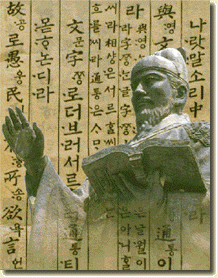
Korean, the official language of Korea, belong to the Ural-Altaric language group, a group which includes such languages as Mongolian, Hungarian, and Finnish. Although Korea has borrowed many words from Chinese and it seems to resemble Japanese gramatically, its phonetic system differs completely. Hangul, korea's native script, was invented in 1443. It is a purely phonetic alphabet of 10 vowels and 14 constants, so efficient that it can be learned in just a few hours. Hangul is the only alphabet in the world which is invented by man. Chinese characters are still used, especially in newspapers and academic works, though their use has been gradually decreasing since 1980s due to the younger generation's preference for the simpler hangul.
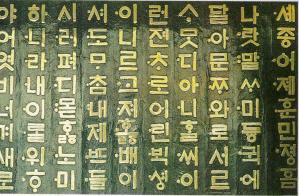
Hunminchongum literally meaning the correct sounds to teach the people was invented by King Sejong and the scholars in the Gibhyunjun research center. With the new writing system, King Sejong sought to educate the masses and create a literate populace. In his view, if the common people were literate, they would accumulate knowledge, develop their culture and contribute to the advancement of their state and economy.
The vowels represent the three elements of Eastern cosmology--heaven, earth and humanity. The consonants were developed in accordance with scientific principles. The five basic consonants were modeled after the vocal organs, and adding a stroke or partially altering the shapes of the five basic consonants formed the rest.
King Sejong's objective was obvious-to make the correct sounds to teach people. ' The sounds of our language differ from those of Chinese and are not easily communicated by using Chinese ideographs. Many among the ignorant, therefore, though they wish to express their sentiments in writing, have been unable to communicate. Considering this situation with compassion, I have newly devised twenty-eight letters. I wish only that the people will learn them easily and use them conveniently in their daily life.
He was clearly determined to protect the unique character of Korean culture from Chinese cultural and linguistic hegemony and concerned with the plight of the illiterate common people.
King Sejong
Do Yi was born in the year 1397. On August 10, 1418, when he was only 21-year old, Do Yi was crowned the fourth king of the Chosun Dynasty. Do Yi was to become the greatest king of Korea history, King Sejong.
When king Sejong took the throne, the people of Korea spoke Korean but did not yet have a written language. So they used Chinese characters to write their records and documents. but there are too many characters to memorize and characters themselves are very difficult to learn. Only the very few well educated Koreans could read and write.
King sejong wanted to teach all his people how to read and write. After becoming a king, he established a research center to invent simple characters for Koreaan language. The characters that
were created, well structured, and easy to memorize. The characters made reading and writing easily for everyone.
In December, 1443, after King Sejong had been a king for twenty five years, the first Korean book, "Hoon Min jeong Eum" was published. It explained and taught the newly invented Korean characters. The name of the new korean written language is to be called "Hangul".
It was thanks to Sejong's efforts to improve the quality of life of the populace that science, and especially astronomy, realized such a remarkable development in the early Choson period. Science in and of itself is meaningless--its development should be preceded by an objective.
Sejong's interest in science was far different from the interest of those who regard science as a means to increase the wealth of the already wealthy or to develop tools of war.
Here is an example of Sejong's efforts to apply science to farming. While traveling on horseback on a late spring day in the second year of his reign, Sejong ordered his attendants to dig up a plant on the roadside and bring it to him. According to the 'Sejong Shillok (Annals of King Sejong)', the king, who was concerned about the prolonged dry spell, wanted to assess the seriousness of the drought by determining how much moisture was left on the roots of the plant. Sejong also measured the amount of rainfall by observing the wetness of the soil.
He ordered an official in the Soun-gwan (Astronomical Board) to regularly dig into the soil and measure the depth to which precipitation had seeped. He learned that a torrential downpour did little for farming, whereas a steady drizzle over a long period of time permeated deep into the soil. However, keeping the king posted on the amounts of rainfall across the country was no easy task, for it took no less than a week on fast relay horses to report on farming in the remote regions of the Cholla-do provinces. Sejong wanted to be kept informed of the harvest in each region so that he could work out plans to efficiently transfer relief grain to areas of greatest need from the nearest government storage bins.
A report to the king from the Ministry of Taxation from 1441 shows that Sejong's concern for his farming populace was shared by his officials:
"Although it has been promulgated that the governor of each province should report on the amount of rainfall, it is difficult to measure it because the soil differs by region. We would like to recommend that a metal container to hold rainfall be placed on a platform in Soun-gwan and an official be assigned to measure its content."
'Ch'ugugi,' the first rainfall gauge in the world, thus came into being in 1442. With the invent of this device, rainfall was measured and reported regularly in Seoul and in each province in accordance with a form and method standardized by Soun-gwan. The surviving 'Sungjong-won Ilgi (Diary of the Royal Secretariat)' contains rainfall records since 1770.


 E-Mail to Eui Ju Jeon