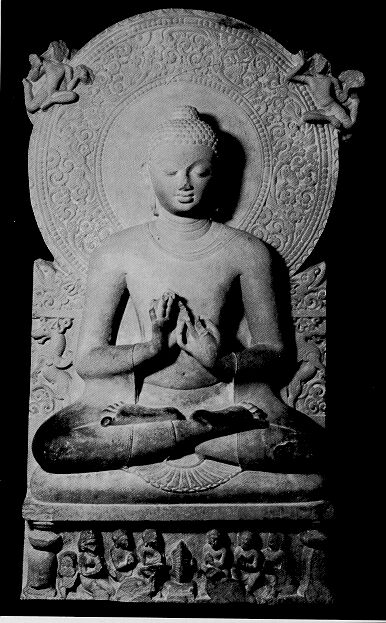
The Original Buddha Shakyamuni
1 of 2
Written by Rev. Kubota
Translated by H.G. Lamont
- We believe that the Lord Buddha Shakyamuni is the Unique, Supremely
Enlightened, Eternal and Omnipresent Lord, Teacher and Parent of All
Beings and All Worlds, Who Alone can save us from Ignorance, Delusion
and Evil and raise us to His Own State of Liberation, Eternity and Omniscience.
The Lord Buddha Shakyamuni descended and manifested Himself in ancient
India thousands of years ago and having manifested Supreme Enlightenment,
taught vast numbers of expedient (provisional or temporary) doctrines
for the
benefit of many types of beings. However, at the end of His Earthly
Career,
He abandoned all these expedient teachings and proclaimed the Truth
in the
Hokekyo or Lotus Sutra:
(I) All beings will be saved by the One Buddha Vehicle of the Lotus Sutra.
(II) Lord Shakyamuni Himself is really the Eternal Buddha Truly Enlightened
in the Most Distant Past.
(III) This scripture, the Lotus Sutra, was not merely for the great
Buddhist
saints of His time but primarily for the sinful, suffering, lowly
beings of the
evil future period, thousands of years after His Earthly manifestation
had
disappeared.
(IV) Especially for that future period He entrusted the Innermost
Essence
and Merit of this Lotus Sutra, the Very Essence of His Own Practice
and
Enlightenment to His disciples from the most distant past, the Bodhisattvas
Who Sprang from the Earth so that they might appear and propagate
this to
all beings. (The Daihatsunehangyo or Great Parinirvana Sutra is
a kind of
appendix to the Lotus Sutra, containing additional instructions).
In the course of time Buddhism as a religion passed through the Age
of
theTrue Dharma and the Age of the Counterfeit Dharma, and finally
in
the year 1052 C.E. the last phase of this cycle of Buddhism, the
Age of
the Latter Dharma (mappo), began: the other forms of Buddhist teachings
had disappeared, been corrupted, or become ineffective. Nearly
two
hundred years into this last phase of the current cycle of Buddhism,
Nichiren Daishonin (1222-1282), the Messenger of the Buddha, the
Reincarnation of the Bodhisattva Jogyo, foremost among the Bodhisattvas
Who Sprang from the Earth, appeared in Japan and inaugurated the
spread
of the true doctrine of the Hokekyo or Lotus Sutra, embodied in
the Three
Great Secret Dharmas (san dai hi ho), which are based on the Doctrine
of
the Original State of the Buddha (hommon), the second half
of the Lotus
Sutra, which is superior to the first half:
(1) The Daimoku of the Doctrine of the Original: this is the "Title"
("Myoho renge kyo"), the essence of the Sutra, containing all the
merits
and virtues of the Original, Eternal Buddha Lord Shakya. When through
faith we receive and keep this as "Namu Myoho renge kyo", the Buddha
spontaneously cedes and assigns us His merits and raises us to His
world.
Since this world is primarily oriented towards hearing, "Namu Myoho
renge
kyo" is most usually manifested through but not limited to chanting
(shodai).
The Daimoku (or Odaimoku) means "Title" but is not merely the title
of a
book but the whole essence of the Supreme Lotus Sutra. The
Daimoku is
called the "One Great Secret Dharma" and by itself becomes a seed
of
Buddhahood even for unbelievers, who, after punishment in the Unremitting
Hell will attain Buddhahood in a future eon. The Daimoku is
not a magic spell
but the effective prayer and practice based on faith. For
those who receive
and keep it with faith it opens out to reveal itself as the Great
Direct Way
(daijikido) to Buddhahood and the other two Great Secret Dharmas:
(2) The Object of Worship of the Doctrine of the Original: it is
from the
Eternal Buddha Shakyamuni (through His Messenger Nichiren Daishonin
[Bodhisattva Jogyo] that we receive the Daimoku, the principal practice,
and
we direct it towards that Original, Eternal Buddha Shakyamuni as
the Principal
(Original or Fundamental) Enlightened One, the Object of Worship
(gohonzon)
in our minds and (where possible) to a physical embodiment, such
as:
(1) A mandala written by or modeled on one written by Nichiren Daishonin,
(2) A written scroll of "Namu Myoho renge kyo",
(3) Images of the manifest Buddha Shakya and the ancient Buddha of
Witness
Taho seated on either side of the Daimoku and surrounded by the
Four Chief
Bodhisattvas Who Sprang from the Earth,
(4) The image of Lord Shakyamuni attended by the Four Bodhisattvas
Who
Sprang from the Earth or,
(5) A statue of Shakyamuni with the Hokekyo (Lotus Sutra) placed
before it.
(All of these are permissible images of the Eternal Buddha but our
sect, which
was often persecuted, has often preferred the mandala because of
its ease of
movement and concealment.) We of the Kempon Hokke Sect do not permit
the
separate enshrinement of other deities in our temples or altars;
however, a
statue of Nichiren Daishonin may be placed before and below the
Gohonzon
itself.
(3) The Precept Platform of the Doctrine of the Original: the Precept
(or
Ordination) Platform is the place where not only priests and nuns
but the laity
as well receive the precepts by which they live their lives as Buddhists.
The
precepts differ according to the type of Buddhism but in the [Kempon
Hokke]
tradition all believers accept the fundamental precept to receive
and keep
"Namu Myoho renge kyo". This is the ideal or abstract
Precept Platform
which in one sense can exist anywhere and at any time when we receive
and
keep the Daimoku but Nichiren Daishonin clearly intended that an
actual
structure be built once the propagation of the true Teaching
had succeeded,
just as the Tendai patriarch Saicho (767-822) had campaigned for
a Tendai
Precept Platform, which was erected after his death. (This Precept
Platform
was probably meant to be established at Minobusan provided it has
the pure
preaching and practice, not in its present degenerate state.) Thus,
the Precept
Platform for society as a whole lies in the future but for individuals
is already
present wherever
they believe and practice.
Next....
Translated by H.G. Lamont
for the Kempon Hokke; formatted here by
Steven Polito.Copyright
©1981-1999 Reverend Tetsujo Kubota, H.G. Lamont all rights reserved.
