 |
Islamic Cairo
Amr Ibn el-As Mosque
|
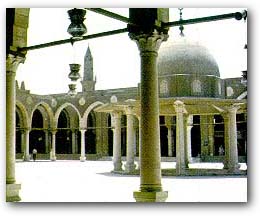
The mosque of Amr Ibn al-Aas, built in 642 (21 H) and said to be built on the site of Amr Ibn el-As's tent at Fustat, is the oldest existing mosque, not just in Cairo, but the entire African Continent. Located north of the Roman Fortress of Babylon, it is actually on the edge of Fustat, the temporary city founded by Amr, and was an Islamic learning center long before El-Azhar Mosque. It could hold up to 5,000 students. The mosque incorporates elements of Greek and Roman buildings, and has 150 white marble columns and three minarets. Simple in design, its present plan consists of an open sahn (court) surrounded by four riwaqs, the largest being the Qiblah riwaq. There are a number of wooden plaques bearing Byzantine carvings of leaves, and a partially enclosed column is believed to have been miraculously transported from Mecca on the orders of Mohammed himself. There are many other ancient legions related to the Mosque. Its current form is derived primarily from a renovation in 1798 by Murad Bey.