 |
Cairo
|
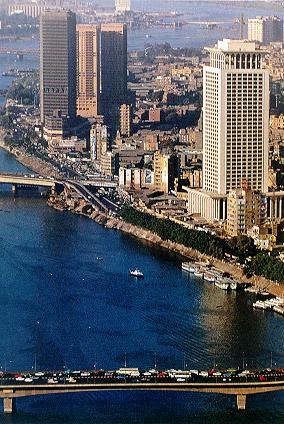
Cairo is the capital of modern Egypt, yet the history of the city goes back thousands of years ago.
With 16 million inhabitants and modern communication and transportation it is truly a cosmopolitan city, that doesn�t fall short of ancient history, from the days of the Pharaohs till today the city has witnessed the rise and fall of one civilization after another and one empire following the other.
In our journey we will try to scan the different eras this unique city has lived through, take a glimpse on each of them to get a taste of the place.
Cairo, The history
While the City of Cairo sprang from the foundations of a "recent" town, by Egyptian historical standards, it is no wonder that this location developed the foremost Egyptian city. With one of the few river crossings, the area around Cairo was originally settled in Paleolithic times and later saw the development of Neolithic trading communities.
Yet it was Menes, the legendary first King-God of the Dynastic period who united upper and lower Egypt and established his capital at Memphis. While it has been suggested that Memphis already existed upon Menes arrival, what is known is that this city, with its ruins 15 miles south of current Cairo, was a dominate influence throughout most of Egypt's pharaonic history. Nearby Memphis (nine miles north and on the opposite side of the Nile) was the contemporary religious center of On located in the community the Greeks called Heliopolis, not to be confused with the nearby modern suburb of Cairo by the same name.
In 525 BC, the invading Persians conquered Egypt and built a strategic fort north of Memphis called Babylon-on-the-Nile. This was where the Persians controlled Egypt until its capture by Alexander in 332 BC. During the Greek period, the fort held little importance, but after the Roman conquest, it regained prominence as a stronghold because of its strategic location guarding the Roman trade routes. The Roman general Trajan repaired the old Red Sea Canal, originally built by the pharaohs, which allowed vessels to sail up the Red Sea, turn west toward Babylon, and then down the Nile to the Mediterranean.
During the Roman period, Babylon continued to be a dominant influence in the region and a Christian community grew up around it, which was likewise a prominent center of the new religion. It was here that St. Mark lived, and where St. Peter sent his greetings from the sister church in Rome. But in the later Roman period, the Coptic church of Egypt grew apart from most of the world's Christianity. This split resulted in unrest and often persecution of the Coptics. Hence, when the Arab Muslims led by Amr arrived in 640 AD, Babylon was an easy target and was captured after a disastrous battle for the Romans. Soon, all of Egypt was in the hands of the Islamic Arabs.
Legend has it that when Amr departed the Babylon area to lay siege to Alexandria, he left his tent standing in the tent camp next to Babylon. Upon his return, the tent was still standing and a dove had built a nest in it. So it was here that Amr built his Mosque, the first in Egypt, and around the Mosque, Fustat or al-Fustat al-Misr (the Camp of Egypt), the City of the Tents and the original Muslim capital of Egypt grew up from his original tent encampment. This encampment was divided into khittat, or districts which originally divided the various Arab tribes which made up Amr's army.
Throughout ancient times, Egypt has been one of the most important trade routes for the world and so it was from that, just as the archaic cities which proceeded Fustat, this new city also prospered from all manner of goods which where transshipped to wealthy markets in Europe. They also developed their own markets in spices, textiles and perfumes which were legendary throughout the world. Beginning as a haphazard conglomeration of tents and huts, Fustat grew into a sophisticated commercial center where its residents enjoyed great wealth. They built high rise houses with rooftop gardens, public baths modeled from the Romans (but smaller, earning the name al-hammamat al-far, or mouse baths). Their architecture grew in both splendor and magnitude, and they even built covered streets to protect themselves from the sun.
�
 |
Cairo today
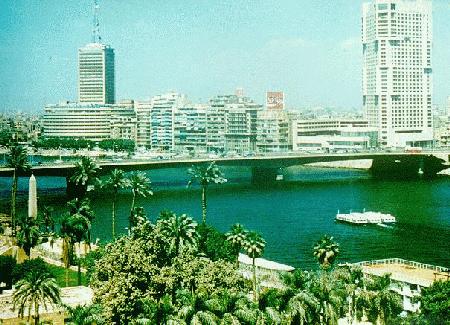
Cairo offers an incredible selection of shopping, leisure, culture and nightlife. Shopping ranges from the famous Khan el-Khalili souk, largely unchanged since the 14th century, to modern air-conditioned centers displaying the latest fashions. All the bounty of the East is here - particularly good buys are spices, perfumes, gold, silver, carpets, brass and copperware, leatherwork, glass, ceramics and mashrabiya. Try some of the famous street markets, like Wekalet al-Balah, for fabrics, including Egyptian cotton, the Tentmakers Bazaar for appliqu�-work, Mohammed Ali Street for musical instruments and, although you probably won't want to buy, the Camel Market makes a fascinating trip.
�
 |
�
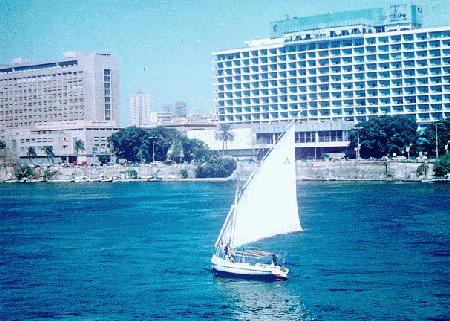
When you need a break from city life, try a round of golf on the famous Mena House course overlooking the Pyramids, watch the horse racing at the Gezira Club or visit the Zoo and the Botanical Gardens. Take a trip on the Nile in a felucca or ride on horseback from the Giza Pyramids to Saqqara. For a day trip outside Cairo visit Haraniyya village and see the beautiful tapestries and weaving produced by local people. If you wish, you may get away from it all at the top of the Cairo Tower, a modern 187 meter-high tower with views of the city from all sides, topped by a revolving restaurant.
�
 |
�
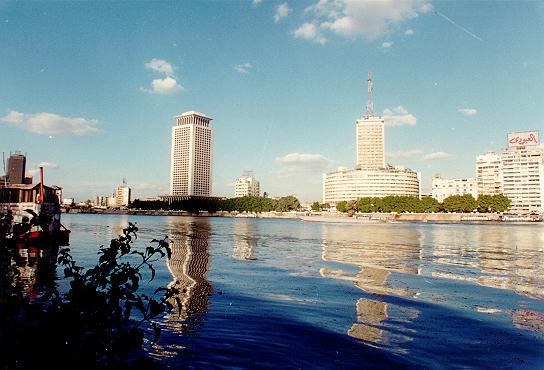
Cairo comes alive at night, the best time to shop, eat delicious Middle Eastern cuisine, or simply watch the world go by from a pavement cafe. You can dine in a floating restaurant on the Nile, sample a shisha at a coffee-shop or see oriental dancers and cabarets at a luxury hotel. The splendid Opera House complex houses several galleries (including the Museum of Modern Art), restaurants and concert halls. Listening to Arabic music under the stars, in the open-air theater, is a magical experience. At El-Ghuriya, in the heart of Islamic Cairo, you can watch folk musicians and whirling dervish dancers. And don't forget the most essential after-dark experience, the Sound and Light show at the Pyramids, a dramatic fusion of light and music recounting the story of antiquity.
Well, this was Cairo in a nutshell.
I hope you did enjoy this trip, and did not find it boring or exhausting, and please do visit the other pages on this site, I think you will find a variety of interesting material.
�
 Get your own Free Home Page