CULTURE
 |
CULTURE
|
With its ancient history, cosmopolitanism, strong Islamic traditions, modern pan-Arab political and intellectual history and relative freedom, Egypt is the cultural capital of Arab world. The Arab television and cinema is dominated by the Egyptian television and film industry as is popular Arabic music.
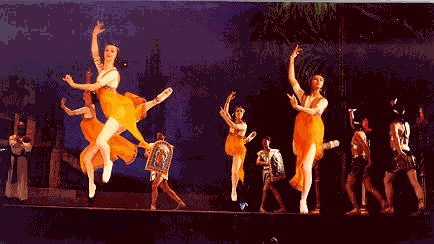
The Egyptian Ministry of Culture presides over a variety of cultural institutions such as the Cairo Opera House, the National Puppet Theater, the Pocket Theater and the National Symphony, as well as the country's many museums .
Egypt has also been a fount of Arabic literature having produced some of the greatest 20th century Arab writers from Taha Hussein and Tawfiq Al Hakim to Nobel prize-winning novelist Naguib Mahfouz. Egypt has also produced some of the greatest modern artisans, including the brilliant designer Azza Fahmy and her equally gifted sister Randa Fahmy, who single-handrevived the art of Mamluki metalwork.
Egypt has had a strong cinematic tradition since the 1930s. Egypt has the only major motion picture industry in the Arab world, with Cairo is its capital.
The influence of the Egyptian cinema on the Arabs is as profound as that of the American cinema on the rest of the world. The golden age of Egyptian cinema was in the 1940s and 1950s. During that period Omar Sharif emerged as a major international star and his former wife, Fatin Hamama, reigned as the queen of Arab cinema.
Directors such as Youssef Chahine have gained wide respect internationally and many of Egypt's leading literary lights, including Tawfiq Al Hakim and Naguib Mahfouz, have written for the cinema.
Today, the reigning superstar of the Egyptian cinema is comedian Adel Emam, whose political satire has earned him the respect of serious cinema-goers and occasionally ire of the government. Other film stars include Ahmad Zaki, Mahmoud Abdul Aziz and Yusra.
Media
Egypt is the capital of Middle Eastern communications with strong journalistic traditions and a relatively free press, the region's most important film, television and recording industries and the largest publishing industry in the Arab world. Most newspapers and periodicals are under governmental supervision and some are under partial governmental ownership.
Newspapers
Al Ahram is the semi-official daily has a circulation of nearly 1 million and is far and away the most important newspaper in the country. Other newspapers include Akhbar Al-Youm, Al Akhbar, Al Mesaa, Al Gomhuriyyah, Al Wafd and Al Alam Al Youm. The International Daily Asharq Alawsat is printed in Egypt at the Al Ahram printing presses.
Radio
Under Gamal Abdel Nasser Egypt's national broadcasting system became a powerful and influential tool for pan-Arab propaganda. Utilizing Egypt's enormous pool of creative talent and powerful transmitters, the government broadcast throughout the Arab world. While propaganda is no longer of primary importance, Egypt's broadcasting system remains the best in the Arab world transmitting programmes in Arabic, English, French and other languages.
Television
Television was introduced to the country in 1960 and, still remains solely in the hands of the government. There are eight national television channels. Egyptian soap operas are a staple of all Arab television and have established the standards of broadcasting throughout the region. In addition, the Egyptian Satellite Channels (three so far) transmits via Arabsat, eutelsat and asisat throughout the Middle East and Nile Television broadcasts in English and French to Europe and Asia.
Exotic Markets
How could a market in Egypt be responsible for the founding of the United States? Khan el-Khalili, once known as the Turkish bazaar during the Ottoman period, is now usually just called the 'Khan', and the names of it and the Muski market are often used interchangeably to mean either.
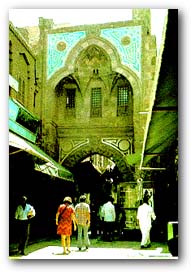 |
Named for the great Caravansary, the market was built in 1382 by the Emir Djaharks el-Khalili in the heart of the Fatimid City. Together with the al-Muski market to the west, they comprise one of Cairo's most important shopping areas. But more than that, they represent the market tradition which established Cairo as a major center of trade, and at the Khan, one will still find foreign merchants. Perhaps, this vary market was involved in the spice monopoly controlled by the Mamluks, which encouraged the Europeans to search for new routes to the East and led Columbus, indirectly, to discover the Americas. During its early period, the market was also a center for subversive groups, often subject to raids before the Sultan Ghawri rebuilt much of the area in the early 16th century. Regardless, it was trade which caused Cairo's early wealth, even from the time of the Babylon fort which was often a settlement of traders.
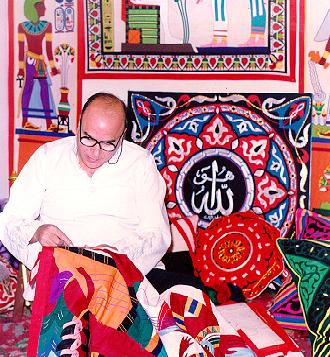 |
This market is situated at one corner of a triangle of markets that go south to Bab Zuwayla and west to Azbakiyyah. The Khan is bordered on the south by al-Azhar Street and on the west by the Muski Market. One of the old original gates guards the entrance to the original courtyard which lies midway down Sikkit al-Badistan (street). On a narrow street leading off al-Badistand, one will find the El-Fishawi Cafe, or Cafe of Mirrors, which was once a meeting place for local artists, and is still frequented by the Nobel Award winning Naguib Mahfouz, one of Egypt's most well known authors. Egyptian buyers generally shop in the area north of al-Badistan and to the west, where prices may be lower. Better deals for gold and silver are to be found west of the Khan along the "street of the goldsellers", and further on one will find the Brass and Coppersmith Markets.