 |
RELIGION
|
 |
Islam is constitutionally established as the official religion of Egypt and around 90% of the population are Sunni Muslim with a small minority of Bahra Muslims and other non-Sunni sects represented.
Egypt is one of Islam's most influential intellectual centers. Al Azhar University, the oldest university in the world, graduates Islamic scholars from every Muslim country on earth. The Rector of Al Azhar occupies one of the most important hierarchical positions in the Muslim world and exercises great influence over religious issues of the day.
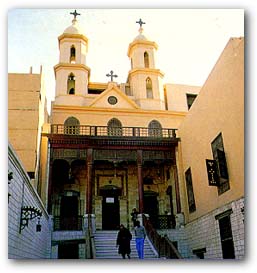 |
Coptic Christians form the country's largest and most significant religious minority with estimates of around 7 million.
Another one million or so Roman Catholics, Greek and Armenian Orthodox Christians as well as Protestants are also among Egypt's citizens. These groups, which thrived during colonial times, are now dwindling as a result of emigration. There is also a tiny Jewish community which has also been depleted by emigration. There are many churches open in the major urban centers .
Devout Muslims do not drink alcohol though most do not object to others imbibing in reasonable amounts. In addition to the prohibition on alcohol, the faithful do not use drugs or eat pork, which is considered unclean.
Moral & social codes
In Egypt there are hardly any restrictions on foreign women. Ticket lines, for example, are occasionally segregated. Women should line up with other women (especially since the lines are usually shorter). On the metro lines, the first car is usually reserved for women.
In general, Egyptians are most accommodating and they will go out of their way to help a foreigner and respond to any questions he has. Most Egyptians require little personal space and will stand within inches of one another to talk.
Invitations
Egyptians, if offered anything, will refuse the first invitation which is customary. If the offer is from the heart and not just politeness, it will be repeated. If you're invited into a home, especially in small villages, and have to refuse, the householder will often press for a promise from you to visit in the future, usually for a meal. If you make such a promise, keep it. If you fail to arrive, your would-be host will be humiliated. To repay invitations, you may host a dinner in a restaurant.
Women
Before the famous Egyptian feminist Hoda Shaarawi deliberately removed hers in 1922, the veil was worn in public by all respectable middle-class and upper-class women, Muslim, Jew, or Christian. By 1935, however, veils were a comparative rarity in Egypt, though they continued to be worn as an item of fashion in neighboring countries like Syria and Jordan for 30 more years and have remained obligatory in the Arabian Peninsula to this day.
Nowadays in Egypt, some women still wear the veil demonstrating either modesty or Muslim piety.
From the 1930s onwards, Egyptian women began to enter into business and the professions. Thus by 1965, thanks in part to social changes affected in the course of the July Revolution, Egypt could boast a far higher proportion of women working as doctors, dentists, lawyers, professors, diplomats, or high officials than might have been found in the US or in any European country outside of Scandinavia.