 Bellows
Main Page
Bellows
Main Page
Bellows
Main Page
Bellows
Main Page
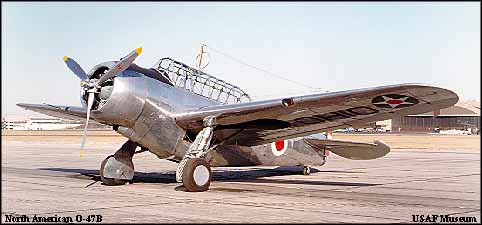
All Pictures and Data Collected from the USAF Museum
| Span: 46 ft. 4 in. | Max speed: 227 mph. | 1 fixed forward-firing .30-cal. machine gun |
| Length: 33 ft. 3 in. | Cruise speed: 200 mph. | 1 flexible .30-cal. machine gun in rear cockpit. |
| Height: 13 ft. 9 in. | Range: 840 miles | |
| Crew: 3 | Service Ceiling: 24,100 ft. | Engine: Wright R-1820 1,060 hp. |
The O-47 was developed as a replacement for O-19 and O-38 observation biplanes. It was larger and heavier than most preceding observation aircraft and its crew of three sat in tandem under the long canopy. Windows in the deep belly overcame the obstacle that the wings presented to downward observation and photography. The design for the XO-47 prototype originated in 1934 with General Aviation, a subsidiary of North American Aviation, as the GA-15. The Air Corps ordered 174 O-47s in 1937-38, 93 of which were assigned to National Guard units. In 1938, the Army ordered 74 O-47Bs with a redesigned engine cowling for better cooling, a more powerful engine, and improved radio equipment.
Training maneuvers in 1941 demonstrated the shortcomings of the O-47. Light airplanes proved more capable of operating with ground troops, while fighters and twin-engine bombers showed greater ability to perform recon and photo duties. Thus, during WW II, O-47s were relegated to such duties as towing targets, coastal patrol, and anti-submarine patrol.
The O-47B on display was acquired in 1978 from Mr. Loren L. Florey, Jr., Eden Prairie, Minnesota. It was restored in the markings of an O-47A of the 112th Observation Squadron (Ohio National Guard) by the 179th Consolidated Aircraft Maintenance Squadron, Ohio ANG, at Mansfield, Ohio.
All Data From the United States Air Force Museum
Bellows
Main Page