Problem
of the slow flooding by groundwater of urban areas in Ukraine:
searching an effective National policy, and planning of local environmental
actions
Slow flooding by groundwater of urban areas is a pressing problem for Ukraine and other former Soviet Union countries. Taking into account Nationwide scale of the problem and influence of economic conditions factors it seems reliable the way of step-by-step solution the problem based on principles of sustainable development, through National and local environmental actions plans. This way is opposed to conservative technical solutions way. The following abstract is dedicated to describe growth of the problem and to assess an effective solution way.
Urban
drainage basins in Ukraine, especially at the country's Northern-East
and South, and at the Dnieper-Donets industrial region, are suffering
from the slow flooding by groundwater as a result of action of man-caused
factors. Among these factors the most influential are: 1) the disturbance
of the natural hydrological balance on drainage basins within vast areas;
2) not quite economic water use (estimated water supplying in some cities
reaches up to 460 liters per capita per day) and enormous leakage in plumbing
networks (up to 30-50% of water supply). Slow flooding effects in the
land in landslides, suffusion and subsidence of soil. Hazardous events
with damages to real estate and rarely with fatal accidents are following
the climatic variability, but in accordance with long-term observations,
there is stable trend to increasing risks caused by man-made factors.
At present Ukraine has about 260 cities/towns and 280 settlements suffered
from the slow flooding, or at least 11% of urbanized areas are damaged
by it. Some surveyors reported of that up to 20% of Ukrainians settled
areas exposed to actually or potentially slow flooding. Slow flooding
is also a problem for some rural drainage basins as an effect of mismanagement
by irrigation systems and reservoirs.
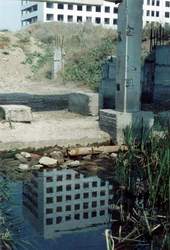
Flooded area in building site since the site work was stopped in early 1990s, Kharkiv
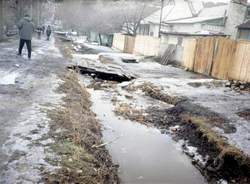
Water floods
a street drain in one-family houses block
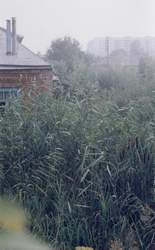
Marshland
flora around
a house in Kharkiv
These pictures have been given kindly by Dr.George Strizhelchik,
Institute 'UkrNDINTV', Kharkiv, Ukraine
The situation like in Ukraine is typical both for the most of former
Soviet Union (fSU) and post-socialist countries of the Eastern and Central
Europe. Some analyses results in conclusion that the slow flooding problem
is one of side effects of not quite efficient economic and environmental
policies in the transition countries in the past and among the current
affairs. The official opinion, that is still prevailing there, is being
changed too slowly, and it mainly consists in that the problem could
be solved only by way of introducing the default set of engineering
and technical measures everywhere, although this has not confirmed by
the latest 30-years experience. Previous National action programs on
'slow flooding liquidation' were not effective because these consisted
only of lists of the proposed local technical measures, which even not
might be fully ensured financially (as a result only a one tenth part
of designed projects had been realized).
Nevertheless the approach of decision-making slightly changes. The development of urban and industrial agglomerates, maximising in number and complication of interrelationships in the system resulted in the situation, when various uses of underground environment increasingly approach to conflicts, so that more sectors of water management have to be involved in decision-making. This creates need for multisectoral approach with large number of interrelationships and conflicts to be solved. Decision-making relating to the slow flooding in the cities of Ukraine can be characterised as being at transitional stage. Adoption of the new National policy on slow flooding prevention is likely to contribute significantly into considering the problem as whole, formulation of strategic environmental and economic objectives and measures to be taken for achieving these objectives. It might be the first step towards an integrative approach to environmental decision-making. The complexity of the current and future problems combined with increasing need to meet demands of sustainable development urgently ask for such an approach. Prospective way for real step-by-step stabilization and improvement of the situation with slow flooding by groundwater on urban drainage watersheds is discussed in this abstract.
The model scenario
of slow flooding progress in the typical fSU city (since early 1970s)
is well-known and may be described in details like the following: 1)
shadow effect of urban impervious covers causes condensation and soils
moistening processes, which results in some increasing of groundwater
recharge;
2) water pipes leaks, absence of sewerage at one-family houses blocks,
and broken storm water sewers provide additional groundwater recharge
that results in the flooding of lowlands and in emergence of perched
groundwater at uplands; 3) the flooding of cesspools as well as of garbage
heaps, and the leaks from sewage systems are causing pollution of upper
groundwater; 4) pollution spreads down to the city water-supply aquifer
and contaminates drinking water, which becomes unsuitable that, in its
turn, triggers supply cut-off; 5) cone of groundwater depression vanishes
away and levels of subsurface water table have been rising in addition;
6) local people make complaints, and municipal authorities start local
engineering actions; 7) at the same time the city water-supply system
switches to the surface water sources, and a huge volumes of water (which
often are brought via long distance mains, up to hundreds kilometers)
involves additionally breaking delicate water balance of the city area;
8) customers do not have incentives for rational water use since water
costs are low and almost nobody have water-meters, and at the same time
water company (as a rule, the monopolist at the local market of municipal
utilities) have incentive to increase water supply because this company
directly collects service charges depending upon input water volumes,
so the water-supply gradually increases;
9) since much of water pipes are corroded but the water company have
no incentive to repair or replace their stuff, the leakage increases
over and over again; 10) in addition to the increasing leakage the level
of groundwater table is raising and these promote unfavourable environmental
conditions at the city area, like silted river channels, disturbed natural
drainage network, destroyed or foul storm-water drains, micro- and meso-climatic
changes etc.; 11) groundwater table raising becomes uncontrolled since
local protection systems are overflowed, and building of new systems
seem to be too expensive and problematically effective.
-
Introducing of water-metering and reliable economising-aimed rates for customers. This would enforce the water supply service to search for market-oriented policy of water management, in opposite to increasing gross supply. It is worth to note that currently per-capita drinking water use in Ukraine exceeds the European standards up to four times. According to preliminary findings the introduction of water-meters would result in 30-50%-decrease in urban groundwater replenishment.
-
Common actions in order to support safe environment and sanitary conditions of the city area, like rehabilitation of storm-water drainage, obligatory treatment of storm waters which inflows to rivers and reservoirs; equipping one-family house blocks by sewerage; clearing river channels with removal of polluted sediments and garbage; etc.
-
Renewal of water supply from groundwater, if its quality will begin to improve as a result of previous actions. At first time this water could be used only for technical needs, and later, as its quality is improving, it could be used for drinking water supply.
-
Socio-economic actions including special insurance programs for residents of flooded areas, preferential loans for building new houses for victims, etc.
List of these actions could be continued, but it is more important to understand a mechanism of their realization within the framework of strong realization of the adopted environmental policy basing on the principles of sustainable development. This mechanism should include main actors' specification, roles dividing, and linkage of the management with local action plans and National policy. Some sufficient correction of the National policy and existing legislation is required to provide in favor of necessary freedom for communities and authorities to undertake corresponding actions in environmental sphere. Also it is important to provide enough relief for victim people and their real estate after hazardous events. So the National action program is surely required and it should be a strategic plan of the environmental policy development in the country (in connection with corresponded policies issues) for introduction the favourable legislative and investment climate that aimed to get things moving in the slow flooding problem (and in corresponding environmental problems).
The following scheme of the roles dividing seems to be usable:
National policy mission is strategic decisions, support of actions plans legislatively, and providing of social programs. Also this is a function of the Government to hold control on situation via providing monitoring of slow flooding nationwide, sponsoring developing of GIS-projects and support of scientific teams through grants to introduce pilot projects.
On the regional administration ('oblast') level and city level it is important to introduce economic levers and create favorable economic climate for investments in local actions plans.
Local actions plans could be introduced on the local level (local municipal community, town, and settlement) as a set of investment projects with participation of municipal sector, businesses, NGO's and local community representatives. Practice of the investment projects is well-known in the World, and it should to be shared to Ukraine and other fSU countries to stabilize the slow flooding problem.
Not slogans of 'liquidation' and 'fight' against slow flooding could be effective, but day-to-day support of adequate and safe environment and sanitary conditions on urban drainage basins. Such police should contribute into improvement of the situation with urban groundwater without delay.