|
During the Bangkok period, King Rama III commanded that a royal barge be
built according to the ancient royal tradition of the Ayutthaya Period. It
was named Mongkolsuban Royal Barge, and was meant to be emblematic of the
glory of the land.
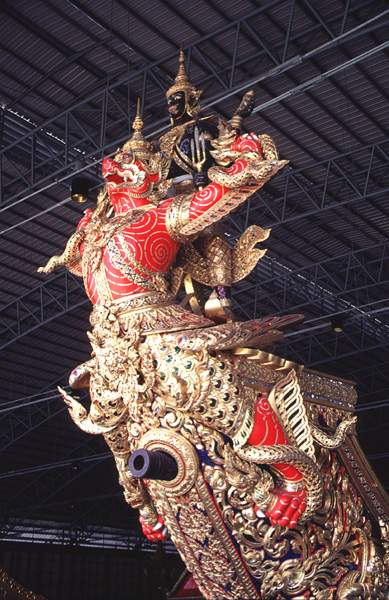
Its interior was painted red, and it was maneuvered by 65 oarsmen. The
original bow was carved in the shape of the King of Garudas with a naga in
his beak.
There is a porthole for artillery at the bow under the garuda. A
description of the barge by Prince
Phra
Krom Phra Paramanuchitchinoros
mentions that
the barge had a cannon manned by 3 westerners who had attained official
positions in Thailand and accquired titles: Phraya Piset songkram, Luang
Chanathukthit, and Luang Ritthiwari. Also in attendance on the barge were
the King's close aides, Chamuen Sanpetchphakdi, Chamuen Si Saowarak, Samoe
Jairaj, and Chamuen Waiworanart. The King was seated on a throne set in a
roofed pavillion, with royal weapons and utensils provided.
During the reign of King Mongkut, Rama IV, the figure of the god Narai was
added, riding on the garuda in accordance with Hindu mythology. This god
is describes in the Thai version of the Ramayana, written during the First
Reign, as a god who is green in color, has four arms, and bears a discus,
a conch shell, a trident and a scepter. The name of the barge therefore
became the Narai Song Suban Royal Barge.
Existing records indicate that the Narai Song Suban Royal Barge was
included in 2 royal barge processions. The first was held for the
Coronation Ceremony of King Rama Mongkut on May 21, 1851, at which time it
was known as the "
Monkolsuban Royal Barge".
The second occasion was the investiture of Crown Prince Mahavajirunhis on
January 19, 1886, during the reign of King Rama V. The attire of the
personnel aboard the vessel as it appeared at the king's Coronation
Ceremony is described in the annals of the Rattanakosin or Bangkok Period
of the Forth Reign.
It is assumed that the Royal
Barge Narai Song Suban deteriorated to the point where only the figurehead
remained, kept in the custody of the Ministry of the Navy until 1953, when
it was turned over to the Fine Arts Department to
be displayed in the National Museum.
The bow of the King
Narai Song Suban Royal barge is one of the artistic masterpieces of forth
reign, when Thai sculpture and ornamental art reached a peak. It
represents the significance and centrality of the monarchy in the life of
the nation, and reflects profound faith in religious symbols, both
Buddhist and Hindu. Such symbols can be found in patterns and decorations
at palaces and temples all over the country.
The newly-built royal barge for the Ninth Reign was christened by His
majesty the King was the Royal Barge Narai Song Suban - H.M. King Rama IX. |