|
||
|
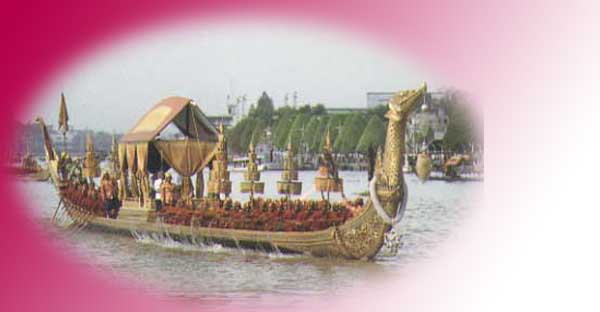
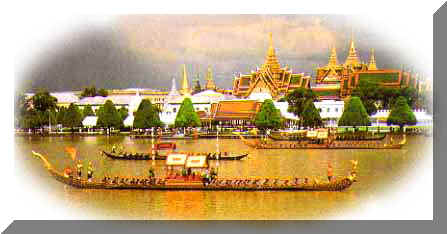
Since ancient times, Thai Kings have traveled in processions on land or by river, and on significant occasions these have been extremely elaborate. Among the most spectacular of all are the major royal barge processions, which are reserved for river journeys made by the king for private or official functions. In former times, such processions were held for the Royal Kathin Ceremony, the Coronation Ceremony, pilgrimages made by the king to the Shrine of the Lord Buddha's Footprint, to transport highly revered Buddha images from the provinces, and to welcome envoys from foreign countries. Ayutthaya is an island city completely surrounded by rivers and canals. Residents of the city who traditionally have lived on waterways were largely dependent until recent times on boats for transportation and communication. In times of war, naval battles frequently took place, and numerous battle barges were built during the Ayudhaya Period. In the year 1357, King Boromtrailokanat of Ayudhaya decreed that provisions be added to thte Palce Law concerning the use of the royal barges. It was specifically stated that during the 11th lunar month a court ceremony called "Asayuth" was to be held, during which a race was to be held between two of the major barges - Samatthachai, The King's barge, and Kraisonramuk, which was used by the Queen. A victory by the Queen's barge would signify fertility and abundance, while of the King's barge won, the populace could expect hardship and famine. In the actual events, therefore, the Samatthachai normally yielded to the Kraisonramuk. Article 164 of the Palace Law also specifies that the Jong Priang royal ceremony is to be held in the 12 lunar month with a floating of lights in the waterways under the full moon. Annals from about a century later, during the reign of King Naresuan the Great, the warrior king who liberated the Thai Kingdom from Burmese rule, mention an expedition made by the King to southern Burma by royal barge procession. At a time calculated by court astrologers as being auspicious, the Suphannahongse Royal Barge set off, bearing a golden Buddha image, which contained a holy relic enshrined under the name "Phra Phichai - The Buddha of Victory" . The front part of the battle fornation followed the Royal Brage. Once again, when King Naresuan led his forces to counter a Burmese force led by the Viceroy of that country, a naval battle formation led by the Suphannahongse Royal Barge carrying the Buddha of Victory was again in the lead. A royal poet of the fifth Reign, Prince Phra Paramanuchit , described the procession vividly in a work called "Lilit Taleng Phai". During the reign of King Narai the Great of Ayudhaya during the 17 century, the king made several river journeys in royal barge processions arranged in the four-line Phet Phuang configuration. The royal barge was at the center of a formation that consisted of more than 100 other barges. An account by a French envoy to the court of King Narai, Nicholas Gevaise, describes the stunning spectacle of a major royal barge procession of over 200 vessels. The royal barges, in pairs, were propelled by well-trained oarsmen attired in red with hood, arm-bands, and knee-bands that flashed with gold. The oars, also gilded, were raised and lowered simultaneously with choreographed precision. Each time the oars touched the water, a traditional boat song, praising the king's majesty and power, was chanted to provide the necessary rhythm. In the Rattanakosin Period, the custom of holding a royal barge procession for the Kathin Ceremony was revived during the First Reign. Although the ceremonial barges of the Ayutthaya Period were destroyed at the fall of Ayutthaya, a battle fleet was built during the Thonburi Period. When not engaged in combat, these barges took part in the royal barge processions that accompanied various ceremonies. For the Kathin Ceremony in the First Reign, in addition to the traditional, ancient battle formation, royalty, noblemen, and wealthy obtained royal permission to join the procession with their vessels, which were decorated in fanciful styles to resemble crocodiles, seashells, fishes, and other animals. Some had musical ensembles and performances on board. During the Second reign, a grand royal barge procession was arranged for the royal Kathin Ceremony, and it was also joined by the decorated vessels of royalty and noblemen. During the next reign, major and minor processions were held, mostly for the royal Kathin ceremonies. In the Forth Reign, the country was not involved in any wars, and motorized boats were becoming more common in Thailand. River boats using cars and paddles were disappearing, with the exception of the royal barges used in important ceremonies like the presentation of the royal kathin robes, which continued in their traditional form as treasured featured of the country's cultural heritage. |
|
|