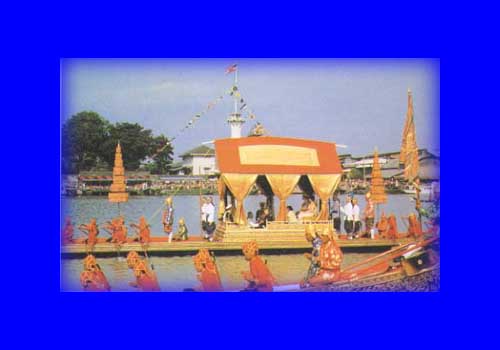
A major merit-making ceremony that occurs at the end of the 3 month Buddhist Lent is the presentation of Kathin robes, a set of saffron robes and necessary commodities to a selected monk at a temple. The period for making these presentations is signaled by the Royal Kathin Ceremony, performed by His Majesty the King of his representative.
The story of the Kathin dates back to the time of the Lord Buddha. A group of monks made a pilgrimage to the city of Sawatthi to pay homage to the Lord Buddha. While on their way there, they had to settle down for a 3-month retreat to wait out the rainy season. Then they set off once again on foot.
By the time they reached Sawatthi, their robes were tattered and muddy. Realizing the difficulties his disciples had encountered, the Lord Buddha granted all monks permission to accept new robes each year at the end of the rainy season retreat, or Buddhist Lent.
The term "Kathin" is associated with robes made especially for Buddhist monks, although it actually refers to the frame upon which the garments are woven. The presentation of the saffron-colored robes to Buddhist monks has therefore come to be called the Kathin Ceremony. The period during which these presentation are made begins on the first day of the waning moon of the 11th lunar month and lasts until the fifteenth day of the waxing moon of the twelfth lunar month, usually during October and November of each year.
The royal court leads the people in presenting the kathin robes to the royal monasteries. In the past, presentation of these royal Kathin robes by the King was the occasion of a royal barge procession. Various communities all over the country continue to mark the occasion with festivities.
Each temple may hold a Kathin ceremony only once a year. Preparations for it are made well in advance. A date is agreed upon, and the entire community is mobilized for the occasion.
The Royal Kathin Ceremony as held during the Ayutthaya Period was always linked to a royal barge procession. This practice continued through the the Thonburi and into the early Bangkok Period, and revived at regular intervals during the reign of King Chulalongkorn, Rama V, and King Vajiravudh, Rama VI. Subsequently, these processions were held annually in conjunction with the presentation of the royal Kathin robes up until 1964, when they were suspended because of the deteriorating condition of the royal barges.
During the present reign, the royal barge procession for the Royal Kathin Ceremony was revived for the grand celebration of the Bangkok Bicentennial in 1982, and again for the Golden Jubilee of the Reign in 1996.
The Royal Kathin Ceremony itself is still performed every year at royal monasteries situated along the river and within the city.