| Range:
Canada, the eastern half of the U.S., and the
Pacific Coast
Habitat:
Moist or
grassy places and along riverbanks and fences |
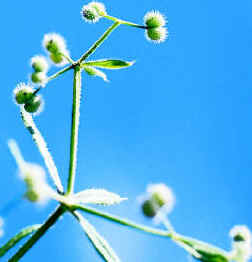 |
| Seed-cases
produced in pairs are covered with hooked hairs
|
|
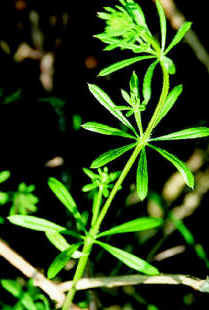
Description:
A native annual, considered a weed by
farmers, with square stems and short, bristly
downward pointing hooks on stem corners; rough,
hairy leaves grow in whorls of 6 to 8; burr-like
seeds produced in pairs. Small, white or greenish-white
flowers bloom from May to September.
Bedstraw was once considered a summer annual, but
now there's evidence that it can overwinter and grow
as a winter annual. |
Uses:
The predominant uses for Bedstraw is
external, although the tea has been recommended for
stomach and intestinal catarrh and for irritations
of mucous membranes, including those of the urinary
tract.
The juice of the
fresh plant or a tea made from the dried plant is
popular for skin problems. The juice or tea is
applied daily and allowed to dry (before each
application, wash the affected area with rectified
alcohol, burning the cloth each time). If
preferred, make a salve for the skin by mixing the
fresh juice with butter (renew every 3 hours and
burn the cloth used to apply it).
Applying the
crushed fresh leaves directly is also said to be
helpful for skin problems and for stopping bleeding.
Bedstraw is popularly used in Europe for healing
wounds and sores.
Historic
Reference:
"The juice
which is pressed out of the seeds, stalks, and
leaves, as Dioscorides writeth, is a remedie for
them that are bitten by the poisonous spiders...and
of vipers if it be drunke with wine. And the
herbe stamped with swines grease wasteth away the
kernels by the throte. Pliny teacheth that the
leaves being applied do also stay the aboundance of
bloud issuing out of wounds. Women do usually
make pottage of Cleavers with a little mutton and
Otemeale, to cause lanknesse, and keep them from
fatnesse. 1633 Gerarde-Johnson
1123.
The G. verum and
also G. aparine are ancient medical plants; the
whole plants are used...Although neglected lately by
medical writers, because apparently inert; they are
by no means so. The taste is bitterish and
acid...Externally applied in poultice, it is a good
discutient for indolent tumors, strumous swellings
and tumors of the breast. Internally used in
decoction sweetened with honey, for suppression of
urine and gravelly complaints, in scurvy, dropsy,
hysterics, epilepsy, gout & c. There are
instances on record of having curred these
diseases. Useful also in bleeding of the nose
and stomach. lately found peculiarly
beneficial in scorbutic, scofulous, and dropiscal
complaints, acting mildly, but
effectually." 1830
Rafinesque 120.
"Cleavers
is regarded as a most valuable cooling diuretic,
useful in most diseases of the urinary organs.
In suppression or retention or retention of urine,
it is a most admirable remedy; also in inflammation
of the kidneys, inflammation of the bladder,
scalding of urine, as in gonorrhea, it is one of our
best remedies. It is also said to be a solvent
of stone in the bladder, and a most admirable remedy
in all cases of gravel. The whole herb is
used. it yields its virtues readily to warm or
cold water, and is always to be used in infusion,
and may be drank freely. Cleavers must never
be boiled or scalded, as that will destroy it
properties. An ounce of the dry herb may be
infused for two hours in a pint of warm water.
An infusion of equal parts of Cleavers and Elder
blossoms is a good drink in scarlet fever, small
pox, and eruptive diseases; and it is said that a
gold infusion of the Cleavers drank three times a
day, and the parts washed with the same, will remove
freckles from the skin, if continued for two or
three months." 1859-61
Gunn 776.
The following
concoction was obtained in confidence from an old
Indian healer who claimed to have used it
effectively a number of times. The cure is for
gonorrhea primarily, although he used it for kidney
trouble and for spitting up blood, but he could not
explain how the two were connected. Cleavers
vine (Galium aparine) is mixed with six other
plants. A small quantity of each is steeped in
water and about half a cupful drunk three times a
day in a quart of water. It is further claimed
to be an excellent tonic by the possessor. 1915
Speck PENOBSCOT 311.
G. Aparine.
Specimen 5066 of the Dr. Jones collection is the
whole plant of this species...It is boiled and drunk
as an emetic. 1928 H.
Smith MESKWAKI 243.
"The
whole plant (G. aparine) is used by the Flambeau
Ojibwe to make a tea used as a diuretic, in kidney
trouble, gravel, stoppage of urine and allied
ailments. Other species are used in much the
same way for the same purposes.
1932 H. Smith OJIBWE 386.
Dosage:
Use the juice of the fresh plant or dry the
plant immediately to keep for later use.
Infusion: Steep 1 oz. dried herb in
1 pint warm
(not boiling) water for 2 hours. Take 2 to 8 tbsp.,
three or four times a day.
Tincture: Take 20 to 30 drops in water, as required.
For kidney and bladder troubles, particularly
burning or suppressed urine, use with uva ursi,
buchu, and marshmallow.
Safety:
Cleavers are very astringent due to its high tannin
content. Take only two weeks at a time, and then
skip one or two weeks.
How
to raise Bedstraw
|