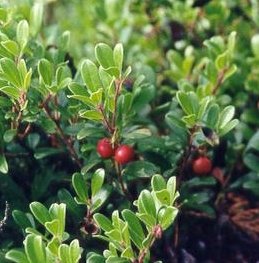
 |
| Best
known by one of its Indian names, kinikinik . The
Ojibwe name is saga-ko-minagunj, "berry with
spikes on it." The leaves were smoked
and used as headache remedies. A tea made of
dried leaves had various medical uses. Berries,
which survive all winter in the snow, were
emergency food, and were used to make a tea. |
|
EBEARBERRY Arctostaphylus
uva ursi L.
Common Names:
Uva-Ursi. Sagakomi. Jackashepuck. Kinnikinik. Bear's
Berry. Mountain Box. Mountain Tobacco. Mountain
Crawberry. Barren Myrtle. Yukon Holly. Universe
Vine. Arbutus
Uva-Ursi. Sagackhomi. Red
Bearberry. Bear's Grape. Bear's Bilberry.
Foxberry. Upland Cranberry. Mealberry. Rockberry.
(Kinnikinik is an Algonquian, Cree or Ojibwa word that
means 'that which is mixed'. A smoking mixture, varying as
to ingredients from tribe to tribe and place to place.)
|
Range:
Native of this country, growing in dry sandy or rocky soil
from the middle Atlantic States north to Labrador and westward to
California and Alaska.
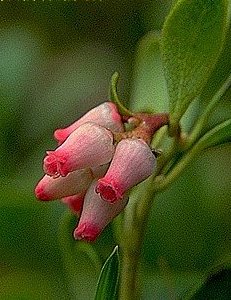 |
Description:
A spreading evergreen shrub growing like a mat on rocky, sandy
soil. The leaves are leathery, round at the tip and narrow
at the hairy stalk. The under side clearly cross veined,
without spots. The flowers are white and bell-shaped.
The fruit is bright red, mealy, and contain five nutlets attached
to each other. |
A cranberry, Bearberry was
first recorded in the 13th century Welsh herbal The Physicians
of Myddfai. The berries of the plant are a favorite food
of bears-thus its name. Its use as a diuretic and lower
urinary tract disinfectant is recorded in subsequent centuries
throughout the British Isles and northern Europe. American
Indians, including the Cheyenne and Thompson tribes, have used the
plant for the same purposes. Indians also made the berries
into a tea that was used to ward off obesity. Today, bearberry
is used as a
diuretic in the folk medicine of Indiana and also by Spanish
Gypsies.
Medicine:
Bearberry is still one of the most often prescribed urinary tract
herbs by professional herbalists in North America and Europe, and
it is approved in Germany for use by medical doctors in the
treatment of bladder infections. Arbutin, a constituent in
bearberry, is broken down in the body and transformed into an
antimicrobial substance that is excreted in the urine, thus
delivering an antibiotic directly to the site of the bladder
infection. What's more, animal research in Spain in 1994
demonstrated that bearberry teas could lower the risk factors for
kidney stones and kidney infection, although the effect was
mild. Avoid using bearberry during pregnancy or lactation.
Directions:
Simmer 1/2 ounce of bearberry leaves in 1 pint of water for five
minutes. Let steep until the water reaches room
temperature. For a bladder infection, strain and drink 1
ounce three times a day for up to five days.
Gathering &
Storing Leaves: Leaves must be
gathered only in fine weather, in the morning, after the dew has
dried, any stained and insect-eaten leaves being rejected. Drying
may be done in warm, sunny weather out-of-doors, but in
half-shade, as leaves dried in the shade retain their color better
than those dried in direct sun. They may be placed on wire sieves,
or frames covered with wire or garden netting, at a height of 3 or
4 feet from the ground to ensure a current of air, and must be
taken indoors to a dry room, or shed, before there is any risk of
damp from dew or showers. The leaves should be spread in a single
layer, preferably not touching, and may be turned during drying.
Failing sun, which in the case
of leaves collected like the Bearberry in September and October
cannot be relied on, any ordinary shed, fitted with racks and
shelves can be used, provided it is ventilated near the roof and
has a warm current of air, caused by a coke or anthracite stove.
Empty glasshouses can readily be adapted into drying sheds,
especially if heated by pipes and the glass is shaded; ventilation
is essential, and there must be no open tank in the house to cause
steaming. For drying indoors, a warm sunny attic or loft may be
employed, the window being left open by day, so that there is a
current of air and the moist, hot air may escape: the door may
also be left open. The leaves can be placed on coarse butter-cloth
stented, i.e. if hooks are placed beneath the window and on the
opposite wall, the butter-cloth can be attached by rings sewn on
each side of it, and hooked on so that it is stretched taut. The
drying temperature should be from 70 to 100 degrees F.
All dried leaves should be
packed away at once in wooden or tin boxes, in a dry place as
otherwise they re-absorb moisture from the air. Dried Bearberry leaves are
usually quite smooth, and entirely free from the hairs that are
present on the margins of the growing leaves and on the
foot-stalks, which drop off during the drying process.
Caution:
The use of bearberry leaves
should not be undertaken without the advise of a doctor as
excessive dosing and long term use can cause chronic impairment of
the liver, especially in children.
Historical
Reference: Josselyn
proclaimed the merits of the bearberry, which became official in
the American pharmacopoeia and all British pharmacopoeias.
He pronounced the bearberries "excellent against the
scurvy" and "also good to ally the fervour of hot
diseases." They were also used as food by the Indians
and the English. V. Vogel, American
Indian Medicine; 42. "They
are forc'd to buy up Brasil Tobacco, which they mix with a certain
Leaf...called Sagakomi." Sagakomin an Algonquian word
meaning 'smoking leaf berry'; Ojibwa and closely related dialects
(Dict. Canad. 1967:652). 1703
Lahontan 11, 53. "The
men and women savages smoke very much, or one could better say
always. Previously they used an herb called mountain
tobacco, but now they smoke black tobacco, or that which is grown
here and is very nearly of the same quality as that cultivated in
France."
1709 Raudot Quebec 345. "Jac'kashepuck,
so called by the natives, is a Leaf Like unto a box Leaf, itt
Grow's about 2 foot high, and Run's in long branches spreading itt
Self upon the Ground, the Stalk's not being of Substance to bear
itt up, this Leaf they Dry and pound, mixing itt with their
tobacco when they smoak, if they Can not procure this, they take a
sort of shrub a black Berry grows on, which they style, (auskemenaw)."
1743 Isham
Hudson Bay 132. "The
bear berries grow in great abundance here. The Indians,
French, English and Dutch, in these parts of North American, which
I have seen, call them Sagackhomi, and mix the leaves with tobacco
for their use. Even the children use only the Indian name
for these berries." N.Y. State. The
bearberry was also found here. The French gathered it and
mixed it with the tobacco which they smoked.
1749 Kalm Quebec Cap aux Oyes September 1st. 489. "A
weed grows near the great lakes, in rocky places, they use in the
summer season. It is called by the Indians Segockimac...These
leaves, dried and powdered, they likewise mix with their tobacco;
and as was said before, smoak it only during the summer...as they
are great smoakers, they are very careful in properly gathering
and preparing them."
1778 Carver 31. "Nor
should we omit..the berry of the kinnikinik...which is prepared
for eating by roasting in a frying pan and mixed with salmon oil
or the grease from any animal."
1910 Morice DENE 128. "The
leaves were dried by several aboriginal tribes and ground with
tobacco or red willow as a smoking mixture. A decoction of
the stems, leaves and berries was drunk by many tribes for pain in
the back and sprained back."
1924 Youngken 500. The
red berries of this plant were cooked with meat as a seasoning for
broth...The dried and pulverized leaves were combined with tobacco
or red willow, smoked in a pipe and smoke inhaled for a
headache...Smoked in a pipe to attract game.
1926-27 Densmore CHIPPEWA 318, 336, 376. The
leaves are smoked causing intoxication. They are much used
in medicine ceremonies, and also as medicine.
1928 Reagan CHIPPEWA 239. "Tobacco:
so far as the Parry Islanders are aware, none of their forefathers
cultivated tobacco, but obtained it from an Iroquoian tribe in
exchange for furs. They was no smoking for mere pleasure in
earlier times; it was a strictly religious ceremony, practiced, by
medicine-men when healing the sick. When tobacco was scarce
the Indians substituted willow bark, Labrador tea, dried and
pounded bearberry roots, or the berry-like tips of the white
ash.
1935 Jenness Parry Island Lake Huron OJIBWA 114. "The
Cheyennes used bearberry both internally and externally for
sprained back. All parts of the above-ground plant were
boiled and the infusion was drunk. Wet leaves were rubbed on
the painful part. Grinnell,
"Some Cheyenne Plant Medicines," American
Anthropologist, N.S., Vol. VII No.1 (Jan-March, 1905), 41. Indians
and colonists called this plant Sagackhomi and mixed the leaves
with smoking tobacco. P. Kalm,
Travels in North America, II, 488-89 The
Menominees used the dried leaves of this plant as a seasoner in
female remedies.
H. Smith, Menomini Ethnobotany, 35.
|





 Submit
URL
Submit
URL