
July 14, 1998

 |
|
 |

 1789: The
French Revolution began with the fill of Bastille. in Paris, the Bastille,
a grim prison and symbol of the monarchy, was seized by the people at the
start of theFrench Revolution.
1789: The
French Revolution began with the fill of Bastille. in Paris, the Bastille,
a grim prison and symbol of the monarchy, was seized by the people at the
start of theFrench Revolution.
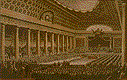
The Bastille was a royal fortress in Paris, but revolutionaries gave it an inflated notoriety by declaring it a state prison. On July 14, 1789, workers stormed the fortress and dismantled it. Though they claimed they were releasing prisoners, their real purpose was to get guns. This gesture triggered the 3 year reign of terror in which King Louis XVI was overthrown and 1,000 people, including Marie Antoinette, were guillotined.

Bastille Day today means,
for all in France, the solemn military parade up the Champs Elysées
in the presence of the head of state. It is also a holiday on which each
commune holding its local dance and fireworks. But above all, Bastille
Day, or the Fourteenth of July, is the symbol of the end of the monarchy
and the beginning of the Republic. The national holiday is a time when
all citizens can feel themselves to be members of a republican nation.
It is because this national holiday is rooted in the history of the birth
of the Republic that it has such great significance.
 The people storm
the Bastille
The people storm
the Bastille
On 5 May 1789, the King convened the Estates General to hear their complaints; but the assembly of the Third Estate, representing the citizens of the town, soon broke away and formed the Constituent National Assembly.
On 20 June 1789, the deputies of the Third Estate took the oath of the Jeu de Paume "to not separate until the Constitution had been established". The Deputies' opposition was echoed by public opinion. The people of Paris rose up and decided to march on the Bastille, a state prison that symbolized the absolutism and arbitrariness of the Ancient Regime.
The Nation marches
towards the Republic
The storming of the Bastille, on 14 July 1789, immediately became a symbol of historical dimension; it was proof that power no longer resided in the King or in God, but in the people, in accordance with the theories developed by the Philosophers of the eighteenth century.
On 16 July, the
King recognized the tricolor cockade: the Revolution had succeeded.
The storming of the Bastille symbolizes, for all citizens of France,
liberty, democracy and the struggle against all forms of oppression.
Philosophical
Questions for Bastille Day
The Tricolor Flag

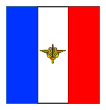
The Constitution of the Fifth Republic stipulates, in Article 2, that the national emblem shall be the tricolor flag: blue, white and red. This tricolor flag, is displayed on public buildings on commemorative occasions and at sporting events. It synthesizes the image of the Nation and is part of this image.
The kings of France wore the three colors separately: blue, white and red
The blue
banner
was flown for Charlemagne's coronation; it represented the cape Saint Martin
shared with a pauper.
From Clovis to Charles X, the
royal mantle was azure blue
adorned with gold fleurs-de-lys, symbols
of loyalty and
fidelity.
symbols
of loyalty and
fidelity.
Under the reign of Hugh Capet and his descendants, the royal standard was the red oriflamme of Saint Denis, protector of the kingdom.
From 1638 to 1790, white was the color of the flags of the king and the royal navy. And from 1814 to 1830 it was also the color of the banners of the king's army.
A
Tricolor
flag
for the French Revolution
It was the French Revolution that inaugurated the Tricolor flag.
At the Federation celebrations, on 14 July 1790, the Champ de Mars was decked with the tricolor flags.
The Tricolor and the cockade became the symbols of the living nation.
A decree of 27 Pluviôse, Year 2 of the Revolution (1794) stipulates that the national flag shall be made up of the three national colors disposed in three equal bands such that the blue strip is attached to the pole with the white in the middle and the red waving free.

The Restoration of 1815 attempted to bring back the white flag, symbol of continuity with the monarchy, and the 1848 uprising tried to impose the red flag as the standard of the Republic.
Since then, the Tricolor
has gone uncontested: gradually, all political families and all opinions
comprising the French nation have come to recognize themselves in it.
Autre
francais
Pronunciation: [sahd] , popular name of Donatien Alphonse François,
comte (Count) de Sade 1740 1814 Writer, born in Paris. He studied at Paris,
served in the army, and was in 1772 condemned to death at Aix for his cruelty
and sexual perversions. He escaped, but was later imprisoned at Vincennes
(1777) and in the Bastille (1784), where he wrote Les 120 Journées
de Sodome (c.1784, The 120 Days of Sodom). After his release (1790), he
wrote the licentious novels Justine (1791), La Philosophie dans le boudoir
(1795, Philosophy in the Bedroom), and Juliette (1797). He died insane,
his name providing the language with the word sadism .