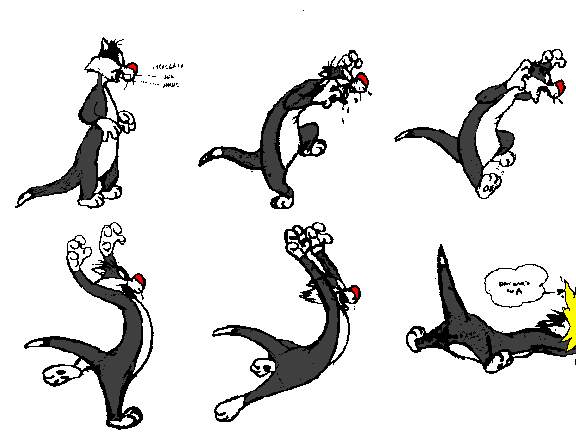
"NO WORKMAN CAN BUILD A DOOR, WHICH WILL BE PROOF AGAINST A CAT OR A LOVER !"
(FRENCH PROVERB )


CAT'S BEHAVIOR

The domestic cat is a solitary animal, an animal, which lives and hunts alone.If the cat creeps across a field, she holds her body close to the ground. If the mouse, she is stalking, shows any signs of fear or recognition, the cat stops and waits. If the mouse does not dart away and the cat reaches a spot close enough to attack, she leaps atop her prey.Holding on to it with extended claws, she administers a swift killing bite to the dorsal (back) side of the neck.This cat is an experienced hunter. Not all domestic cats kill. All cats have the innate potential to kill, but the act of killing requires learning and experience.


Included among the physical signals used by the cat are the following:
Visual signals - ear position, eye position, degree of eye-opening, tail movement, hair bristling, mouth-opening, bearing and walk, body patterns (tufts of hair on cheeks , color).
Vocalization -there are sixteen different vocal patterns used by the cat. These can be catagorized as murmur patterns, vowel patterns and strained intensity. The murmur pattern ("purr") indicates a friendly, relaxed state. The vowel pattern ("meow") is used to solicit care or express frustration. Strained intensity ("hiss, growl - scream") is heard during attacks, defense and mating.
Scratching - is sometimes used as a sound signal.
Olfactory signals - the cat marks by urinating, and with scent glands located in the tail(caudal gland), forehead (temporal gland), lips (perioral gland), chin and anal area.
Tactile signals - licking. nuzzling. rubbing, pawing.
Threat display - the cat uses threat displays to avoid actual combat. These are particularly expressive and varied. Slight changes in the degree of fear or rage will bring about corresponding changes in the display.


If a cat on his travels sees another cat further along the path , he will most likely stop, sit , sniff the ground and wait until the other cat is out of visual range. If both cats see each other at a crosspath , they may both stop and sniff the ground until one or the other decides to move on. They rarely go out of their way to attack each other on these occasions, but may do so, if they have never fought before. An adult cat usually has only one serious fight with each strange cat he encounters. Male cats are generally more aggressive and concerned with relative ranking than females, yet at the same time males are more tolerant of casual social contact.


Sometimes, domestic cat may suddenly refuse his litter pan. Perhaps, the pan is not clean enough or is too small. Try placing the pan in a different spot, clean it more often, or buy an additional pan. Be aware that cats,as children, sometimes urinate for attention. If the cat has been left alone too long , he may demonstrate anger by urinating in a forbidden area.Unlike a child , the cat will often return to urinate, where he has before ; once he has vented his anger on your bathroom mat , he will probably do so again. If this happens, throw the mat away: washing it will not eliminate the odor.
Squatting and straining to urinate outside the litter pan is a sign of cystitis, especially in male cats.


Some people spank a cat for it. People, please, do not do it !!!
It's a huge mistake ! By doing this way you show everybody your stupidity ! Cat normally will not do something wrong, if he is OK.
But, if he does - it means he needs help.
So,help him !!! Take the cat to the vet immediately !!!


TITLE PAGE: Cat's behavior

Web Page designed by OLGA RYKOVA


Hosted by www.Geocities.ws

1