Sample signals recorded from my
cavitation experiment
- We used light scattering method
to detect cavitation events. We shine a He-Ne laser beam (632 nm) through
the windows of our experimental cell. The cell is filled with liquid helium.
The laser is aligned carefully so that it goes through the acoustic focus
generated by the hemispherical transducer. If cavitation event occurs,
bubble(s) (with slightly different refractive index from liquid) would
scatter light off its incident beam. We use photomultiplier tube (PMT)
to detect the scattering light and use digital oscilloscope (LeCroy
9310A) to record and count the signals.
-
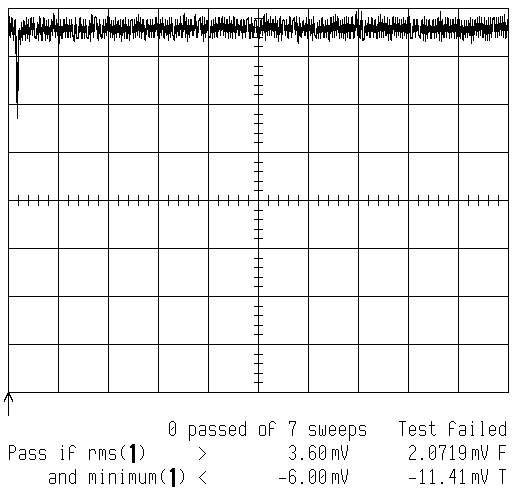 Without
having cavitation events, we may only detect the light scattered by the
density fluctuation due to the big pressure swing at focus if the fluctuation
is big enough, or just detect the background of light. The figure shown
left is the scattering light of density fluctuation. The duration of the
scattering light is exactly the same as the duration of the driving voltage
on the transducer. Typically we use quite short pulse (about several microseconds
long) to drive our transducer. The time scale for the figure is 0.2 minisecond
per division. You can see the width of the pulsed signal on the left upper
corner of the figure is very short.(5 microseconds)
Without
having cavitation events, we may only detect the light scattered by the
density fluctuation due to the big pressure swing at focus if the fluctuation
is big enough, or just detect the background of light. The figure shown
left is the scattering light of density fluctuation. The duration of the
scattering light is exactly the same as the duration of the driving voltage
on the transducer. Typically we use quite short pulse (about several microseconds
long) to drive our transducer. The time scale for the figure is 0.2 minisecond
per division. You can see the width of the pulsed signal on the left upper
corner of the figure is very short.(5 microseconds)
-
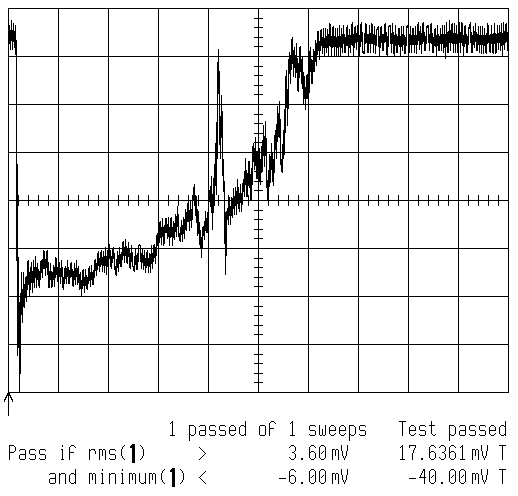 Once
a bubble of macroscopic size (typically bigger than 10 microns) formed
within the acoustic focal region, much more light would be scattered by
the bubble. If the laser beam is appropriately focused, hugh scattering
signal can be detected. For really big bubbles, the scattering light even
can be seen by bare eyes. The lifetime, proportional to the maximum size
of the bubble, depends on liquid temperature, static pressure and driving
voltage on the transducer. The figure shown right is the scattering light
of a bubble detected by PMT. We can see the formation, growth, and collapse
of the bubble. The time scale for the figure is the same as the first figure.
(0.2 minisecond per division) We can clearly see the difference between
the cavitation events and non-events. One important thing I want to point
out is that the acoustic sound lasts only a few microseconds. The bubble
grows abruptly under negative pressure caused by the gigantic sound pulse.
After that, the bubble grows only due to its inertia. That's why the scattering
light signal increases rapidly at the very beginning. If the bubble is
so big (like the one shown right) that secondary bubbles can form. When
the big bubble collapses, a lot of energy would be released and deposited
into small region so that a second bubble would be created by those energy.
In the figure, the second and third bubbles can be seen.
Once
a bubble of macroscopic size (typically bigger than 10 microns) formed
within the acoustic focal region, much more light would be scattered by
the bubble. If the laser beam is appropriately focused, hugh scattering
signal can be detected. For really big bubbles, the scattering light even
can be seen by bare eyes. The lifetime, proportional to the maximum size
of the bubble, depends on liquid temperature, static pressure and driving
voltage on the transducer. The figure shown right is the scattering light
of a bubble detected by PMT. We can see the formation, growth, and collapse
of the bubble. The time scale for the figure is the same as the first figure.
(0.2 minisecond per division) We can clearly see the difference between
the cavitation events and non-events. One important thing I want to point
out is that the acoustic sound lasts only a few microseconds. The bubble
grows abruptly under negative pressure caused by the gigantic sound pulse.
After that, the bubble grows only due to its inertia. That's why the scattering
light signal increases rapidly at the very beginning. If the bubble is
so big (like the one shown right) that secondary bubbles can form. When
the big bubble collapses, a lot of energy would be released and deposited
into small region so that a second bubble would be created by those energy.
In the figure, the second and third bubbles can be seen.
-
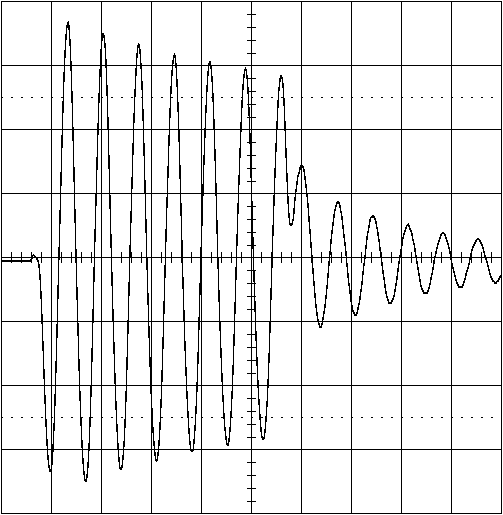 The
figure shown left is the typical signal applied on the transducer for generating
sound pulse in liquid helium. The time scale for the figure is 1 microsecond
per division. The resonance frequency of the transducer (in thickness resonance
mode) is about 1.4 MHz.
The
figure shown left is the typical signal applied on the transducer for generating
sound pulse in liquid helium. The time scale for the figure is 1 microsecond
per division. The resonance frequency of the transducer (in thickness resonance
mode) is about 1.4 MHz.
Back to Main
Index