Human Farsight
Essay on Memetic
Engineering
What it is.
What it ain't:
 When
I was young I enjoyed "hard" science fiction like that of Larry Niven.
When
I was young I enjoyed "hard" science fiction like that of Larry Niven.
 I
came across the "far look" in his Ring
World novel,
I
came across the "far look" in his Ring
World novel,
a hypnotic effect induced by staring for hours into the endless horizon
of the Ring World.
I am not interested in hypnosis. If you are, go here.
I have always been nearsighted, wearing corrective lenses since the
second grade.
I imagine that my poor ability to see details has made me tend to move
towards "the big picture" in any field of study.
At the age of 40, I am also becoming farsighted and bifocals are in
my genes.
I am not interested in defects in the function of the eyes, if you
are, go here.
I am not interested in the idea that humans can "see"
beyond our field of vision by some "sixth sense".
If you are, go to The home of Scientific
Remote Viewing
I am not interested in the idea of prophecy and
seeing into the future or the past by some kind of "sixth sense",
magic, or devine intervention. If you are, go here.
 There is
apparently something called "Farsight Christian Mission"
There is
apparently something called "Farsight Christian Mission"
that does work in places like Haiti.
I am not interested in missionary work,
if you are, or just want to get away form "it all" go here.
 Learning
from the Future : Competitive Foresight Scenarios by Liam Fahey
(Editor),
Learning
from the Future : Competitive Foresight Scenarios by Liam Fahey
(Editor),
Robert M. Randall (Contributor)
 When
I was a kid "Futurism" was a hot topic and I read books like Future
Shock.
When
I was a kid "Futurism" was a hot topic and I read books like Future
Shock.
I thought it might be cool to grow up be employed as a "futurist",
helping society find a safe way into a pleasant future....so I became
a scientist.....and poor.
Like any good idea, Futurism has been comercialized, and I should have
gone to marketing school if I wanted to get rich.
But I am not interested in "managing" companies, financial planning,
or investments, if you are go here.
I want to distinguish "farsight" from "foresight". The
term "human farsight" is redundant because what I mean by "farsight" is
unique to humans (as far as we know).
Aug 10, 1999 Altavista
farsite
1334 hits
farsight AND future 351 hits
farsight NEAR future
3 hits
human farsight
0 hits
Human Farsight: What It Is
Having said what "farsight" does not mean to me, and there is a lot
that it does not mean, it might be wise to give up on the word "farsight"
and use a different word. However, I'm going to try to use the word. So
what does "farsight" mean to me?
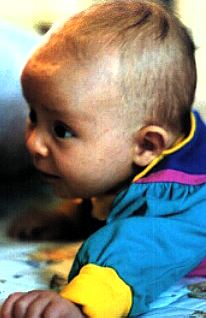 Farsight
is a state of mind that develops incrementally in people as part of cognitive
development. Farsight comes from having your thinking "in tune" with reality.
In a normal human, farsight normally starts developing as a cognitive function
in parallel with the development of normal vision. (This in no way implies
that people with damaged vision systems or no visual sense are unable to
achieve farsight, it only implies that the sense of vision is usually part
of the process.) At birth, human vision is poor. Many careful observers
of human babies have noticed that they do not pay attention to most visual
stimuli unless the stimuli are very close to the baby. This fact is often
cloaked by a baby's ability to compensate for poor vision by using the
sense of hearing. Anatomical studies of the newborn human eye have shown
that the cells in the retina that detect light are few in number and structurally
immature. It has been estimated that the newborn eye is about 350 times
worse at detecting light than is an adult human eye. Maturation of the
human eye and the sense of vision takes years. Visual development also
involves the continued development of the human brain
after birth. Visual brain circuits continuing to have great plasticity
for many years after birth.
Farsight
is a state of mind that develops incrementally in people as part of cognitive
development. Farsight comes from having your thinking "in tune" with reality.
In a normal human, farsight normally starts developing as a cognitive function
in parallel with the development of normal vision. (This in no way implies
that people with damaged vision systems or no visual sense are unable to
achieve farsight, it only implies that the sense of vision is usually part
of the process.) At birth, human vision is poor. Many careful observers
of human babies have noticed that they do not pay attention to most visual
stimuli unless the stimuli are very close to the baby. This fact is often
cloaked by a baby's ability to compensate for poor vision by using the
sense of hearing. Anatomical studies of the newborn human eye have shown
that the cells in the retina that detect light are few in number and structurally
immature. It has been estimated that the newborn eye is about 350 times
worse at detecting light than is an adult human eye. Maturation of the
human eye and the sense of vision takes years. Visual development also
involves the continued development of the human brain
after birth. Visual brain circuits continuing to have great plasticity
for many years after birth.
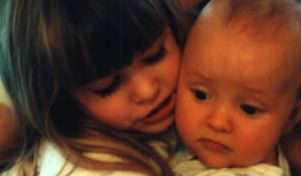 Even given
the limitations of vision in the human newborn, newborn babies CAN see.
The ability to see in built into the human brain by our genetic program.
Part of the genetic program for human vision involves what are called sensory
maps. The thousands of neuronal connections ("wires") that carry visual
signals from the retinas to the brain are carefully arrayed during embryonic
development so that their 2-dimensional spatial ordering in the retina
is faithfully mapped into layers of neurons in the brain. We correctly
percieve left-right and up-down spatial ordering in the world because our
brains are genetically programmed to be able to do so. Thus, the base-line
state for human vision is for a newborn to be able to see the extended
world around it, but in a rather fuzzy fashion. In many animal species
that care for their young, a genetically programmed "dialog" must be carried
out in order for the adult to be able to feed the young. For the
Even given
the limitations of vision in the human newborn, newborn babies CAN see.
The ability to see in built into the human brain by our genetic program.
Part of the genetic program for human vision involves what are called sensory
maps. The thousands of neuronal connections ("wires") that carry visual
signals from the retinas to the brain are carefully arrayed during embryonic
development so that their 2-dimensional spatial ordering in the retina
is faithfully mapped into layers of neurons in the brain. We correctly
percieve left-right and up-down spatial ordering in the world because our
brains are genetically programmed to be able to do so. Thus, the base-line
state for human vision is for a newborn to be able to see the extended
world around it, but in a rather fuzzy fashion. In many animal species
that care for their young, a genetically programmed "dialog" must be carried
out in order for the adult to be able to feed the young. For the 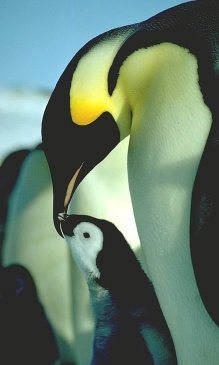 Emperor
penguin (Aptenodytes Forsteri) it starts with the yongster going 'Piu!',
'Piu!' with a head motion from front to back. Then when the adult looks
down, the chick touches its beak which triggers a feeding (food regurgitation)
reflex. In humans, "milk let down" (the relaxation of the involentart muscles
that pinch the ducts that drain the milk glands) is a relex in response
to sucking by the infant. Just as there are certain shapes that bird hatchlings
are programmed to respond to, human infants "know" to latch onto a nipple"
and humans have a built in "face detector" and babies like to see smiling
human faces.
Emperor
penguin (Aptenodytes Forsteri) it starts with the yongster going 'Piu!',
'Piu!' with a head motion from front to back. Then when the adult looks
down, the chick touches its beak which triggers a feeding (food regurgitation)
reflex. In humans, "milk let down" (the relaxation of the involentart muscles
that pinch the ducts that drain the milk glands) is a relex in response
to sucking by the infant. Just as there are certain shapes that bird hatchlings
are programmed to respond to, human infants "know" to latch onto a nipple"
and humans have a built in "face detector" and babies like to see smiling
human faces.
An early stage in cognitive development comes when a human baby becomes
aware that objects can pass out of sight (for example, behind the baby)
and be hidden, but that proper action can retrieve the objects. This understanding
of the reality of object permanance, location in space, and awareness of
the baby's own power for action is a good example of the types of cognitive
abilities that appear in a definitive order in both human and nonhuman
primate development. Tests of what developmental psychologists call "the
object concept task" can be used to document the
development of an understanding of object permanence in infant macaques.
The test measures the infant's ability to locate and grasp an object and
then, at a later age, the ability to locate the object when it is in plain
view, partially hidden, and completely hidden . We say that infants form
a cognitive model of reality and an understanding of the world. Non-human
animals do this just fine, and these basic aspects of cognitive development
are just the foundation for farsight, which is only found in humans.
When I was in second grade I was called out of my regular class and
put into some kind of behavioral test (this is the kind of joy students
get to experience when they grow up in university town). I was shown a
series of test images and then allowed to play at a table with a bunch
of cool toys. The experimenter left the room for a while then came back
and tested my memory for the images. In fourth grade a similar test was
done. I was shown a complex series of colored shapes and then challenged
to remember them. A popular theory among phychologists has been that young
children have a kind of "iconic" memory that dominates
in the early stages of human cognitive development. Some type of "imagery",
the developmental stage which many call 'iconic', seems to be a principle
mode of mental activity in younger children, to be replaced by more verbal
and abstract thinking in the 'symbolic' stage of cognitive development
of the child. (source)
In my own experience, it seems that children have what I call a "sponge
mode" in which they are very aware of what is around them, they notice
huge amounts of detail. I think that most normal people grow up and loose
this kind of perceptual and cognitive ability. People begin to tune out
unimportant features in their environment. Young children are still learning
what is important and what is unimportant, so they "absorb" every thing
like a sponge. Of course, this tends to make children easy to distract,
but it is important for learning about the world.
 Many philosophers
have been interested in an aspect of human cognitition called the "intentional
stance" by Dan
Dennett. The basic idea here is that we go through life with the expectation
that other people will bahave in the same way that we would behave if we
were in their place. Some people have claimed that "intentionality" in
this sense is fundamental to understanding human minds. Studies of chimps
have clearly shown that holding the "intentional stance" is not unique
to humans. Chimps are very aware of each other and expect other chimps
to behave in certain ways. In particular, chimp groups have a dominance
hierarchy, and chimps carefully adjust their behaviors for each individual's
position in the hierarchy. This is not to say that humans and chimps are
behviorally identical, just that the intentional stance is not a distinguishing
feature of human cognition. Still, having an understanding of what to expect
other people to do is very complex, and an important part of the foundation
for farsight.
Many philosophers
have been interested in an aspect of human cognitition called the "intentional
stance" by Dan
Dennett. The basic idea here is that we go through life with the expectation
that other people will bahave in the same way that we would behave if we
were in their place. Some people have claimed that "intentionality" in
this sense is fundamental to understanding human minds. Studies of chimps
have clearly shown that holding the "intentional stance" is not unique
to humans. Chimps are very aware of each other and expect other chimps
to behave in certain ways. In particular, chimp groups have a dominance
hierarchy, and chimps carefully adjust their behaviors for each individual's
position in the hierarchy. This is not to say that humans and chimps are
behviorally identical, just that the intentional stance is not a distinguishing
feature of human cognition. Still, having an understanding of what to expect
other people to do is very complex, and an important part of the foundation
for farsight.
Many people like the idea that what most clearly distinguishes humans
from chimps is our ability to use language. My view is that language is
just a part of what sets us apart from chimps. Another key difference is
in tool use. Chimps form and use simple tools in the wild and can learn
the basics of human language in the lab, but they cannot perform the fine
conscious motor control of the fingers and mouth parts that are required
for fine tool manufacture and human speech. For humans, investing a lot
of time in the production of a tool only makes sense if you have a clear
idea of what you are going to do with the tool. Chimps are clever, but
they are usually child-like in their appreciation for the power of tools.
Experiments with captive chimps (such as Kanzi) suggest that when chimps
learn language, their understanding of abstact ideas like "future" and
how to use tools expands. It has been suggested that not only is language
use a stimulant to cognition, but that written language also alters the
human mind. When we teach children to read are we altering the way
the brain is wired and changing the way in which people think? Some people
have suggested that language use and reading do have such power.
 The
Alphabet Versus the Goddess : The Conflict Between Word and Image by
Leonard Shlain
The
Alphabet Versus the Goddess : The Conflict Between Word and Image by
Leonard Shlain
From Amazon.com:
This groundbreaking book proposes that the rise of alphabetic literacy
reconfigured the human brain and brought about profound changes in history,
religion, and gender relations. Making remarkable connections across brain
function, myth, and anthropology, Dr. Shlain shows why pre-literate cultures
were principally informed by holistic, right-brain modes that venerated
the Goddess, images, and feminine values. Writing drove cultures toward
linear left-brain thinking and this shift upset the balance between men
and women, initiating the decline of the feminine and ushering in
patriarchal rule. Examining the cultures of the Israelites, Greeks, Christians,
and Muslims, Shlain reinterprets ancient myths and parables in light of
his theory. Provocative and inspiring, this book is a paradigm-shattering
work that will transform your view of history and the mind.
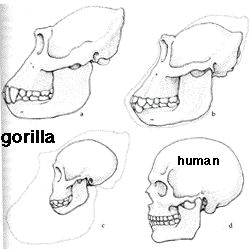 I think
that the situation is a bit more complex. Human language learning and tool
manufacture and concern for events in the far future all arose from a fundamental
modification in the development of the human brain. Human brain development
is "neotenic".
I think
that the situation is a bit more complex. Human language learning and tool
manufacture and concern for events in the far future all arose from a fundamental
modification in the development of the human brain. Human brain development
is "neotenic".
Neoteny, "holding youth", is a term applied to changes in development
by which adult members of some species possess characteristics of young,
even fetal members of related species. Adult humans "resemble" young chimps
in many features: large, round head, flat face, no prognathism,lack of
body hair, centered foramen magnum that moves, mostly in-line big toe,
retention of open cranial sutures. Neoteny is important for larger brains
since there is a longer period of brain growth in humans after birth than
in chimps. Brains of all apes grow very before and after birth. Human brains
retain this rapid phase of brain growth for a longer time than is seen
for other apes. Neoteny may be the result of a mutation of one or more
debvelopmental genes that retard the normal timing in the development of
features.Thus we can say that to a certain degree, a larger brain is the
result of a mutation that retained the period of rapid brain growth. However,
there is no good evidence that what was selected for in human evolution
was larger brains. What is important is plasticity in brains after birth
and the ability to learn from experience. Neoteny was a strategy for lengthening
the primate juvenile "play and learning" period of infancy and extending
brain plasticity into human adult hood. Bigger brains was just part of
a package deal produced by the neotenic mechanism used to produce extended
brain plasticity. There is good evidence that human brains have been getting
smaller in recent human evolution, getting rid of some of the un-needed
and energetically expensive extra baggage. (source)
What are the implications of an enhanced capacity for learning? Learning
about the environment is great, particularly if you can use what you have
learned to predict the future and to "see" or imagine things in your thoughts
that you have never experienced in your life. Here we are dealing with
the thorny psychological and philosophical issues of "creativity" and "induction".
Many folk psychologists view creativity as some type of miraculoue "gift"
and some philosophers have taken pains to "prove" that induction is a logical
imposibility. Can we say anything useful about foresight?
I like the metaphor of foresight as mental model of reality. In some
sense, when you anticipate the arrival of a ball and hit it with a bat
your brain has the functional equivalent of a model of the batting situation
that allows the brain to calculate when to initiate the swing and where
to push the bat. If you prepare for a hike that you have never made before
that will take you over a snow-covered peak, you also must have a mental
model of the future and you must plan what to take with you in anticipation
of what you might face. Not only do human brains learn about the world,
but they learn about their own ability to predict the future. As humans
age they learn how their own brains work and how to better use them. This
is part of the accumulation of wisdom with age. All normal human brains
can do this. I define "foresight" as this normal human mental capability
to think your way into the future. Foresight is not unique to humans, but
humans take the power of foresight to extreams not seen in any other animal.
What then is "farsight"? I want to define farsight as a uniquely human
mental capacity that also happens to be very unequally distributed within
individuals of the human species. The idea of inequality in mental abilies
is currently outside of the domain of political correctness. However, if
we are honest with ourselves we know that humans are diverse in every characteristic,
physical and mental. We recognize and treat mental deficiencies. Fortunately,
there are still also some special "treatments" for "gifted" children. I
am not particular interested in gifted children because the gifts often
"wear off" resulting in normal adults. Further, the mental ability I call
"farsight" is not one that is associated with youth, but rather with the
accumulation of wisdom through long experience in the world. I place farsight
at the opposite extream from the "sponge mode" of childhood mental abilities
mentioned above.
A Place for Every Thing and Every Thing in its Place
Humans go through adult life integrating all of their experiences into
the matrix of a mental model of reality. The normal human mind has no trouble
integrating new experiences with what they already know about the world.
One type of human "intelligence" depends on the ability to make predictions
about the future. Another aspect of intelligence is the ability to figure
out puzzles of how things work. When we combine puzzle solving with predicting
the future, we enter into the domain of human farsight. I have long been
interested in the idea of human and memetic engineering. Are there certain
people who are able to treat the future as a puzzle and solve that puzzle
so as to "know" what they need to to in order to assure that a particular
future is created? This is a rather amazing idea when stated so flatly.
I think most of us have the experience of WANTING to have such farsight,
but life is complex and unforeseen difficulties usually derail our plans
for the future. We can use this as a defining property of "foresight";
it is usually limited and we really expect our expectations to go unfullfilled.
This sentiment is expressed in various self-referential laws of pessimism.
Law of Pessimism: things take longer than you expect even when
you take into account the Law of Pessimism.
 We have
wishes and dreams for the future; exact "viewing" of the future is the
stuff of crystal balls and fantasy. Such is like. At least for most of
us. What then of farsight? My suggestion is that there is a small minority
of humans that achieve what we might call an "enlightened" or "transcendental"
state. In everyday life we might talk "about being in the groove" and having
things working well for us. Is there an equivalent state for some people
in which they can actively manipulate the future. Can some special human
brains essentially simulate the future, allowing some people to "see" the
future and how to produce a particular future? I call this idea "dramatic
solipsism", meaning the idea that some people might have the power to do
exactly what needs to be done in order to get other people to do what needs
to be done in order for a certain future to be created. Certain great leaders
have has an amazing capacity to build empires and creat a future in which
they control millions of lives and the fate of future civilization. Think
about Alexander the Great.
We have
wishes and dreams for the future; exact "viewing" of the future is the
stuff of crystal balls and fantasy. Such is like. At least for most of
us. What then of farsight? My suggestion is that there is a small minority
of humans that achieve what we might call an "enlightened" or "transcendental"
state. In everyday life we might talk "about being in the groove" and having
things working well for us. Is there an equivalent state for some people
in which they can actively manipulate the future. Can some special human
brains essentially simulate the future, allowing some people to "see" the
future and how to produce a particular future? I call this idea "dramatic
solipsism", meaning the idea that some people might have the power to do
exactly what needs to be done in order to get other people to do what needs
to be done in order for a certain future to be created. Certain great leaders
have has an amazing capacity to build empires and creat a future in which
they control millions of lives and the fate of future civilization. Think
about Alexander the Great.
Part of the farsight issue is the problem of tools and methods for human
and memetic engineering. One tool at Alexander's disposal was the Greek
language. We generally credit Alexander with having spread Greek around
a large part of the world. The Greek of Alexander was special because it
was the first complete alphabetic language. The Greeks "invented" vowels
in the written form we are familiar with. With a complete and rational
alphabet, a ruler could issue written orders and be sure that his men could
understand them. A large empire could be administered efficiently with
the power of the Greek alphabet. Of course, after other cultures learned
the "secret" of Greek, the playing field shifted to a higher level, some
new engineering tool was needed in order to take control of human minds.
So part of farsight must be to have the tools that are required to get
people to do what you want and another part must be having the type of
personality that would drive you to use those tools. We often talk about
people as being "manipulative". The human capacity to be "manipulative"
is like human foresight.....almost by definition it goes wrong. Manipulative
people are discovered and condemned. People do not like being manipulated.
Part of farsight is avoiding the trap of becoming a known manipulator of
other people. There are two ways you could do this. First, you could be
so shrewd in you manipulations that you never get caught. I suspect that
this is impossible. Primated seem to be engineered for detecting cheating,
it is one of out few instictive abilities. The other alternative for avoiding
the pit fall of manipulation is to restrict what you get other people to
do the those things that they want to do. Managers are praised for "motivating"
workers and getting them to do things. Getting people to WANT to do things
is the easiest path. It has been suggested that Alexander was a great motivator
of soldiers, supplying them with the means of fullfillment of "every man's
desires" while on an endless campain of conquests.
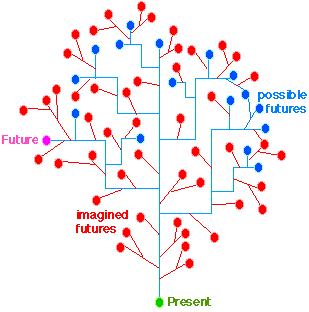 This
is not the place to deal with the issue of determinism and Free Will or
"multiple-universes", so I will simply say that we imagine multiple futures
as possible outcomes of our possible actions. We can imagine futures that
are really quite impossible. We imagine that there are "branch points"
on the way to any particular future where we can make choices so as to
guide the way to a particular future. When me plan for the future we prepare
to make the choices that will get us to a particular imagined future. A
person with farsight has the ability to imagine a particular future and
work skillfully towards that future. A parson with farsight is by definition
a person who seems to other people to have a miraculous power to control
worldly events by making the right choices in what to do and how to get
other people and elements of the memosphere to evolve in a certain way.
This
is not the place to deal with the issue of determinism and Free Will or
"multiple-universes", so I will simply say that we imagine multiple futures
as possible outcomes of our possible actions. We can imagine futures that
are really quite impossible. We imagine that there are "branch points"
on the way to any particular future where we can make choices so as to
guide the way to a particular future. When me plan for the future we prepare
to make the choices that will get us to a particular imagined future. A
person with farsight has the ability to imagine a particular future and
work skillfully towards that future. A parson with farsight is by definition
a person who seems to other people to have a miraculous power to control
worldly events by making the right choices in what to do and how to get
other people and elements of the memosphere to evolve in a certain way.
Luck or skill?
When things turn out the way you want them to turn out, is that due
to luck or skillful application of your efforts? This is a false dichotomy.
Good things can come by no effort of your own, but we are interested in
engineered results that do depend on a person working towards a goal that
IN THE ABSENSE OF those specific human eforts would be impossible to achieve.
Doesn't Chaos Theory Rule-out Farsight?
I am not thinking about farsight in terms of perfect vision into the
future, more as a type of "intuition" about the existence of certain natural
paths into the future which can be seen an taken as channeling courses,
down-sloaping valleys, or strange attractors that have pleanty of room
for unforeseen variations, but which are nonetheless constrained so as
to result in a future of a particular desired type. So farsight is taken
to be a mental capacity that takes into account chaos and deals with futures
that are orderly and naturally in tune with present reality. It is the
natural inertia of historical and cultural change that farsight can "see".