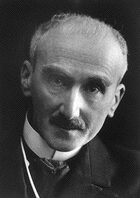
 1910
AD Bergson. France. His book, Matter
and Memory, distinguishes between unconscious memory that automatically
controls behavior and conscious memory which can be uncoupled from automatic
actions. I have placed this book in the biology section, even though it
is really philosophy. Why? Because it is philosophy which took the biology
of behavior seriously. Bergson was well aware that brain damage can alter
behavior. The only question for Bergson was if the brain was the source
of mind or a conduit that connects the material world to the non-material
world of the soul. Bergson was forced into a compatabalistic stance with
respect to mind and brain because he could not imagine how a material brain
could possibly produce things like memory and he was not happy with a simplistic
mind/brain dualism. If the brain is a connection between physical reality
and the thinking, remembering, non-material soul, then what allows these
two distinct systems to interface? Bergson is driven by logic to conclude
that our dualistic black and white distinction between material world and
non-material soul must be modified to allow for some type of fundamental
similarity between brain and soul in order for them to constructively interact.
But he is not willing to take the final step and admitt that the type of
matter studied by science is all that there is, that the brain is carbon,
nitrogen, hydrogen, and oxygen and that "mere matter" must be able to account
for mind. This book provides a good example of how the new biology of the
1800's impacted on philosophy. People like Broca had identified localized
brain lesions that disrupt specific brain functions like production or
comprehension of speech. Darwin had introduced the powerful idea that the
human brain had evolved from simpler brains. The question could no longer
be avoided: which aspects of human mental activity can be explained in
terms of the brain? Bergson had to admit that the empirical evidence indicated
that the physical strucutre of the brain was important for movement. However,
the fact that complex memories and abstract reasoning could not be localized
to specific brain regions was siezed upon by Bergson as an excuse for spliting
the mind into two parts: basic sensory and motor functions could be linked
to specific cortical areas. Memory and reasoning and the seat of Free Will
must be non-material, in the domain of spirit. Bergson
net. (Jones, 939. Bergson had similarities to Schopenhauer). (question
of influence of Bergson on Wittgenstein)
1910
AD Bergson. France. His book, Matter
and Memory, distinguishes between unconscious memory that automatically
controls behavior and conscious memory which can be uncoupled from automatic
actions. I have placed this book in the biology section, even though it
is really philosophy. Why? Because it is philosophy which took the biology
of behavior seriously. Bergson was well aware that brain damage can alter
behavior. The only question for Bergson was if the brain was the source
of mind or a conduit that connects the material world to the non-material
world of the soul. Bergson was forced into a compatabalistic stance with
respect to mind and brain because he could not imagine how a material brain
could possibly produce things like memory and he was not happy with a simplistic
mind/brain dualism. If the brain is a connection between physical reality
and the thinking, remembering, non-material soul, then what allows these
two distinct systems to interface? Bergson is driven by logic to conclude
that our dualistic black and white distinction between material world and
non-material soul must be modified to allow for some type of fundamental
similarity between brain and soul in order for them to constructively interact.
But he is not willing to take the final step and admitt that the type of
matter studied by science is all that there is, that the brain is carbon,
nitrogen, hydrogen, and oxygen and that "mere matter" must be able to account
for mind. This book provides a good example of how the new biology of the
1800's impacted on philosophy. People like Broca had identified localized
brain lesions that disrupt specific brain functions like production or
comprehension of speech. Darwin had introduced the powerful idea that the
human brain had evolved from simpler brains. The question could no longer
be avoided: which aspects of human mental activity can be explained in
terms of the brain? Bergson had to admit that the empirical evidence indicated
that the physical strucutre of the brain was important for movement. However,
the fact that complex memories and abstract reasoning could not be localized
to specific brain regions was siezed upon by Bergson as an excuse for spliting
the mind into two parts: basic sensory and motor functions could be linked
to specific cortical areas. Memory and reasoning and the seat of Free Will
must be non-material, in the domain of spirit. Bergson
net. (Jones, 939. Bergson had similarities to Schopenhauer). (question
of influence of Bergson on Wittgenstein)
Bergson's Brain: Between Metaphysics and Neuroscience by Paul A. Harris
Replacing the Perception/Memory duality with the Consciousness/Unconsciousness duality and diversifying our conception of memory processes within the context of time.
When we introspect, the relationship between perception and memory is always difficult to correctly sort out. A "tricky" part of the relationship between perception and memory is that it is easy for people to adopt a naive view of memory when they rely on the limited view of mind that we get from introspection. In the commonly-held view of memory that is produced by introspective analysis of mind, we over-empasizes the role of long-term and explicit (conscious) memory while at the same time our introspection leads us towards the incorrect position of ignoring short-term and implicit (unconscious) memories. Short-term, long-term, implicit, and explicit......this terminology is a new terminology of the 20th century that dominates modern study of memory. A clear distinction between short- and long-term memory, implicit and explicit memory is not found in the thinking of early philosophers of mind. Bergson is interesting because he was among the first philosophers to begin to apply not only subjective introspection but also the fruits of objective studies of memory to philosophy of mind.
It is natural and inevitable that conscious brain activity dominated early philosophy of mind while the unconscious was usually ignored. This is natural because introspection, the original tool of philosophy of mind, is a tool that depends on consciousness. Unconscious brain activity is largely invisible to introspection. Bergson himself relegates it to its own category, "habit" and elevates conscious "representation" (the darling of classical philosophy) to the status of "real memory". It took a revolution in human thought for people to begin to recognize the importance of the unconscious part of mind. This "revolution of the unconscious" is often traced by historians to the work of 19th century pioneers of the study of the unconscious such as Freud. This is a revolution that is still in progress. Some living philosophers of mind such as John Searle are reluctant to even admit unconsciousness into their study of mind, still prefering to equate mental processes with consciousness.
Memories were always recognized as being either "active" or "latent". It is clear to our introspection that we each contain many "latent" or "currently silent" memories, while at any given time only a few of our memories compete to enter into our conscious awareness, into our narrow window of present experience. The broader modern view of memory goes beyond the original naive understanding of latent memories which was a view of all memories as at least having the possibility of entering into our consciousness. The modern view of unconsciousness includes the idea that minds contain memories that never can and never do directly enter into consciousness. These are not simply latent memories that never happen to get recalled, they are absolutely introspectively invisible memories. It took tools beyond introspection for people to be able to even recognize the existence of such memories as being more than "habit" and as being intimately associated with explicit, conscious memories..
Modern thinking about memory has involved a broadening of the concept
of memory not only from
the earlier restricted view of all memories as conscious memories
and towards
inclusion of unconscious memories,
and also towards a more sophisticated conception of time as a useful
measure of the many different types of memory that brains utilize.
Careful analysis of amnesiacs in clinical settings allowed for clear
recognition of temporal restrictions in the loss of memory. Blows to the
head that induce sudden but temporary unconsciousness can cause a person
to lose only the most recent, short-term memories. Certain types of gross
brain damage can cause a loss of the ability of people to form new long-term
memories while short-term memory processes remain intact. The careful study
of memory with respect to time that objective analysis provides, has allowed
the modern philosopher of mind to recognize that a whole array of different
memory processes covers the entire dimension of mental time from fractions
of seconds to minutes to hours to years.
The idea of "memory" has been changed. We now go beyond introspection
by exploring memory using the tools of clinical case studies, psychology,
and modern brain science. Bergson was one of the first philosophers to
start down the road to a wider concept of memory than is possible by introspection
alone.
Both Bergson and Edelman saw memory as being of central importance in the study of mind. Most philosophers have had different views, not recognizing memory as being so fundamental. The more common view of mind takes perception to be distinct from memory. In contrast, Bergson knew that, "perception and recollection always interpenetrate each other" (page 72, "Matter and Memory", 6th Edition, 1950). Since perception is a mental process restricted to our experience of present time, it is clear that Bergson held (or, perhapse more accurately, he was in the process of personally growing so as to be capable of holding it) the modern concept memory being complex, with some memories extending into the domain of very short time scales. It was difficult for earlier thinkers to envision a role for memory IN perception, because introspection alone tends to make people view memory as being a long-lasting thing that exists in our minds beyond and distinct from the narrow window of present experience. Only a modern thinker like Edelman would have the ability to openly refer to perception as "The Remembered Present".
Bergson's attempt to analyze mind in terms of the fundamental role of memory led him to the definition of concepts such as "pure perception". For most philosophers from Plato to Searle, perception is mighty pure. Introspection presents us with an experience of perception that paints perception as a homogeneous essence. We need a magnifying tool that can give us a closer view of perception, then we begin to see the cellular and atomic components of perception and we stop seeing it as a homogeneous monolith.
In Bergson's time, the available clinical data (such as Broca's results on speech centers in the brain) indicated that mental functions perception and motor output can be closely linked (by correlations of structural and functional damage) to the structure of the brain. This was a slippery slope for philosophers of mind; given the initial successes of relating perception and movement to physicial brain structures, what if science was on the virge of showing that ALL mind is produced by the physical brain? If so, then what remains of the human yerning for Freedom of Will? What if those silly atomists of ages past were really correct?
Bergson saw a way to salvage Free Will. Split the mind into two parts, one intimately associated with the brain and acting as a conduit between the physical world and the inner world of memory, consciousness, sense of time, Free Will, and the non-material soul. But how to deal with the age-old problem of interfacing the material and non-material? To find a compatibility between matter and mind he has to find a new way of looking at both matter and mind that would reveal a commonality, a mechanism for linkage. This became a fine example of the cart before the hourse, with Bergson's desire to salvage Free Will leading him to interpret brain pathophysiology and psychological studies of memory in the "proper" way so as to give the result that he desired. (this might be a good place to bring in Dan Dennett on Free Will)