Present Experience, Platonic Realism, Cartesian
Solipsism
I found your examination of Platonism and Solipsism in terms of Present
Experience very stimulating. I hope you do not mind me repeating some of
what you said in my own words.
 One
particular idea kept dominating my thoughts while I was reading your essay,
an idea that I will call the "focus/frame" idea. In order to experience
or think about a THING, we need to mentally focus in on it. We need to
get intimate enough with it so that we can begin to understand some of
its details. However, we also need to retain our perspective and be able
to maintain a view of any particular THING that also includes a surrounding
contextual frame. In the case of Vincent Van Gogh's painting "Las Chaise
a la Pipe" we are given a good perspective from which to think about the
chair and are also provided with some things that are either smaller (the
pipe) or larger (part of the room containing the chair) and that serve
to put the chair in its proper perspective.
One
particular idea kept dominating my thoughts while I was reading your essay,
an idea that I will call the "focus/frame" idea. In order to experience
or think about a THING, we need to mentally focus in on it. We need to
get intimate enough with it so that we can begin to understand some of
its details. However, we also need to retain our perspective and be able
to maintain a view of any particular THING that also includes a surrounding
contextual frame. In the case of Vincent Van Gogh's painting "Las Chaise
a la Pipe" we are given a good perspective from which to think about the
chair and are also provided with some things that are either smaller (the
pipe) or larger (part of the room containing the chair) and that serve
to put the chair in its proper perspective.
A 20th century version of a visual representation of this focus/frame
idea is present in Carl Sagan's movie Contact.
The introductory scene starts with the planet Earth. The camera pulls away
to show our place in the Solar System, then the Milky Way Galaxy, then
the whole Universe. Finally the whole expanding Universe becomes just a
speck in the eye of a person as the camera continues to pull backwards.
A poetic visual metaphor for the capacity of the human mind to contain
or represent all of reality. In the lingo of the current age, our brains
can contain a mental model of external reality.
 The
most explicit analysis of this focus/frame idea that I know of is in Dug
Hofstadter's book Godel,
Escher, Bach. In that book, Hofstadter extensively uses the art work
of M. C. Escher as a source of visual examples of recursion, self-representation
and the problem of finding the correct contextual frame for knowledge.
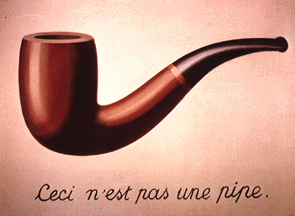
"Las Chaise a la Pipe" reminds me in particular of an image (I wonder if
Rene Magritte was inspired by Van Gogh?) that Hofstadter discusses: a drawing
of a pipe that is labeled "This is not a pipe". Imagine Van Gogh's painting
"Las Chaise a la Pipe" hanging before you in a museum with the title "This
is not a chair". You wrote that "one can't look at that picture for the
first time and doubt the existence of that chair", but, particularly when
told to do so, we can begin to imagine that there is no chair there. Maybe
it is really just A PAINTING OF A CHAIR. Maybe for Van Gogh the thing with
four legs is never used for sitting and is just a convenient place to set
things, A PIPE STAND. This power, the power of the human mind to contextually
frame any THING in a seemingly infinite number of ways, is a defining feature
of human intelligence that artificial intelligence researchers like Hofstadter
would dearly love to be able to insert into a man-made machine. A modern
thinker like Hofstadter is in love with the multiplicity and richness of
mental representations, Plato was embarrassed by this richness and sought
to clothe it in a tapestry of Ideal Forms. We have come a long way!
The
most explicit analysis of this focus/frame idea that I know of is in Dug
Hofstadter's book Godel,
Escher, Bach. In that book, Hofstadter extensively uses the art work
of M. C. Escher as a source of visual examples of recursion, self-representation
and the problem of finding the correct contextual frame for knowledge.
"Las Chaise a la Pipe" reminds me in particular of an image (I wonder if
Rene Magritte was inspired by Van Gogh?) that Hofstadter discusses: a drawing
of a pipe that is labeled "This is not a pipe". Imagine Van Gogh's painting
"Las Chaise a la Pipe" hanging before you in a museum with the title "This
is not a chair". You wrote that "one can't look at that picture for the
first time and doubt the existence of that chair", but, particularly when
told to do so, we can begin to imagine that there is no chair there. Maybe
it is really just A PAINTING OF A CHAIR. Maybe for Van Gogh the thing with
four legs is never used for sitting and is just a convenient place to set
things, A PIPE STAND. This power, the power of the human mind to contextually
frame any THING in a seemingly infinite number of ways, is a defining feature
of human intelligence that artificial intelligence researchers like Hofstadter
would dearly love to be able to insert into a man-made machine. A modern
thinker like Hofstadter is in love with the multiplicity and richness of
mental representations, Plato was embarrassed by this richness and sought
to clothe it in a tapestry of Ideal Forms. We have come a long way!
Solipsistic thinking involves pulling the frame of reference in so tightly
around your self (I love the idea that solipsism collapses into a single
infinitesimally small point!) that you abandon the reality of the external
world as your proper frame of reference. Platonic thinking involves an
attempt to construct a wide frame of reference (an imagined world of Ideal
Forms) that can encompass all the Sacred Truths of Reason, but you end
up in the same dead end as for solipsism: you abandon the primacy of the
objectively real, external world. The moral of this story is, I think,
that as humans we must retain and fully utilize our power to mentally focus
inward (towards the self) or outward (towards universality) as each new
situation demands. Sometimes a microscope gets broken and is stuck at one
extreme of focus. As human philosophies, Solipsism and Platonism are broken
tools, stuck and restricted to one extreme of the in/out scale of focus/frame.
Stuart Kauffman (in his book, The
Origins of Order) has suggested that our brains function best when they
are balanced "at the edge of chaos". It strikes me that our ability to
mentally flip between extremes like Solipsism and Platonism might be an
indication that our brains are able to flexibly seek such a balance. Platonic
thinking invites us to try to nail reality in place, to lock it to a set
of unchanging Ideal Forms. This is what Kauffman calls the "frozen domain"
where nothing moves, change is impossible, and information processing cannot
occur. At the other extreme, Solipsistic thought is the perfect positive
feedback system, a self-contained system with the power to produce all
of the complex world we experience, but with no mechanism for control,
just a recipe for self-indulgent chaos.
 You mentioned
the title of the novel, The
World Is Not Enough as a good description of the Platonic philosophical
perspective. Here is one you can use for Solipsism: Wave
Without A Shore by C. J. Cherryh. As you say, Platonic thinkers are
driven to accept an entire imaginary world of Ideal Forms in their search
for how to correctly frame human knowledge. Solipsism is like an electromagnetic
soliton in outer space; self-propagating, in no need of a medium, and in
no danger of crashing into a distant shore. By the way, "Wave Without A
Shore" is a fun read, full of philosophy. It is as good as any philosophy-rich
story by Ursula K. Le Guin. (I see that "Wave Without A Shore" is out of
print.....why is the world flooded with idiotic books while so many of
the great works are abandoned?)
You mentioned
the title of the novel, The
World Is Not Enough as a good description of the Platonic philosophical
perspective. Here is one you can use for Solipsism: Wave
Without A Shore by C. J. Cherryh. As you say, Platonic thinkers are
driven to accept an entire imaginary world of Ideal Forms in their search
for how to correctly frame human knowledge. Solipsism is like an electromagnetic
soliton in outer space; self-propagating, in no need of a medium, and in
no danger of crashing into a distant shore. By the way, "Wave Without A
Shore" is a fun read, full of philosophy. It is as good as any philosophy-rich
story by Ursula K. Le Guin. (I see that "Wave Without A Shore" is out of
print.....why is the world flooded with idiotic books while so many of
the great works are abandoned?)
For me, as a biologist, application of the focus/frame idea to epistemology
has to include the issue of nature vs. nurture, experience vs. genetic
predisposition. Your exploration of Present Experience struck me as a having
a tight focus that called out for a wider frame. Basically, what is needed
is inclusion of the evolutionary perspective. I keep thinking "Darwit,
Darwit". There is nothing wrong with leaving the issue of a frame implicit
in your presentation; just allow me to make it explicit so that we can
talk about it.
In order to frame your focus on Present Experience I asked myself this:
how do genes and memes set the frame for Present Experience? My thinking
about this is strongly influenced by Dug Hofstadter's (again, in "Godel,
Escher, Bach") provocative suggestion that the reason we cannot hold two
simultaneous views of an ambiguous situation (like your vase/faces example)
in our thoughts is because our neural circuitry is simply incapable of
doing so. The specific illustrative example used by Hofstadter involved
two unique neural sub-networks in a brain that were required to be active
in order to produce two different thoughts. For example, one sub-network
creates the subjective experience of seeing a vase, the other creates the
subjective experience of seeing two face profiles. But what if the sub-network
circuits overlap and both can not operate correctly at the same time without
disrupting each other? I'll return to this line of analysis again, below
under the label of "thoughts in conflict").
Why would brains be incapable of making us consciously aware of both
the vase and the faces at the same time? I can only suggest that, in the
broadest sense, this is a biological reality that we cannot escape because
our conscious minds evolved as part of a system that must, moment by moment,
produce a single coherent behavioral response. We really do have one-track
(conscious) minds. Mike Arbib has discussed (in his book, The
Metaphorical Brain) this fundamental brain task of producing a single,
unified behavioral output in terms of "resolving redundancy of potential
command" and he placed this task at the core of the brain's To Do list.
Edelman struggled to produce a coherent theory of "global brain function"
that would explain the unity of purpose produced from the jumble of parallel
processing (poetically labeled by Minsky as the Society
of Mind) that the brain performs. I find it informative that Science
is called inhuman when it produces only fragmentary knowledge. Philosophy
is heralded as the pinnacle of human expression when it seeks Grand Unified
Philosophies of Life. How easy it is for me to see such human biases as
having been programmed by our biological nature, as being built into our
brain structure. Of course, it is only with a modern understanding of brains
and the availability of computers to show us possible alternative paths
to mind that we can frame epistemology in this way.
Parenthetical aside.......
Two other issues I want to spend more time talking and thinking about:
1) Is there an "ideal", "proper", or "best suited" social context for
each of: Platonism, Solipsism, Objectivism? In my youth, Plato's Utopian
work was my introduction to philosophy, quickly followed by a visit to
the Cave of Shadows. I have spent most of my life imagining my own Utopia
that would be a good fit for Objectivism (I call it "The Diverse Society").
It would be an interesting literary exercise (I wonder if it has already
been done?) to comprehensively catalog all Utopian writings according to
the authors' underlying personal philosophical perspective. Can we conclude
that in order to write a book like "Wave Without A Shore" that C. J. Cherryh
must be leaning towards Solipsism?
2) Is there a single, logical, inevitable, and linear progression of
human philosophical perspectives that are forced on philosophers by biological
and social evolution or is this really a "Postulate of Parallels" situation?
I like how you start your essay with Present Experience viewed as an
example of a source of potential cognitive dissonance. If we focus our
thoughts in one direction we can FEEL that any particular case of Present
Experience is an utterly sterile and worthless momentary picture. However,
if we shift our perspective, as some "Eastern" philosophical traditions
demand that we frame our thoughts, then we can FEEL that living for and
in Present Experience is the most sublime and vital thing that we can and
must do.
I love how you then immediately relate the above focus/frame issue to
the way in which we can have a "mystical" experience by contemplating the
question: "why does anything exist"? You then frame both
1) this particular philosophical nugget (which, by the way, is still
beautifully tormenting physicists.....do you know about the Anthropic Principle
in cosmology?)
and also
2) mysticism in a broader sense
in the context of Wittgenstein and the "limits of language".
Your approach stimulated me to begin to play another frame game, contrasting
i) our conscious mental world of Present Experience
with
ii) unconscious brain activity.
In so doing, I was struck by this fact: while we prize those rare "mystical"
(okay, so shoot me for inserting endless parenthetical comments, but Carl
Sagan suggested that we can use the term "sense of wonder" to describe
such experiences.......does doing so allow one to avoid a certain amount
of excess baggage and distracting connotations that "mystical" has accumulated
over the centuries? Personally I am willing to take the risk and use both
"mind" and "mystical".....I'll even put both butter and jam on the same
biscuit!) experiences that flower in our minds beyond the limits of language,
most of our mental activity that exists beyond the limits of language is
totally mundane and worthy of never entering into consciousness. So what
does it mean to say that our unconscious thoughts can produce in us mystical
experiences? Why and how do mystical experiences erupt from our unconscious
while 99.999% of the mundane aspects of unconscious mental activity never
intrude on our conscious minds? If we build on Hofstadter's suggestion
of "thoughts in conflict", then it may be that the brain is designed so
that whenever two "thoughts in conflict" occur in our unconscious minds,
they are brought to the attention of our conscious mind. This makes sense
in terms of survival. If our unconscious brains provide vast parallel processing
capacity, sometimes two contradictory thoughts or interpretations of data
will arise. It makes sense in terms of evolutionary design that an alarm
will be triggered by "unconscious brain activities that are in conflict"
and then the conflict will be "kicked upstairs" (another Hofstadterism)
to the conscious mind for more detailed analysis. In the case of a human
being engaged in the process of trying to imagine non-existence, it is
easy to understand why all sorts of conflict alarms would be triggered.....99.999%
of the time our brains are working on the assumption that THINGS DO EXIST.
Is the jangle of alarms triggered by contemplation of non-existence what
we subjectively feel as a "mystical experience"?
Sagan would have said that the human ability to step outside of conventional
lines of thought is the source of human wonder and the engine of scientific
creativity. Hofstadter would say that human intelligence depends on being
able to step outside of a conventional conceptual frame of reference so
as to attain a higher order perspective that allows you to solve a problem.
Maybe the human capacity for mystical experience can be viewed as part
of a survival trick that brains evolved in order to respond adaptively
to the existence of contradictory patterns of brain activity. If conflict
is detected within unconscious brain activity, then conscious brain activity
can be focused on the conflict in order to resolve it. We revel in a mystical
experience when we can imagine no resolution to the conflict. At other
times of mental conflict, when we can imagine a way out, we simply start
with our experience of existing mental conflict and proceed to engage in
a conscious attempt to "rationalize" and resolve the underlying conflict.
"the continuum problem" In his book, The
Astonishing Hypothesis, Crick explains the type of experiments that
have shown that the brain is only capable of producing conscious experiences
when a pattern of brain activity persists for at least 40 milliseconds.
200 msec or longer is often required for subjective experience of more
complex qualia and thoughts. This 40 msec "biological quantum of conscious
time" is due to the mechanical details of the particular type of short-term
memory process that the cerebral cortex uses to allow us to focus our attention
on particular THINGS. The fact that 40 msec is not much longer than it
must take for a series of action potentials to get around through a neural
network in the brain suggests that the brain is about as fast as it can
be given the limitations of its building blocks.
Of course, this "quantum of conscious time" is invisible to our subjective
experience.........neither can we see the cells in our eyes that allow
us to see. The "invisibility" of our quantum of conscious time is well
illustrated in one of E. E. "Doc" Smith's SKYLARK
SERIES space opera novels which I enjoyed in my pre-scientific youth. After
inventing a faster-than-light space ship propulsion system that makes it
possible to get around within the galaxy in a reasonable period of time,
the hero still finds it tedious to spend years traveling to other galaxies....an
even faster mode of travel is required! After an amazing research program
involving a cerebroscope that allows him to watch the thoughts of his man
Friday (as a classic example of early SF, this novel was in no way either
politically or scientifically correct!), the hero realizes that he must
build a space ship that can travel AT THE SPEED OF THOUGHT! The author
assumes that this means "almost instantaneous travel" and after a few hours
of engineering work, he has revamped the engines of the SKYLARK and we
are happily moving between the galaxies at the rate of a modern trip from
New York to London.
faces/vase and awe-that-anything-exists/doubt-that-anything-exists
In order for this analogy to work best the reader should be personally
familiar with both of these experiences (awe-that-anything-exists and doubt-that-anything-exists).
I am in the less satisfactory position of only being able to understand
one of them on an intellectual level. I have experienced awe-that-anything-exists,
and on rare occasions I still do, if it sneaks up on me. However, I cannot
automatically experience awe-that-anything-exists just by thinking about
it. Modern cosmology has taught me to suspect that our universe MUST exist,
which for me seems to mostly nullify awe-that-anything-exists. I have never
personally experienced doubt-that-anything-exists. I can think of 3 "classical"
literary tricks for inducing an experience of doubt-that-anything-exists:
1) approaches such as asking one to imagine what we could know if our
eyes or brains were designed to fool us and not accurately convey to us
the true nature of reality,
2) discussion of insanity as a route to detachment from reality, and
3) discussion of dream scenarios in which characters do not know if
they are dreaming.
The current "modern" literary trick involves a virtual reality scenario.
Unfortunately, in the same way that I have never experienced contact
with God, I have also never experienced doubt-that-anything-exists. Even
my dreams in which I convincingly dream that I have just woken up do not
lead me to doubt that anything exists.....that everything is "just a dream".
I feel like in discussing solipsism, I am like a blind man discussing a
rainbow.
Why am I resistant to "radical skepticism"? I suspect that the most
solid escape route from this valley of despair is through a firm attachment
to a stable social group within which one is free to exchange and intersubjectively
validate subjective experiences. The capacity to engage in such a social
process is genetically predetermined (nature) and also must be nurtured
by the social group one is born into.
At the risk of playing the role of Tony Nickles, let me ask: "what is
classical epistemology?" I'll take a focus on "knowledge as justified
belief" as a way to define the approach of "classical epistemology". If
you have another definition, please run it by me again. After having spent
many years developing my own ideas about what I think of as "experimental
epistemology" (Have you ever seen Ray Smullyan's story about an experimental
epistemologist? Edelman uses the term "biologically based epistemology"),
I was initially shocked to find that so many philosophers still view epistemology
as the problem of justified belief. Why place subjectivity at the heart
of the study of knowledge? With time I have been able to reconcile "justified
belief" with my personal approach to epistemology which is not centered
on the subjectivity on belief. I have seen some philosophers argue against
any attempt to develop an epistemology that does not center on belief;
they would say that you have left epistemology behind if you try to do
so. To me, such an argument is like saying cosmology was originally defined
as a way to explain Earth's unique position as the center of the universe,
so any heliocentric theory cannot be part of cosmology. I now view the
study of knowledge in terms of judtified beliefs as having been the best
approach available before the development of a modern scientific (objective)
approach to epistemology.
Within the framework of "justified belief", we are sucked into the classical
argument about sources of justification: does justification of belief derive
from experience or from rational thought? This is the horrible dichotomy
that the subjective approach to knowledge forces upon people. If Wittgenstein
wanted us to proclaim examples of wasted effort within philosophy, here
is a great one. But I can understand how easy it was to fall into this
trap before the development of organized science.
You wrote that you have had experiences of "realizing that my sensations
may not be of the world I take them to be." For me, "experience of realizing"
is a phrase that leads to an analysis of the various types of experience.
How should we start to sub-categorize experiences? I will follow Ned
Block's austere distinction between "Perceptual" and "Access" consciousness
in order to distinguish two classes of experience. This is similar to the
type of primary/higher-order consciousness distinction made by other folks
like Edelman,
but for our purposes here I prefer to avoid getting involved with language,
which Edelman tries to make central to his conception of higher-order consciousness.
Perceptual (or just P, for short, in Block's lingo) consciousness is
tightly coupled to sensory input. Go into a sensory deprivation chamber
and you can lose P consciousness. What remains, an awareness of your inner
thoughts that are independent of on-going sensory experience, is Access
(or just A, for short) consciousness. If you have an experience of "realizing
that my sensations may not be of the world I take them to be," then you
are using A consciousness in order to produce a complex "realization" that
is based on a past history of P consciousness.
If we relate this distinction between A and P consciousness back to
the dichotomy in possible sources of justification for beliefs, then we
can suggest that some philosophers have imagined that our A consciousness
has special access to SOMEthing that allows us to justify beliefs, SOMEthing
that is independent of P consciousness. Other philosophers have suggested
that all knowledge must come by way of P consciousness acting as a conduit
leading to A consciousness and that there is no "internal" source of knowledge.
My view is that we need P consciousness for contact to the objectively
real external world, but I am willing to grant that the genetically determined
structure of the human brain does provide us with certain innate thought
patterns that provide us with a source of knowledge about the world that
has been validated (justified in an evolutionary sense) through the process
of natural selection.
Within neuroscience we know more about the mechanics of P consciousness
than we do about A consciousness. We have a fairly good idea of how our
brains are genetically determined to automatically process certain sensory
inputs in particular ways. We also have the begining of an understanding
of how our genetic predispositions towards certain types of P consciousness
can be modified by experience and learning. A consciousness is a lot murkier
because it is deeper in the brain (in the sense of being further removed
from primary sensory brain regions) and apparently more widely distributed
around the brain in an intricate system of cooperating brain regions. I
suspect that these brain regions which produce A consciousness are more
flexible with respect to genetically determined ties to our
objective external reality than is the case for the brain regions that
produce P consciousness. When you say you have "a sensation of realization"
with respect to doubt-that-anything-exists, this strikes me as being the
type of experience that is heavily influenced by memes and rational thought
experiments. This is the same mental domain where religious faith resides
(or in my case, fails to reside). My grand conclusion from this A/P consciousness
analysis? We need to make the effort to distinguish three inter-related
sources of knowledge, genes, memes, and experience. For me, this tripartite
perspective is a satisfactory frame for an analysis of the role of Present
Experience in philosophical stances like Solipsism.
Loose ends.
Kant has never made a great deal of sense to me, but I am willing to
agree that our brains are designed to (correctly, I have no doubt) interpret
space as three dimensional and time as a ribbon stretching from past to
future. I suspect that primate brains have been selected to interpret sensory
input in this way, this interpretation of the world is innate. I am thinking
about space/time in the same way we think about language and about the
idea that humans have a Language Acquisition Device in their brains.
Interestingly, certain types of brain damage can abolish a person's sense
of either 3D space or the progression of time. Of course, this is a case
of a genetic predisposition. For humans, experience normally confirms,
refines, and greatly fleshes-out our innate predisposition towards a particular
way of dealing mentally with space and time. I ask, to what extent are
we genetically predisposed towards or away from philosophical stances like
Solipsism? Studies of twins have been useful in sorting out such questions,
usually for asking questions about the inheritance of predispositions for
diseases (the money for such studies comes from biomedical research funds).
I wonder if there has ever been a study of twins to investigate the genetics
of philosophical orientation?
In your discussion of knowledge gained "on the basis of the senses alone"
you specify that you are concerned with the ontological status of THINGs.
In such a discussion, I think it is best to very clear and make painfully
explicit the relationship between ontology and epistemology. When you say
"the first statement deals with language" are you implying that ordinary
skepticism is an epistemological stance that assumes the ontological reality
of an objective external world? Does "deals with language" mean "deals
with the limits of language and what we can hope to know and express by
way of language use"?
I agree that we are in trouble if we rely on persistent peering at
Present Experience when we search for an incontrovertible reality. Even
when we try to use language to describe qualia and subjective experience
we will fail to avoid Solipsism unless we move ourselves towards objectivity
by way of social validation of our subjective experiences. "I'm okay, you're
okay" held Solipsism at arm's length until modern science was firmly established
as our anchor of objectivity.
As someone who has never personally experienced Solipsistic sensations,
I have never been driven to make a study of the subject. I was surprised
to see that you include belief in an immaterial mind as part of Solipsism.
I wonder if it is possible to have a materialistic type of Solipsism?
Your discussion of "candidates achieving possibility" intrigues me.
In response to this and other similar lines of thought expressed by philosophers
I keep being induced to suspect that philosophy is inherently wedded to
Functionalism, even if most philosophers try to deny the relationship. Do you mean "candidate ideas" or "candidate objects" or what?
When you refer to "the screen of conscious experience" having no real
present, I assume that you are talking about P consciousness. Higher order
or A consciousness generates our sense of past, present and future. For
Descartes it was "I think" (which I take as A consciousness) NOT simply
"I experience" (which I would classify as P consciousness unless it was
"I experience the realization"). I suspect that many philosophers like
Descartes were not really Solipsists, although they were playing on the
slippery slope that can lead to Solipsism. Never having studied most philosophers
(like Descartes) and only having seen what other people say about their
thinking, I have to rely on your opinion. I'd be interested in seeing a
list:
"philosopher A admits to being a solipsist, see page B of his book
C"
.
.
.
"philosopher X admits to being a solipsist, see page Y of his book
Z"
I hope you find my reactions to your essay of some value. I'd be happy
to be "set straight" about any misconceptions I have expressed in my response.