 Just
how closely related are humans and chimps?
Just
how closely related are humans and chimps?
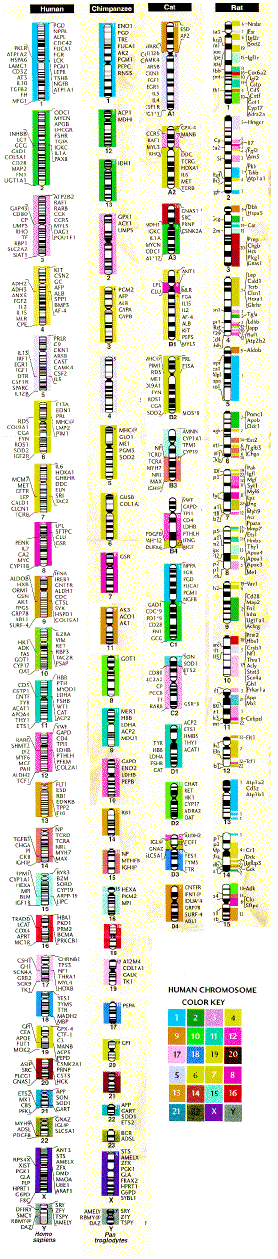
These chromosome maps allow you to compare the evolutionary relatedness
of some mammals.
Along the left hand side of the figure are the color coded human chromosomes. The labels on chromosomes indicate the locations of some particular genes.
Adjacent to the human chromosomes are the chromosomes of the common chimp. Notice that the main difference (besides altered numbering) between human and chimp chromosomes is that human chromosome 2 corresponds to chimp chromosomes 12 and 13. This is the type of chromosome alteration that can result in populations that cannot interbreed, which can be a key step in speciation.
Humans have some unique genetic features which distinguish them from
other apes, such as an unusual telomere length. These photographs from
stained chromatin spreads 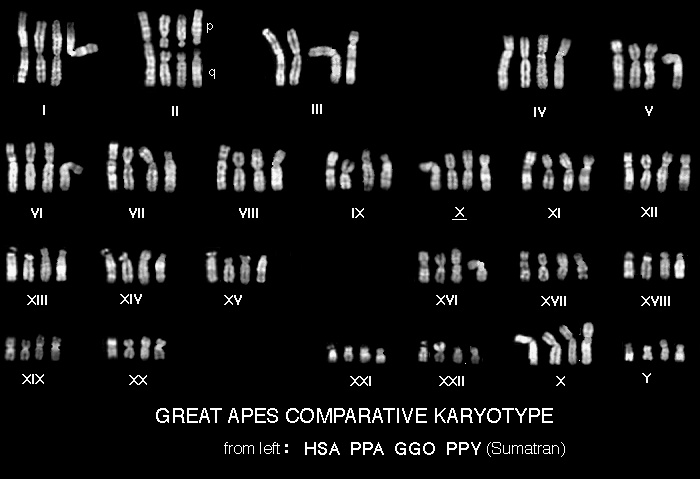 show
human (HSA), chimpanzee (PPA), gorilla (GGO), and orangutan (PPY) chromosomes.
The chromosomes were stained with the DNA stain DAPI and show that chimps,
gorillas, and orangutans all have the "split human chromosome 2". Click
on the image for a closer look.
show
human (HSA), chimpanzee (PPA), gorilla (GGO), and orangutan (PPY) chromosomes.
The chromosomes were stained with the DNA stain DAPI and show that chimps,
gorillas, and orangutans all have the "split human chromosome 2". Click
on the image for a closer look.
(Photo from Dr. Mariano Rocchi, Istituto di Genetica, Italy) Source
Cats are more distantly related to humans than are primates, and several major chromosomal changes took place since primates and cats split from a common ancestor. For example, cat chromosome A1 is a composite of parts of human chromosomes 5 and 13.
The figure to the left indicates that the chromosomes of rats have undergone more structural changes since divergence from humans than have the chromosomes from cats. However, based on the sequences of some genes it has been suggested that among primates, rodents and cats it is the rodents that should be grouped closer to the primates. (See this.) I wonder if this is due to the shorter life span of small rodents?
It would be interesting to be able to compare the genomes of humans,
common chimps, bonobos, and other primates. There seems to be a a type
of heterochrony (neoteny)
in humans by which most human brain growth is after birth and the human
brain seems to retain a high level of plasticity even after sexual
maturation. Can we find the genes responsible for this pattern of human
development? Here
is a good list of sources dealing with human and chimp patterns of development.
Here is a great
primatology links page.
Primate Cytogenetics Network
Unfortunately, specific information about bonobos is rare.
Go to John's Book Page.
Go to John's
Home Page.