
prev upd 10/16/98
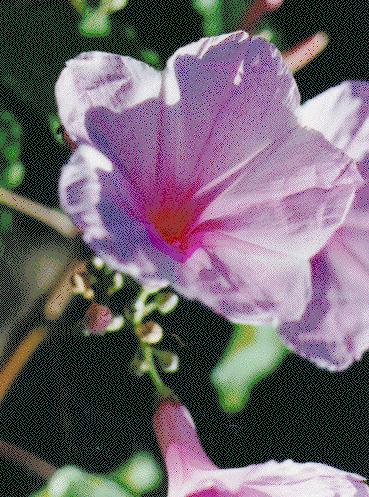
 FINALLY! WEDDING BELLS (Ipomoea Tricolor) See description below pictures:
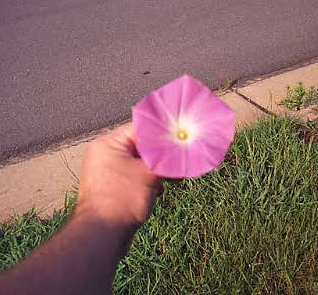
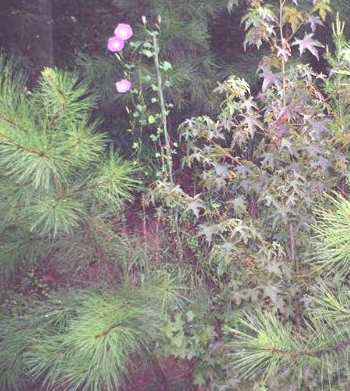
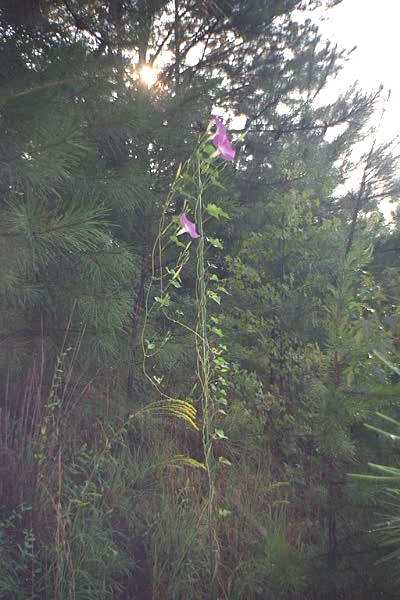
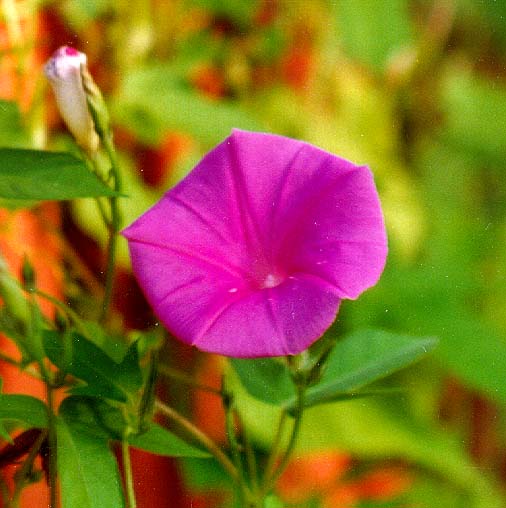
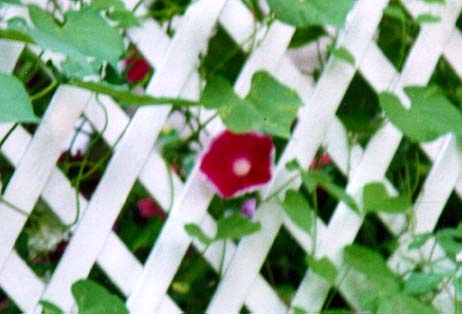
Ipomoea Tricolor - "Wedding Bells". Extremely Rare! I've got a few seeds, and finally got one to bloom after 2 years trying! Commercially available NOWHERE. It is exactly like Heavenly Blue except for the main color - it is a very beautiful "rosy-lavender", but has the same creamy yellow center. This is due a a genetic lack of blue pigment in the flower, I think. It also almost completely lacks the faint fragrance that Heavenly Blue has. It is a mutation of Heavenly Blue that the late Darold Decker introduced in 1961 for the 1962 growing season. This is my main "save it from extinction" project of 1998. I'll get photos and as many seeds as possible from this year's crop. On cloudy days it seems to glow! It looks purplish-pinkish and like electric or neon lavender depending on the angle you look at it, and depending on if its sunlight or shade. Very nice. It is in a small 4" pot of potting soil. It is growing up a stake in the ground, and the pot is sitting on the ground next to the stake. I tied it to the stake with a couple of those nylon fastening ties. It has to be watered every day unless it rains because the heat drys it out in such a tiny pot. The stake is 6 feet tall, and the vine quickly topped it, and branched into three vines that loop down to about the 3 foot level and climbed up again! There are about 100 buds on the vine, and 1 to 4 open each day. If in a bigger pot, there would be 20 times as many.

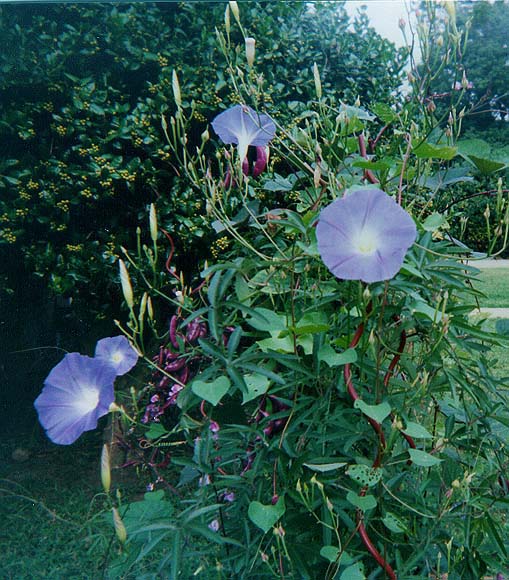
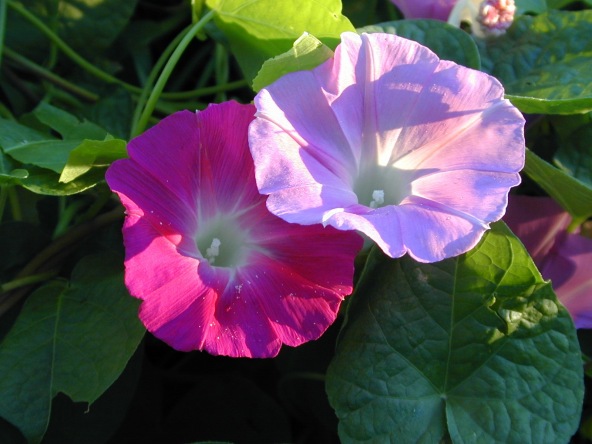 Taken with a digital camera by a friend. Probably "Tall Mix" which is a mix of several Ipomoea Purpurea colors.
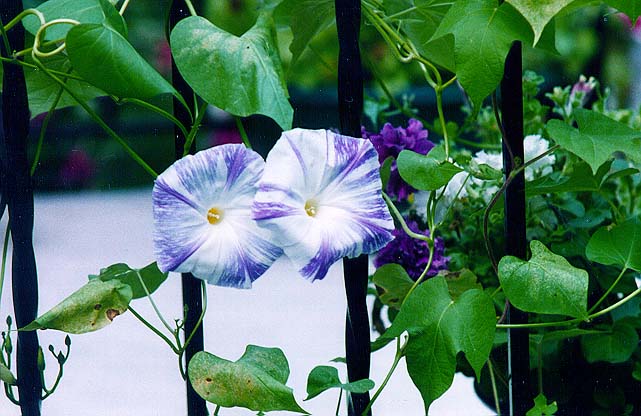
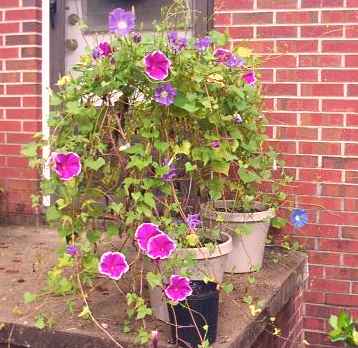 Update - Cornell was grown by me successfully in 2002, in a pot with Wedding
Bells! The blueish flower in the lower right near the brick wall is one plant
that turned out solid periwinkle colored ones - it was a cross between Flying
Saucers and Wedding Bells.
Update - Cornell was grown by me successfully in 2002, in a pot with Wedding
Bells! The blueish flower in the lower right near the brick wall is one plant
that turned out solid periwinkle colored ones - it was a cross between Flying
Saucers and Wedding Bells.
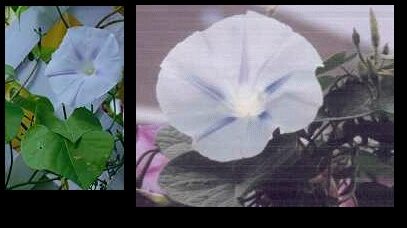
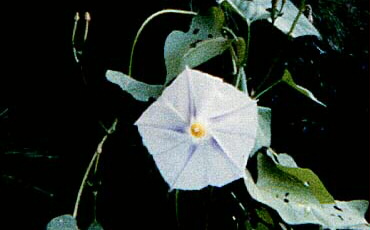
Ipomoea Tricolor - Summer Skies (NO PICTURE) This one is gone. UPDATE - FOUND IN ENGLAND MARCH 2000 - I WILL BE GROWING IT THIS YEAR. It was sold from about 1962 to about 1980? It was very pale blue, like Blue Star, but with no star. It was also a mutation of Heavenly Blue.
 Ipomoea Fistulosa - "Bush Morning Glory." Can grow to 8 feet tall by 5 feet wide, loaded with these flowers.
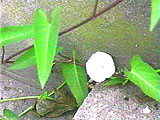 Ipomoea Aquatica (Chinese Water Spinach) Leaves and stems eaten as a salad vegetable. (CAUTION - Never eat ANY plant of uncertain identification - some are poisonous. Ipomoea has over 500 species. Do not eat ANY wild morning glory, many look alike!!)
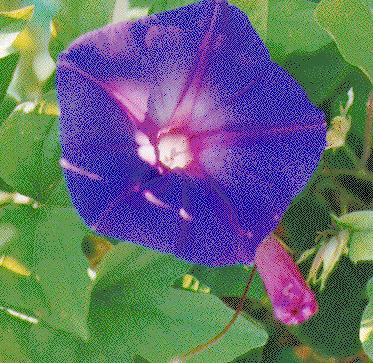 Ipomoea Learii, the Blue Dawn Flower. It is a purplish blue. Loads of leaves, and loads of flowers. Now grows wild in California. A serious agricultural pest in New Zealand.
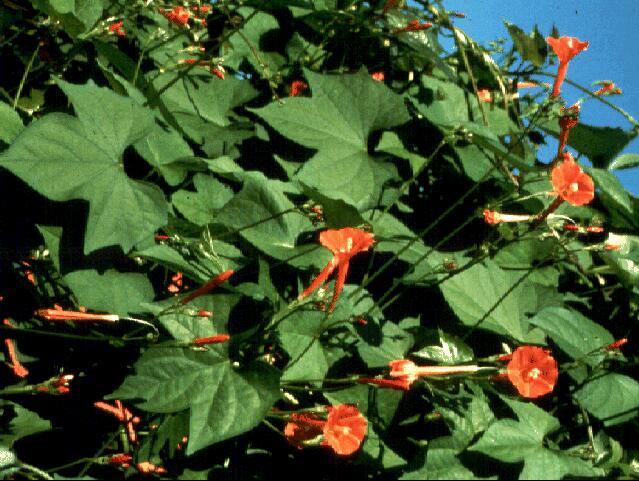 Ipomoea coccinea, and this one is a trilobed leaf variation.
I'm building seed of red Cypress Vine, and the more rare white flowered Cypress Vine, both of which are Ipomoea (Quamoclit Pennata), identified by the feathery leaves of many thin needles that make the outline of a heart. (Whew!)
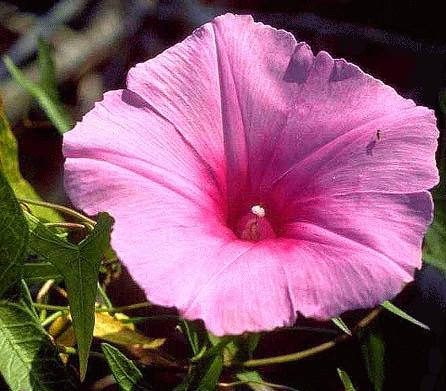 Ipomoea Sagittata
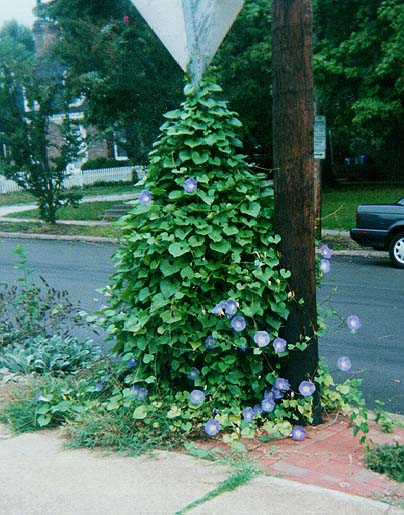
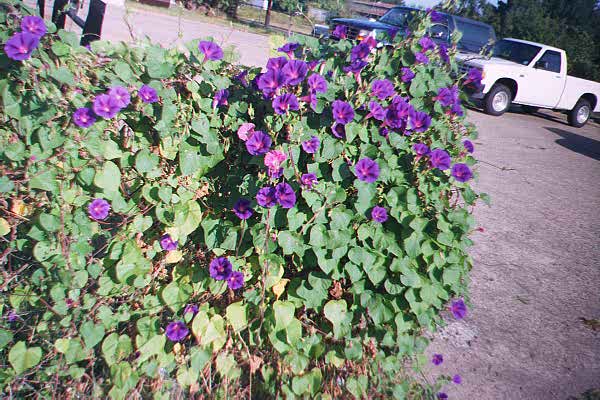 Ipomoea Purpurea (common morning glory) This has a bloom about 2 inches across, and exists in purple, white, red, pink, and blue. This is a tangle of a bunch of purple vines and one pink vine in there! I think the blue variety has a 1 inch flower - I'll check the J.L. Hudson 1998 catalog. There is a "black" morning glory, called "Kniola's Purple Black", or maybe "Grandpa Ott's," but it is not really black, just a very dark purple.
