Summary of the Elastic Continuum
Theory
Introduction
As per the Elastic Continuum Theory, our familiar ‘empty space’ or ‘vacuum’ with the characteristic property of permittivity ε0 and permeability μ0 behaves as a perfect isotropic elastic continuum with elastic constant 1/ε0 and inertial constant μ0 . For this ‘Elastic Continuum’ the equilibrium equations of elasticity are found to be identical with the vector wave equation of Maxwell’s electromagnetic theory. Particular solutions of these equilibrium equations as functions of space-time coordinates, satisfying appropriate boundary and stability conditions within a bounded region, are shown to represent various ‘strain bubbles’ or elementary particles and the electromagnetic fields. Through analysis of various strain bubbles, we can study the structure of various elementary or composite particles and deduce their mutual interactions. Consequently the currently accepted ‘exchange theory of interaction’ is found to be not valid. All basic interactions in nature are shown to be arising out of physical superposition of the strain fields of interacting particles. The shape, size and strain field structure of the electron, positron, neutron and the proton has been derived and their mutual interactions computed. In the quantum theory of electromagnetic field, PAM Dirac showed that the electromagnetic interactions could be regarded as arising out of the exchange of virtual photons between charged particles. This notion was subsequently extended to imply that all basic interactions in nature are mediated through the exchange of specific particles, even though there is no rigorous mathematical proof for this ‘exchange theory of interaction’
The proposed Elastic Continuum Theory represents an entirely novel and drastically different point of view regarding the ultimate reality of Nature; regarding the most fundamental basis of physical reality. This novel point of view is drastically different from the currently accepted quantum mechanical viewpoint in somewhat similar way as the Copernican & Kepler models of the Solar system represented drastically different viewpoint from the then well accepted, highly complex and accurate Ptolemaic system.
Ether as an Elastic Continuum
A close scrutiny of fundamental notions behind the physical concepts of 'vacuum', 'ether' and the 'Elastic Continuum' will show that in fact they represent ONE and the SAME entity. It appears that all the electromagnetic phenomena, all energy entrapping and exchange processes and all characteristic wave motion that we usually believe to be occurring in empty space, can be viewed to be occurring in the elastic continuum with elasticity constant 1/ε0 and inertial constant μ0 in appropriate units. This revised notion of 'ether' no longer requires it to be 'thin, ideal fluid' to allow free unrestricted motion of matter through it since matter is no longer considered an independent entity separate from the 'ether' or the 'Elastic Continuum'.
The most striking feature of the proposed Elastic Continuum concept is that it essentially reinterprets the already known fundamental properties of 'empty space' or the 'vacuum' as the elastic and inertial properties of the Elastic Continuum pervading the physical reference space. The whole concept of Elastic Continuum is centered around the ELASTICITY properties of the Continuum which are none other than the permittivity (ε0) and permeability (μ0) of 'vacuum' reinterpreted as the elasticity constant (1/ε0) and inertial constant (μ0) in appropriate units. Such a practically unbounded Elastic Continuum supports dynamic stress/strain waves subject to appropriate equilibrium equations and boundary conditions. The energy density associated with these stress/strain waves in any particular region of the continuum will be proportional to the square of the intensity of such waves. The matter particles essentially exist in this Elastic Continuum as packets of standing strain wave oscillations whose total strain energy remains 'conserved' in the absence of any interaction with other strain waves or packets.
Equations of Elasticity
· Stress
Strain Relations
In the Elastic Continuum, due to lack of discrete atomicity, we must take the Poisson’s ratio equal to zero for the continuum. Also noting that there are no translational or rotational rigid body motions in the continuum, we find that the components of strain tensor S = [Sij] need not be symmetric. The components of strain tensor referred to a coordinate system yi, will therefore be related to the components of displacement vector U=[ui] through the relation Sij = ui,j or

The Hooke’s law of elasticity, relating stress tensor T=[tij] to the corresponding strain components, takes the simple form tij = (1/e0) Sij, where 1/e0 is the elasticity constant for the continuum in appropriate units. In conventional electrical units the dimensions of (1/e0) are Nm2/Coul2. However, in mechanical units the dimensions of elastic constant (1/e0) are required to be N/m2. Hence, to ensure the compatibility of electrical and mechanical units in the Elastic Continuum, we must assign the dimension of [M0L2T 0] or m2 to the electrical unit Coulomb, even if the exact equivalence is unknown yet.
·
Equilibrium
Equations
The equilibrium equations of elasticity in the Elastic Continuum turn out to be identical to the Maxwell’s vector wave equation for the electromagnetic field as
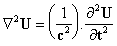
The displacement vector U, strain tensor S and the stress tensor T, are absolute entities and are invariant under coordinate transformations. Only the magnitude of components ui , Sij etc. transform with coordinate transformation. Hence, the analysis of strained state of the Elastic Continuum is equally valid in all admissible coordinate systems; even though we generally prefer to use a particular coordinate system for particular problems on the overall considerations of symmetry and boundary conditions. These equilibrium equations, subject to appropriate boundary conditions, do not permit of any static (i.e. time invariant) strained state in the continuum and all permissible solutions in terms of displacement vector components ui will be functions of space and time coordinates. The partial derivatives of ui with respect to time t ( more correctly ct ) will constitute temporal strain components Sit in addition to the spatial strain components mentioned above.
·
Solution
of Equilibrium Equations
The detailed study of any deformed or the stressed region of the Elastic Continuum primarily involves the detailed solution of the equilibrium equations subject to appropriate boundary conditions. Most of the boundary value problems involving linear partial differential equations, can be solved by the method of separation of variables. It involves a solution ui in a particular coordinate system, which breaks up into a product of functions each of which contains only one of the independent coordinate parameters. In a particular coordinate system, if the boundary conditions are such that the corresponding unique solution for ui consists of such a product of functions, the boundary conditions may be said to be ‘symmetric’ in that coordinate system. Therefore, depending on ‘symmetry’ of the boundary conditions, an appropriate coordinate system will be used for solution of the equilibrium equations. The essential boundary condition for admissible solutions of equilibrium equations is that the displacement components ui must vanish at the boundary and along with strain components, must remain finite and continuous within this boundary.
·
Strain
Energy Density
In the deformed
or stressed state of the Elastic Continuum, certain amount of strain
energy will get stored in
the region under stress. The strain energy density W or
the energy of deformation per unit volume, at any point of the continuum,
is a function of the intensity of strain at that point, and an
invariant. Therefore, extending the Clapeyron formula for the strain energy
density in ordinary material bodies under static equilibrium, the strain energy density in the
Elastic Continuum may be given by W = (1/2e0)[Sum of squares of
spatial and temporal strain components].
·
Strain
Wave Propagation
The equilibrium equations of elasticity represent the propagation of strain waves at velocity of light c in the continuum. Here, if the displacement vector U satisfies the condition Ñ.U=0, the equilibrium equations will represent solinoidal or transverse strain wave propagation through the Elastic Continuum. If on the other hand Ñ´U =0 , these equations will represent irrotational or longitudinal strain wave propagation through the continuum. However, even for such strain wave propagation, the displacement vector field U must satisfy the essential boundary condition mentioned above. A strain wave contained within finite boundaries where displacement vector components ui vanish, may be termed a strain wave packet. A photon will be seen to be such a transverse strain wave packet.
·
Electromagnetic
Field
A solution of equilibrium equations of elasticity for U , that satisfies the essential boundary conditions, will represent a transverse strain wave field if Ñ.U=0 . Further, we may identify U and the associated spatial and temporal strain components with the conventional electric and magnetic fields E & B in ‘free space’ through the identities,
 and
and 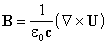
The displacement vector field U will now satisfy all the electromagnetic field equations that are satisfied by E & B in ‘free space’. We can thus see that our familiar electromagnetic field in ‘free space’ is just a dynamic strained state of the continuum. Whereas the temporal stress in the continuum corresponds to the electric field E in ‘free space’, the torsional stress in the continuum corresponds to the magnetic field B .
·
Strain
Bubbles
A closed region of the Elastic Continuum in a permissible strained state, satisfying the equilibrium equations & boundary conditions, may be termed a strain bubble provided the total strain energy content in this closed region is time invariant constant and the displacement components ui vanish at its boundaries. Although the strain components at any point within the strain bubble are always functions of space and time coordinates, yet the strain energy density at that point may or may not vary with time. If the strain energy density at all points within a strain bubble is constant or time invariant, the strain bubble is likely to be stable, otherwise unstable. The total strain energy content E0 of a strain bubble will represent its ‘rest mass’ m0 through the relativity relation E0/c2 = m0. All forms of strain energy are expected to display the property of inertia during the motion of a strain bubble.
·
Strain
Bubble Interactions
If the strain fields of two strain bubbles overlap in a certain region of the Elastic Continuum, the total strain components will be obtained by superposing the corresponding components of both the strain bubbles referred to a common coordinate system. Strain components can be transformed from one coordinate system to another as per the rules for transformation of mixed tensor components. Strain energy density and hence the total energy of the common field will be governed by the sum of squares of the resultant strain components. Interaction energy (Eint) or the conventional potential energy, of two such interacting strain bubbles may be defined as the difference between the total strain energy with superposed strain fields (Esup) and the sum of their separate strain field energies (E1 and E2) that is, Eint = Esup - ( E1 + E2 ) . If Sij(1) and Sij(2) represents the strain components of two bubbles, referred to same coordinate system then it can be easily seen that the interaction energy density Wint will be given by the sum of products of the corresponding strain components as,
Wint(1,2)
= (1/2e0).S[{
Sij(1) + Sij(2) }2-{ Sij(1)
}2-{ Sij(2) }2]
or Wint(1,2) = (1/e0). S[ Sij(1). Sij(2)] (i ® 1 to 3 & j ® 1 to 4)
A
negative interaction energy or potential energy will imply the release of
a portion of the total strain energy of the two interacting bubbles. The
released energy may either transform into another strain bubble wholly or
partly and emitted out of the system, or transform into kinetic energy of
motion of the interacting strain bubbles.
·
Elementary
Particles
At subatomic scale the primary constituents of matter, namely the electrons and nuclear particles are known to occupy an extremely small volume fraction of the order of 10 -12 percent of the physical volume of any material body. The remaining bulk of intervening space is supposed to be empty or so called ‘vacuum’ with some electromagnetic fields ‘existing’ in this ‘empty space’. These ‘material particles’ concentrated in such a small volume fraction of entire space consist of the so called ‘elementary particles’ and are essentially characterized by their ‘mass’, ‘charge’ and interaction properties. In the parlance of strain bubbles existing in the Elastic Continuum, the clusters of pure and composite strain bubbles depicting ‘elementary particles’ are essentially characterized by their ‘strain energy content’, ‘strain wave fields’ if any and their interaction properties. In principle, there could be an infinitely large number of different types of strain bubbles occurring in the Elastic Continuum that may be correlated with equally large number of stable and unstable elementary particles.
The Electron & the Positron
·
Core
Structure
The electron, positron pair is found
to be the lowest order spherically symmetric strain bubble solution of
equilibrium equations, a solution in which the displacement components uR
& uf are sinusoidal
oscillating functions independent of f coordinate
and uq is zero. This
strain bubble consists of a standing strain wave core of about 1.61´10-15 m (1.61 f ) radius,
surrounded by a radially propagating phase wave field extending up to infinity.
The standing strain wave oscillation frequency is estimated at ne=(kc/2p) = 8.291´1022
Hz, where the corresponding wave number k=1.7377´1015 m-1. From
the well known Planck’s energy relation for the photon, E=hn, it is found that the total strain energy
content of all types of strain bubbles comes out to be proportional to the
frequency n or wave number k of their strain wave oscillations, only if
the magnitude of their displacement vector components ui is taken to
be proportional to k. Further keeping
in mind the existing units of 1/e0
and the dimensional equivalence of charge unit we finally take the
magnitude of displacement vector components to be proportional to ek, where e is the magnitude of electron
charge. The core structure
of electron and positron is identical except for the phase opposition of their
displacement vector components ui.
·
Radial
Strain Wave Field
The central core of the electron / positron strain bubble is surrounded by a propagating phase wave type strain field where the amplitude of these waves keeps diminishing with radial distance and is zero at infinity. These phase waves propagate outwards from the core at radial velocity c for the positron and propagate inwards to the core at radial velocity c for the electron. The effective strain components in this wave field are proportional to the ‘root mean square’ (rms) value of the amplitude of the corresponding strain waves. . Even though these phase waves do not transport strain energy, yet they appear to display certain ‘wave momentum’ effects. In a way these strain waves could be compared with sinusoidal AC voltages. The unique characteristic features of these radial strain wave fields manifest in the unique charge property of these strain bubbles. Detailed computations of strain energy content show that almost 65 percent of the total mass energy of the electron is contained in its core and remaining 35 percent in its field. This feature is in sharp contrast to the conventional understanding of the electron as a ‘point charge’ and ‘point mass’.
·
Coulomb
Interaction
As against the computation of normal strain bubble interactions , computation of the interaction energy in the common overlapped region of strain wave fields of two charge particles, appears to be a complex problem due to the presence of phase waves. For the purpose of developing a simplified model of Coulomb interactions we consider only the rms valued amplitudes of the respective strain components and assign them +ve or -ve signs depending on whether the phase waves are propagating outwards from or inwards to the source particle. The computation of interaction energy of two charges, separated by distance ‘R’ say, involves transformation of effective field strain tensor components from one coordinate system to another, for effecting the superposition in a common coordinate system. The interaction energy density can now be computed from summation of the product of corresponding physical strain components and the total interaction energy from the volume integral of this interaction energy density over the entire common or overlapped region. Actual computation results verify the Coulomb interaction law for separation distances much greater than the core size of the electron. Essentially the Coulomb interaction between two charges is the interaction between their wave fields and not between their cores.
·
Electron
Spin Concept
Both for electron as well as positron, the displacement components uR and uf are in quadrature to each other. Thus the resultant displacement vector in any transverse plane keeps continuously rotating with constant angular velocity w=kc whereas its magnitude remains constant or time invariant at any space point. This constant rotation or ‘intrinsic spin’ of the displacement vector found in the core as well as strain wave field of the electron/positron type strain bubbles may be, at least partly, identified with the conventional notion of ‘Spin’ in these particles. Another part of the electron spin could be associated with the mechanical rotation of the core as well as its radial wave field about Z-axis. For this mechanical rotation, the moment of inertia of the core works out to be equal to Ic= 5.9805´10-61 kg.m2, which is too small to produce any significant angular momentum effects since the core can not mechanically rotate at an angular velocity ³ w. However, if we compute the moment of inertia of the radial wave field region containing about 35% of the total mass energy, it tends to infinity. This in essence implies that even for small mechanical rotations or ‘mechanical spin’ of the core, the radial wave field of the electron will tend to ‘angularly’ lag behind due to the inertial property of strain energy. This angular lag of the radial wave field will produce the effect of deforming the radial ‘field lines’ to the spiral shape, thereby giving rise to the torsional strain field effects. The well-known magnetic moment of the orbiting electron may be attributed to this phenomenon. The effective total moment of inertia of the core and the deformed field may also be much higher.
The Nucleon
·
Nucleon
Core
The nucleon core is represented by one most important, lowest order, cylindrically symmetric solution of equilibrium equations of elasticity in the Elastic Continuum. This strain bubble is stable, finite in size with cylindrical symmetry and oscillates at a frequency ne= 8.291´1022 Hz, that matches with the oscillation frequency of electron/positron cores. The strain energy density within the core region is completely time invariant implying overall stability of the nucleon. Detailed computations show that the nucleon core is of the shape of a right circular cylinder of radius 2.7 fm and length 3.1314 fm . Here too, the resultant displacement vector keeps continuously rotating or ‘spinning’ about the axial direction at constant angular velocity w whereas its magnitude remains constant or time invariant. This constant ‘intrinsic spin’ of the displacement vector U in the nucleon core may be, at least partly, identified with the conventional notion of ‘Spin’ in these particles. Another part of the nucleon spin could be associated with the mechanical rotation of the core about Z-axis, for which its moment of inertia works out to be equal to In= 4.6259´10-57 kg.m2 . However, still another part of the nucleon spin and the anomalous magnetic moment could be associated with the orbital motion of the positron within the nucleon core.
·
Strong
Interactions
When the cores of two or more interacting strain bubbles get partly overlapped, with their intrinsic spins parallel, the resulting interaction is the ‘strong interaction’ encountered among nucleons and many other elementary particles. Procedure for detailed computation of such interactions is already indicated above. When the cores of two nucleons overlap axially, with their axes aligned or collinear and centers separated, the resulting interaction may be termed axial strong interaction. Similarly when the cores of two nucleons overlap radially, with their axes parallel but separated radially, the resulting interaction may be termed radial strong interaction. The negative energy part of the axial interaction enables axial bonding between a neutron and a proton. In this p-n coupling, mean separation between the centers of two cores is about 2.6 fm , varying from about 2.1 fm to 3.1 fm and frequency of their axial oscillations is about 5.21´1022 Hz.
Similarly the radial interaction energy curve shows that two nucleons are likely to get radially coupled together under suitable conditions and oscillate at a frequency of about 3.6´1022 Hz with mean radial separation of about 2.7 f . The radial interaction energy is positive for core separation between 0 to 1.9 fm and again from about 4.3 fm to 5.4 fm . The positive ‘hump’ of this interaction energy curve suggests that the radial coupling between two interacting nucleons may be very difficult to form and once formed may be much more difficult to break in comparison with their axial coupling. Further it implies that if two radially coupled nucleons get separated by a distance greater than 4.3 fm during a part of their oscillations, they will tend to break off and fly apart.
·
Binding
Energy
There is one very important point regarding the magnitude of negative interaction energy available for strong coupling and the actual ‘bond energy’ ensuring stable binding between the interacting nucleons. The available interaction energy ‘released’ by the system, must be actually emitted out of the system for it to become ‘bond energy’ of the coupled nucleons. In practice only a small fraction of the negative interaction energy released by the system is actually emitted out of the system and the balance is converted to the kinetic energy of motion of the interacting nucleons. There must be a valid mechanism available for emitting a portion of the released interaction energy out of the system. The interacting nucleons by themselves do not appear to possess any such mechanism. Energy could be emitted out of the system with due conservation of energy and momentum, either as photons or some other elementary particles like mesons, neutrinos etc. But photons could be emitted out from the strain wave field region only through specific motion of charge particles - the electron and positron, whereas the neutrinos could be formed and emitted out from within the core region itself. Therefore the presence of positron and electron among the nucleons appears to be an essential feature in the coupling and securely binding the nucleons in the nucleus.
·
The
Proton
The proton consists of a nucleon core with a positron superposed over it through strong interaction. The detailed computations of interaction energy for the strong interaction between the nucleon and positron cores can be made on similar lines as done for two nucleon cores. The axial and radial interaction energy of the positron, nucleon cores thus obtained, shows maximum negative interaction energy of about 20 MeV between two cores when their centers coincide. The radial interaction energy is positive for core separation of 1.7 f to 3.7 f . From such data we can even compute the magnitude and direction of force experienced by the positron when its center is located within the proton core. From the detailed data of the interaction energy and the associated force field acting on the positron entrapped within the nucleon core, we can make a fairly good estimate of the elliptical orbit on which the positron will move. The positron moving around the center of nucleon core on specific elliptical orbit, within a radius of about 1 fm from the core axis, will produce a magnetic moment, which is the familiar anomalous magnetic moment of the proton.
·
The
Neutron
When the strong interaction between
an electron and nucleon cores is computed, we find the interaction curves
obtained for nucleon-positron cores just get reversed. That is, the electron
core is found to have negative interaction energy at radial separation of more
than 2 fm or so. Thus under optimum conditions a proton can entrap an electron
within the outer boundary of the nucleon core to form a neutron. The electron
thus entrapped through strong interaction with nucleon core, is also expected
to move in elliptical orbits within about 2 to 3 fm radius from the core axis. Therefore, a neutron
consists of a nucleon core with a positron entrapped within its central region
and an electron entrapped in its peripheral region.
· The p-n
Bond
In an axial proton-neutron bond forming ‘deuteron’, the orbiting electron and positrons keep axially shifting from one nucleon core to the other after each cycle of rotation. Since the axially interacting nucleon cores tend to vibrate at a frequency of about 5.2´1022 Hz, the orbiting particles will give off a part of their kinetic energy to synchronize their motion with the nucleon oscillations. During each cycle of their oscillations, when the nucleon cores are closest together at a separation distance of about 2.18 fm, the orbiting particles will tend to be in their mid section or equidistant from them. However, two nucleon cores when coupled radially, will tend to vibrate at a frequency of about 3.6´1022 Hz with a minimum separation of about 1.9 fm between their axes. Here again the orbiting particles will tend to synchronize their motion with radial vibrations of interacting nucleon cores by radiating out a portion of their kinetic energy. The amount of energy thus radiated out by the orbiting particles will become the effective bond energy of this p-n coupling. This bond energy is relatively a small fraction of the total kinetic energy available in the system. The combined radial orbit of orbiting particles around two radially coupled nucleon cores will be of the shape of figure of 8.
· The
Nucleus
The nucleus consists of an assembly of nucleons, radially
arranged in a hexagonal close packed (hcp) configuration, each nucleon partly
overlapping and hence strongly interacting with its adjoining nucleons.
Since the nucleon core is of cylindrical shape each axial layer of the nucleus
built up from these nucleons will also tend to be axially symmetric.
Moreover this assembly of nucleons is not static but highly dynamic with each
nucleon vibrating vigorously about certain mean overlap positions. Since
in the radial p-n coupling, mean separation between the vibrating nucleon cores
is about 2.7 fm and in the axial p-n coupling the mean separation is about 2.6
fm, we may take the effective ‘contact’ diameter of the nucleon as 2.7 fm
and effective contact length of the nucleon as 2.6 fm for the purpose of
developing a 'static picture' of the nucleus. The nucleons of this
effective size may now be assembled in above mentioned radial hcp configuration,
repeated in axial layers (containing different number of nucleons) to build up
a nucleus of the required size. In general the central layers will
contain maximum number of nucleons and the layers at the two ends of the axis
will contain minimum number, such that the overall nucleus with its inherent
synchronous vibrations and rotations, will appear to be approximately spherical
in shape. As a simple example, the nucleus of 7N14 will
consist of two axial layers of 7 nucleons each, (or one layer of 7
deuterons) arranged on the corners and center of a regular hexagon. However this is just a representative
'static' picture made from the effective mean contact diameter mentioned
above. Actual
dynamic picture of the nucleus with its vibrations and rotations, may be quite
different depending upon the mode of observation.
Quantum Mechanics
·
Kinetic
Energy
Since all forms of energy exist in the Elastic Continuum as strain energy, the kinetic energy associated with the motion of any strain bubble also must exist in a ‘strain wave field’ associated with its motion. But we know from Quantum Mechanics that the only waves of non-electromagnetic origin, associated with the motion of microscopic particles, are the de Broglie waves represented by ‘y’ wave function. Hence, logically the ‘y wave field’ associated with the motion of a strain bubble, must be identified with the longitudinal strain wave field induced by the motion of that strain bubble. Therefore, during motion of the strain bubble, it is the interaction energy released by the system that keeps getting transferred to the kinetic energy or ‘total strain energy of the associated y wave field’. Since the bubble interactions and such energy transfer processes are limited by finite velocity of light ‘c’ due to their inherent ‘spatial spread’, classical mechanics may be considered adequate for describing the motion of strain bubbles at low velocities. However, at higher velocities and corresponding high-energy interactions, adequate study of the associated phenomenon can only be made by using the techniques of special theory of relativity and Wave Mechanics.
·
Basis
of Wave Mechanics
As pointed out earlier, the strain energy or its mass equivalent displays the property of inertia. Therefore, the energy density W in a strain bubble divided by c2 should also display the property of inertia during the motion of that strain bubble. Dimensionally too, W/c2 may be considered equivalent to the inertial constant m0 for the Elastic Continuum. Hence, it seems quite natural to extend the equilibrium equations of elasticity by replacing m0 with (m0 + W/c2) to obtain the equilibrium equations for a strain bubble in motion. Even though such extended equilibrium equations turn out to be non-linear partial differential equations in displacement vector components ui, yet they may be indispensable for the study of longitudinal strain wave field associated with the motion of strain bubbles. The detailed study of such extended equilibrium equations must provide the basis of Wave Mechanics.
·
Conceptual
Mistake in Schrodinger’s Equation
Considering the Schrodinger’s wave equation as founded on L. de Broglie’s suggestion that some sort of waves or wave packets accompany the electrons and other micro particles in motion, we must emphasize the distinction between the moving particle and the waves that accompany it. At any instant t, if y(r,t) is the wave function that describes the accompanying wave packet, it must be defined at all space points (i.e. variable r ) that constitute the y field, while at that instant the moving particle can be located at only one space point say Q(r¢). The potential energy V or the interaction energy of the proton-electron pair is a precise function of their relative separation distance r¢ and hence should be represented by the function V(r¢) and not by V(r). This precisely is the error in the Schrodinger’s wave equation, where the potential energy function used is V(r) instead of V(r¢).
Concluding Remarks and Future Development
In conclusion, we list some of the salient predictions of the Elastic Continuum Theory that are experimentally distinguishable from the existing knowledge.
·
Size,
shape and mass distribution of the electron
As against the currently held belief of electron being a ‘point mass’ with no internal structure, the ECT shows the electron to be consisting of a spherical core of 1.61 fm radius containing about 65% of the total mass energy. It is surrounded by electrostatic wave field extending up to infinity and containing the balance 35% of the mass energy.
·
Strong
interaction characteristics of electron and positron cores
As per the current belief, electrons and positrons can take part only in electromagnetic interactions and not in strong interactions. However the ECT shows that the electromagnetic interaction is the unique characteristic of electron/positron wave field while their cores display strong interactions among themselves as well as with the cores of many other elementary particles including the nucleon core.
·
Limit
on magnitude of Coulomb interaction
As per the currently held belief, the
Coulomb interaction energy as well as the force between two interacting
electrons will tend to infinity as their separation is reduced to zero.
However as per the ECT, the Coulomb interaction relation holds only for the
separation distances much greater than the core size of the electron. If two
electrons are exactly superposed, their interaction energy will not be infinite
but just twice the mass energy of one electron.
·
Shape
and size of the nucleon
The nucleons are generally assumed to
be composite spherical entities of about 1.0 fm to 1.2 fm radius surrounded by
a mysterious ‘strong force’ field of about 1.5 fm to 1.7 fm range. However as
per the ECT, the nucleon core is a cylindrical strain bubble of radius 2.7 fm
and length 3.1314 fm with no extra range for any mysterious ‘strong force’ field.
The familiar strong interaction between nucleons results from their physical
overlap. The nucleus formed by the assembly of mutually interacting
nucleons is also expected to be generally cylindrical in shape.
·
Instability
of eight nucleon configuration
As per the ECT, the radial interaction energy curve shows a positive hump for radial separations between 4.3 fm to 5.4 fm. This implies that four nucleons cannot form a stable configuration through radial coupling and that four deuterons cannot get radially coupled to form a stable nucleus. Two radially coupled deuterons form a stable alpha particle but two alpha particles cannot get radially coupled to form any stable nucleus. It is an established fact that no stable nucleus exists in nature with eight nucleons.
·
Anomalous
magnetic moment of proton
As per ECT, the strong interaction between the nucleon core and the positron core results in the positron getting entrapped in elliptical orbits within the nucleon core. This orbital motion of the positron results in the familiar anomalous magnetic moment of the proton.
Scope
for Future Development
The proposed Elastic Continuum Theory, is only
the proverbial ‘tip of the iceberg’. The theory needs to be developed
further step by step. After the basic elements and the essential features
of the ECT are brought to the notice of scientific community at
large, this theory will need to be interfaced with the current knowledge
in the fields of Quantum Mechanics and Elementary Particles. After that a
tremendous scope for future development and applications of ECT is expected to
open up.
One of the most fascinating applications of
ECT, which can be anticipated at this stage, will be in the
‘scientifically forbidden’ realm of human experience, namely the
spiritual phenomenon or the Soul. As per the ECT, finite cylindrical strain wave
rings are predicted to exist as one of the few stable strain bubble solutions
of equilibrium equations in the Continuum. These strain bubbles are
somewhat neutrino like and are capable of mutual coupling through axial and
radial interactions. The formation and existence of such mutually
coupled wave rings may be intricately associated with the storage of tiny bits
of information in the neural networks of the brain. Mutually coupled
structures of billions and billions of such strain wave rings may somehow
constitute an information storage network that is generally perceived as the
‘Soul’.
Important
Articles Related to ECT
v GTR is founded on a Conceptual Mistake
v Ether, Vacuum or the Elastic Continuum
v Invalidation of Michelson-Morley Experiment
v What Ails the Fundamental Research in Physics
v Permittivity and Permeability Constants of Vacuum
v What If the Permittivity and Permeability of
Vacuum were Zero
v Physical Theory and Mathematical Models
Go
Back To :