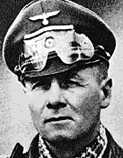
Erwin Rommel was born in Heidenheim, Wurttemberg, on Nov. 15, 1891. He joined the 124th Infantry Regiment as an officer cadet in 1910, and two years later was commissioned a 2nd lieutenant. During World War I he served in France and on the Romanian and Italian fronts. After the war he held regimental commands and was instructor at the Dresden Infantry School and the Potsdam War Academy . His textbook on tactics, Infanterie Greift was published in 1937.
In 1938, Colonel Rommel was appointed commandant of the War Academy at Wiener Neustadt. Shortly thereafter he was placed in command of the battalion responsible for Adolf Hitler's safety during the march into the Sudetenland and the entry into Prague. Promoted major general on the eve of World War II, he was again responsible for Hitler's safety during the invasion of Poland.
In 1940 he commanded the 7th Panzer Division in the advance into France. In 1941, with the rank of lieutenant general, he was given command of the German troops in Libya. On June 21, 1942, he was made a field marshal, the youngest in the German Army, in recognition of his success in forcing the British back from Cyrenaica into Egypt as far as El Alamein. However, he was unable to advance to capture Alexandria. In the months that followed, during which he commanded all Italo-German troops in North Africa, he was driven back into Cyrenaica and across Tripolitania into Tunisia, where he encountered fresh Allied forces. After the battle at Medenine on March 5, 1943, he returned to Germany because of ill health.
In July he was given command of Army Group B in northern Italy, and in November he was ordered to report on the coastal defense in the west, from the Skagerrak to the Spanish frontier. He was made commander in chief of all German armies from the Netherlands to the Loire River in January 1944. Despite his great efforts, the Germans were unable to prevent the Allies from landing in Normandy in the following June. On July 17, while Rommel was motoring near Livarot, he was severely wounded by fire from Allied aircraft, and he returned to his home in Germany to convalesce.
Never a member of the Nazi party, he had become increasingly outspoken in his criticism of Hitler's leadership. On Oct. 14, 1944, he was visited by two German generals investigating the cases of officers suspected of complicity in the July 20 plot against Hitler's life. He was given, on orders from Hitler, the choice between taking poison and having his death reported as resulting from his wounds, or facing trial by the People's Court. He elected the former course, ending his life in the generals' automobile near Ulm, Germany, on Oct. 14, 1944.
Hitler ordered national mourning, and Rommel was buried with full military honors. A man of the greatest personal bravery, he earned the deep respect of his adversaries for his brilliant achievements.
North African Campaign:
In September 1940 Egypt was invaded by Italy from Libya. By february 1941, little British armoured forces inflicted heavy defeats, thousands prisoners of war were taken. But, under General Rommel's aggressive leadership the German Africa Korps won a brilliant series of Axis victories.
Rommel threatened Egypt at the summer of 1942. This was the high point of his campaign. He became shortages of equipment and fuel and his supply lines were exposed by Allied attack and too long. Lieutenant-General Montgomery commander of the Eight Army in august, won a decisive victory over Axis forces in November at El Alamein. This battle from 23 octobre until 4 november cost the British Eighth Army nearly 13.500 men killed, wounded and missing, while the Axis had 25.000 and 30.000 prisoners.
Rommel Links
--end--
All Contents of this page are CopyRight of Smith or Smith Enterprizes.
Any images that wish to be used require my permission. Thank You.
Created 5-30-99.