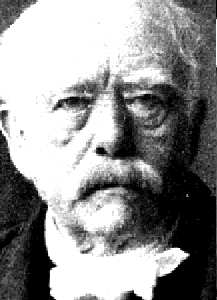
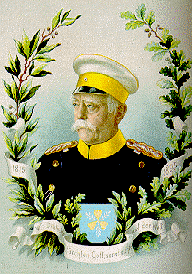
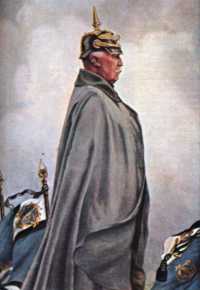
(above are pictures of Bismarck)
When the new Prussian chancellor, Otto Eduard Leopold Von Bismarck came to power in 1862 he was ambitious and very devoted to uniting all the German Estates under Prussian Rule thus resulting in the Franco-Prussian War that later was to affect the 20th century world stage.
Bismarck's main goal throughout his life had been to see the German Estates united under one rule. When he gained the chancellorship in 1862 that was his goal from the start. After Bismarck led the Prussians successfully through the Seven Weeks' War between Austria, he secured the position of Prussia as the ultimate power of the German speaking estates. French informants who had watched this quick war go by were affected by the blinding speed of the Prussian army and it's soldiers and they urged their Emperor, Napoleon III, to keep close eye on the conniving Prussians.
Bismarck had always longed to attack the French who he considered inferior to his Prussian troops. This would explain why he is known to have quoted about the problem of uniting the German estates as only being able to be achieved by "blood and iron" instead of using diplomacy. Bismarck finally got his chance when a relative in his family was offered the crown of Spain.
This relative of Bismarck was Prince Leopold of Hohenzollern who gave Bismarck the opportunity he had been waiting for. When Napoleon III learned of this offering of the Spanish crown to the Hohenzollern family he was furious. Though Leopold turned down the offer of the crown, the French still protested and sent an ambassador named Count Benedetti to complain the Kaiser Wilhelm I of Prussia. The Kaiser was said to have received Benedetti politely but refused to pay any attention to Benedetti's pleas and ignored them entirely. Upon doing this, Wilhelm dispatched Bismarck at Ems and told him what had happened. Now Bismarck had his chance to start a quarrel. He leaked out the news of the Ems Dispatch to the French news and it was printed and it infuriated the French people when it rolled off the printing press. In retaliation to this insult to the French hierarchy and the French people as a whole, the French declared war against Prussia on July 14, 1870.
Though war is looked down upon today, both the French and Prussian people were enthusiastic to wage a war of conquest. Bismarck's plan had been completed by the signing of the war declaration for it united the German estates. The other German estates besides Prussia were much too weak to repeal the French invaders who encroached on the North German Confederation land and therefore had to side with their Prussian counter parts so their territory would not be overrun and conquered. Bismarck's final dream had finally come true with this war pact, but he still none-the-less wanted to add to the new German Empire some French territory.
The French were largely unprepared compared to the Prussian army mainly due to the fact that the Prussians had been preparing for the war for months on end. The head of the Prussian army, General Helmuth Karl Von Moltke, had also greatly readied his troops for battle by updating their weapons and artillery. The French still used smooth bore cannon and muskets where as the Prussians used rifling in their cannon and cartridge firing arms which could be loaded much faster.
The First battles to place near Weissenburg, Worth and Spichern where the Prussians embarrassed the French by decimating their lines and causing humiliating defeats. At these battles, the French armies under Marshall MacMahon and Marshall Bazaine were separated. Exploiting this separation, the Prussian soon took advantage of it. Marshall MacMahon who was ordered to rejoin Bazaine and his army was cut off by the Prussian at Sedan where there was a great battle fought in which the French lost and their leader and emperor Napoleon III was captured and taken prisoner by the Prussians.
When news of this defeat at Sedan reached Paris, the French people in Paris renounced Napoleon's leadership and prepared the defend their city from the advancing Prussians. The French people fought bravely but to no avail for the training and the experience of an average Prussian soldier was much too advanced for a simple city folk to comprehend and the blocked city was defeated quickly by the Prussians in early 1871.
The war concluded with the Treaty of Frankfurt on May 10, 1871 where the French agreed to the harsh terms of giving the entire city of Alsace and part of Lorraine to the now German Empire and paying Germany one billion dollars in war fees. Thus ended the North German Confederation and emerged the German Reich.
The ending of this conflict between Germany and France set the stage later for the Great War because the taking of Lorraine and Alsace was a blow to the national pride of France. This empire set up by Bismarck was known as the Second Reich or Second Empire which would be dismantled after World War I. This second empire made by Bismarck was to be praised later for uniting the German estates under one rule and creating a industrialized Germany.
Franco-Prussian War Links
--end--