Early Life
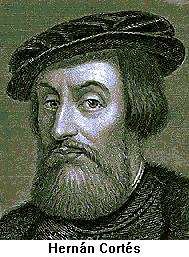
The sickly yet active child Hernan Cortes was born in 1485 in Medellin in the small province of Estramadura. This active child was the son of a very religious mother and a warrior father. As a young child Cortes was prone to illness but nevertheless he kept venturing out into the unknown. It is said as a young child Cortes would spend hours in the woods by himself playing games.
Cortes's father fought bravely to expel the Moors from the Iberian peninsula and bring Spain under Christian rule. After the wars, Cortes's father, Martin Cortes, tried to make a decent life for his family and bought a small mill, vineyard and a beehive that he used for a source of income. Hernan's mother was described as an honest, religious woman who loved and cared about little Hernan until her death. There are not many records of Cortes's early childhood but historians do know that he was prone to ill-health.
When Cortes got into his mid-teens, his parents scraped together enough money to send him off to the University of Salamanca. Though Hernan was a bright young man, he failed miserably as a student. Although he failed at a further education, he did find time to read up on the tales of the "New World" which fascinated him.
In 1504, at age 19, Martin Cortes arranged for Cortes to take a voyage to Santo Domingo in the West Indies. When he reached Santo Domingo, he managed to get a small farm and Indian slaves to go with it. He soon learned that the parched infertile soil and harsh hot weather were anything but ideal for growing crops.
In 1511, Cortes was recruited by the Spanish crown to help fight natives in Cuba to gain control of the island. This when Hernando acquired his first taste of real combat. He learned many tactics from these Cuban natives that he later used in his conquest of the Aztec empire.
Aztec Conquest
In 1518, the Governor of Cuba wanted to send an expedition to Mexico to search for Mexico's treasures. The governor gave Cortes the job of leading a small fleet and 650 men to explore the Yucatan peninsula and beyond. The expedition did not set sail until 1519 and within that year between 1518 and 1519, Cortes recruited fellow Spaniards to help him during the campaign.
When Hernando Cortes landed on the shore of the Yucatan peninsula, he was at the age of 34. At his landing point, Cortes established the colony of Veracruz. Upon setting up the small colony, Cortes had the ships that brought him to Yucatan burned and only kept one afloat that he sent back to Spain to report to the king directly about how the conquest should be handled. On the second night that the Spaniards had landed, they were met by emissaries from the Aztec capital who had heard about the white men who had arrived. Apparently the Aztec ruler, Montezuma, believe that these white men who had came from the sea were in fact Gods who had came back just as they had said they would. Therefore, with the emissaries came gifts of gold, silver and precious beads for the "gods".
Each day more and more emissaries visited and gave gifts. Cortes pleaded with them to allow him to meet Montezuma in Tenochtitlan but they told him he would have to wait. Overriding what the emissaries were saying Cortes detached a large portion of his troops and left a minor force at Veracruz and led the rest of his men onward to Tenochtitlan.
While marching to Tenochtitlan, Cortes and his men had to march through thick swamps and low passes to reach the valley of Mexico where Tenochtitlan lie. When reaching the city, the Spaniards and even Cortes were amazed by the vastness of the city and it's huge buildings. They especially adored the ingeniousness of how the Aztec used floating gardens to farm their crops on the lake that surrounded Tenochtitlan.
Being led by Aztec nobles, Cortes and his men were led to the main hall where Montezuma resided. Montezuma received Cortes graciously but secretly he was afraid of the white skinned man. After a few weeks of kindness from Montezuma, Cortes started pressing his views on Montezuma and made him become a puppet leader for the Aztec. Basically, Montezuma was a prisoner of the Spaniards and nothing more than a figure-head.
During Cortes's stay in Tenochtitlan, he learned that a large Spanish force had landed at Veracruz to take him prisoner by orders of the governor of Cuba. The charges were treachery because the governor thought that Cortes was pocketing his loot that he was gaining from the Aztec.
Meanwhile the Aztec people were growing weary of Montezuma's submission to the white skinned man named Cortes and a mob formed outside of the main hall that housed both Montezuma and Cortes and his men. The Aztec mob tried storming the door but were met by a cannon fire from the Spanish guns to repel them. Attack after attack and day after bloody day the Aztecs tried breaking into the hall to kill the white men. Ounce a hole was broken in the ceiling of the hall and an Aztec person throw a rock and killed Montezuma because they felt betrayed by him and wanted his blood as much as the Spaniards. During these days of unrest, Cortes and his men fought off the Aztecs and killed them by the thousands. His weaponry was far superior to the Aztecs who used clubs, slings and rocks as weapons.
Though his weapons were superior, Cortes had to withdraw from the city because the shear numbers of the Aztec were overwhelming. Luckily Cortes had used his wits to persuade the larger Spanish force to come to his aid and join his army and forget the false charges the governor had blamed him for. As he reached from the city and a few days after, Cortes was pursued closely by the Aztec warriors.
Days later after the battle that took place in Tenochtitlan, the large Spanish force that landed at Veracruz met up with Cortes and his men and formed a large quite formidable army.
At the plain of Otumba, the larger Aztec army assembled and was ready to fight. They were no match to the normal Spanish soldier equipped with armor made of metal plates plus muskets and small bore cannon. Though this large Aztec army was defeated, the people of Tenochtitlan would not go down without a fight.
Taking his large Spanish force, now accompanied with thousands of natives who hated the Aztec and their human sacrifices, to the city of Tenochtitlan and surrounded it. Cortes planed to employ the method of starving the Aztec into submission just as the Europeans did in Europe.
His method worked and on July 7, 1521 Cortes gave his men the go and his troops sacked Tenochtitlan. The Spaniards went through the city killing and raping the native women as well as killing what was left of the men and children. Most of the population and city had been destroyed after the Spaniards were done looting and killing. Thus the Aztec Empire was in ruins and the roots of New Spain were planted.
The majority of the loot captured from the city was sent back to Spain via ships but Cortes got his share which he had to divide among himself and his men. His men were paid handsomely by that day's standards and Cortes was a rich man, richer than even some of the nobles back in Spain. For the next 15 years Cortes ruled former Tenochtitlan as governor of New Spain. He tried to improve the lives of the Aztec people and converted many of them to Christianity but many of them eventually died under the harsh conditions that were implied on them as slave labors. Cortes lived the high life as governor until he financed an expedition in 1536 to lower California where he founded a colony but did not find gold. This expedition left him broke and to add to his troubles the King of Spain had given a new Spaniard the job of managing New Spain now. Cortes was furious and decided to go back to Spain and plead his case.
Last Days
In 1540, during the voyage back to Spain, Hernando fell ill. His illness lasted until he saw the king who would not listen to his pleas to reinstate him as governor of New Spain once again. After this incident, Cortes lost the favor of the king as well as his wealth. For the next 7 years Cortes was treated as nothing more than a common citizen. Cortes was mostly forgotten by the Spanish people of the time and he never went back to New Spain but rather lived out his last years in Spain. In 1547, Hernando Cortes, the conquistador of the Aztec Empire, died in a small village outside of Seville alone and forgotten.
Cortes Links
--end--
All Contents of this page are CopyRight of Smith or Smith Enterprizes.
Any images that wish to be used require my permission. Thank You.
Created 9-17-99.