Astronomy 110


HOMEWORK #5

Copyright © 1999 by Paul Sasse (HTML-ized by H. Preston) 

Use a calculator whenever necessary.


For full credit, always show your work and explain how you got your answer.

Be careful about units!


Please CIRCLE or put a box around your final answer if it is numerical.


If you wish, you may discuss the questions with friends, but please turn in your own hand-written solutions, with questions answered in your own way.


  1. What are the pros and cons of the Celestial Coordinate System (R.A. and dec.)?
  2.  

  3. Determine the celestial coordinates of the following objects:
  4.  

    1. Fomalhaut
    2.  

    3. M31
    4.  

    5. Aldebaran
    6.  

    7. Delta Cephei
    8.  

    9. Dubhe
    10.  

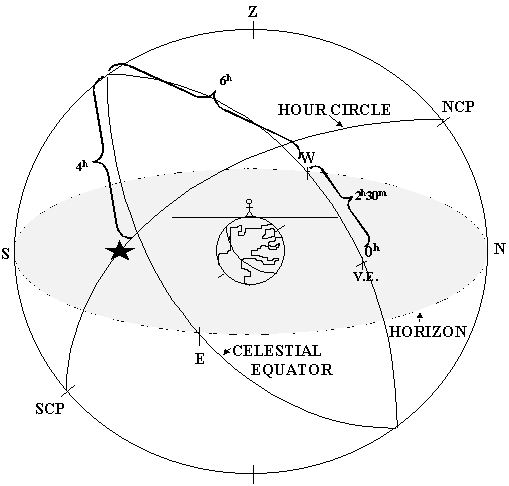
  5. Determine the coordinates of the star on the following diagram.
  6.  

  7. Meridian altitude
  8.  

    1. What is the meridian altitude of a star with a declination of 15o at DVC?
    2.  

    3. What is the meridian altitude of Sirius at DVC?
    4. If you see Sirius transit with an altitude of 50o, at what latitude are you?
    5. At what latitude will the star Vega transit at the zenith?


  9. Hour Angle
  10.  

    1. How long until the next transit if a star has an hour angle of –5h?
    2.  

    3. How long until the next transit if a star has an hour angle of 3h?
    4.  

    5. What is the hour angle of a star having a R.A. = 5h 30m if the sidereal time is 9h?
    6.  

    7. What is the hour angle of Rigel at a sidereal time of 2h?


  11. Position Plotting
  12. a) Plot a star with declination 30o and a right ascension of 8h as seen by an observer at 45o N latitude at a sidereal time of 3h.


    b) Plot a star with declination 50o and a right ascension of 8h as seen by an observer at 65o N latitude at a sidereal time of 18h.

    Back to Astro 110 page

    Hosted by www.Geocities.ws

    1